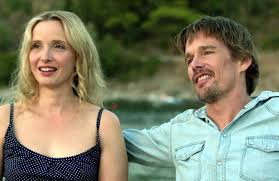
Julie Delpy and Ethan Hawke in Before Midnight Source: U-tube
There are good but troubling reasons to predict a redesign of the K-12 curriculum in the next decade to explicitly teach conversation skills.
It’s easy to imagine that our absorption with digital media will soon require adjustments to school curricula to formally model the process of engaged conversation. With rates of attention to screens at astronomical highs, Americans seem to be spending less time directly conversing with each other in the same physical space. And while it has become a cliché to bemoan “the lost art of conversation”—virtually every parent of a thirteen year old will express this in some form—there are good reasons to expect a redesign of the K-12 curriculum in the next decade to explicitly teach and model the skills of direct engagement. Schools with low teacher-to-student ratios already do this as a pedagogical style. It’s natural to put learning within a conversational frame.
To understand the importance of conversation we need to remember that the central model for communication is the dialogue. From the dialogues of Plato to the advocacy-saturated screenplays of Aaron Sorkin, the act of talking with another is taken to be the generative source of how we discover who we are and what we believe. By comparison, a monologue can seem like an orphan: a living thing withering without its natural counterpart.
The Greeks were among the first to enshrine the truth-testing as a representative purpose of entering into direct discussion. The power of “dialectic”–the give and take of discussion–is not simply as rhetorical decoration for professional philosophers. We know what’s at stake every time our ideas or preferences are challenged by others. Can we successfully respond? Can we defend what we believe? Conversations do not have the sparkling repartee of a dinner with André. But they need the feature of putting two people in the same space to be immediate interlocutors with each other. Anonymous comments added at the bottom of an online post just won’t cut it.
Consider Richard Linklater’s wonderful trilogy of films about love gained and lost—Before Sunrise (1995), Before Sunset (2004), and Before Midnight (2013). All of these popular features are constructed as extended conversations over the life cycle of a relationship. Linklater wrote the films with Julie Delpy and Ethan Hawke, the actors who fully embody the couple. A viewer ends up enthralled not because of what they do, but because of what they say. They are alive to the world and the choices they’ve made. They appear to know each other in ways that couples who have become mute cannot match.
Another important writer/director makes the same point by giving us just the reverse: fascinating models of conversation that have metastasized into something more toxic. David Mamet is known to audiences and actors as the creator of encounters crippled by stilted exchanges. His characters typically flounder in a choppy surf of incomplete sentences, corrosive asides and blank stares. In films like Glengarry Glen Ross (1992) and The Spanish Prisoner (1997), they mostly pay the price. Misunderstandings are compounded. Distrust begins to flourish. And characters are unable to complete thoughts without resorting to abusive threats.
By contrast, young kids are natural conversationalists. Most like to talk. They want to exercise their growing curiosity about others. Reading a book with a child is often a delight (unless you are in a hurry) because almost every page is an invitation for commentary and questions. Reading is not the solitary activity it becomes in adulthood. With more age, the conversational impulse isn’t necessarily killed, but it’s smothered in packaged media content that is still mostly one-way. As it is now, a child in a home brimming with screens seems to be pushed to move from early loquaciousness to comfortable spectatorship. Most of my colleagues note that coaxing even high-performing college students into conversational can be a challenge.
This will all need to change if we want to produce a new generation of active listeners and engaged problem-solvers. We are simply going to have to start earlier to teach and model the kind of animated conversational skills that define what it means to be fully alive to the moment.
Human brains which have been alternately addled and enhanced by the machinery of the electronic age are accustomed to limits imposed by time and space.
There probably aren’t many times Elvis Presley and Giacomo Puccini are mentioned in the same sentence. But they did have at least one musical problem in common. By extension, it turns out to be the same problem we all face. Both needed to produce pieces that would last no more than four minutes. That time length was about the limit for the 78-rpm records that were beginning to revolutionize music during Puccini’s lifetime. And so it is thought to be more than an accident that his melodic operas include dozens of arias that would just fit on a 10 or 12 inch disk. For a sample try out the great Tenor aria, Nessun Dormafromthe opera Turandot. Among other things, it isa virtual FIFA/World Cup theme song.
To this day the four-minute song remains more or less the standard for music producers guiding a commercial musician into lots of radio airplay. It was a similar kind of brevity that was required on RCA’s smaller new 45-rpm disks that fully launched the pop “single,” and Elvis Presley’s career soon after. Jazz performers might riff on a song for seven or eight minutes. But they would need to wait a few more years for Columbia’s “long playing” record that could handle a solid 25 minutes per side.
Though our preferred media have continued to evolve, the media squeeze on time hasn’t really changed. Brains which have been variously addled and enhanced by the machinery of the electronic age have gotten used to time and space limits imposed by physical and commercial constraints. Music, news, conversations, advertising; it hardly matters. All pop in and out of our lives in rapid succession. And while we can keep shifting our attention to try to accommodate all of this clutter, we have no chance to expand the hours of the day to fit more in.
True, digital media can store and retrieve the largest works of writing and music with ease. Today anyone with an internet connection and even a modest computer also has, by default, a library, a museum, a performing arts theater, and nearly unlimited access to the intellectual output of the world’s cultures.
But we still mostly prefer to stay with the familiar, and with it, the same time and space limitations that our grandparents would have recognized: news articles cut to “short reads,” television journalists given only three minutes to tell a complex story, or expert commentators whose video sound bites still hover at an average of just under ten seconds. And don’t even get us started on Twitter’s measly 140 characters.
What’s a consumer of this cultural maw to do? One response is to try to swim with the tide by becoming perpetual information-grazers. We breeze through media content quickly before moving on to other new enticements. In communication terms, most of us are “peripheral information processors” most of the time. Like restless children moving from toy to toy, there is a constant search for new stimulation. Many advertisers and content providers feel lucky to get even a minimal level of attention. Web sites like this one struggle to hold a reader’s interest, measured by Google as a site’s “bounce rate” and its average “session duration.” (This site averages about two minutes per visit.) Print advertising gets even less time from restless readers. As for traditional television viewing: family members frequently migrate to separate screens. Even so, the remote channel selection button for a family’s 60-inch television is probably the most cherished piece of real estate in a household.
But there are advantages to also swimming against the tide. We arguably gain a great deal by consciously giving up grazing in favor of more purposeful media use. Exchanging breadth for depth usually brings clearer rewards. The goal ought to be to find time for long-form content.
Think of the monumental intellectual and artistic achievements that endure. They are not just arias, but entire operas; also the entire books, symphonies, cinematic masterpieces, epic poems and novels, lectures, paradigm-shifting monographs and essays that keep inviting us back to explore their wonders. These are brain-shifting media forms that challenge and reward in equal measure. Given the ease of access we have to most of these materials, they only await our decision to sometimes forgo the transient for the permanent. We just need the raised consciousness to know when we are wasting our time.