To be fully human is to be responsive to the shifting landscape of others’ feelings.
People who spend time assessing how we relate to each other usually also reach the conclusion that we possess not just intellectual intelligence—however that is measured—but also social intelligence. We have various capacities that help us function effectively with others. These traits include such basic ideas as empathy, the capacity for identification, and a reasonable awareness of what others need from us. This last ability for self-monitoring is a fundamental attribute of maturity. It’s what makes us social creatures.
Certainly not all communication is so self-regulating. Hit your finger by mistake when hammering a nail and the first sounds you utter are not likely to be intended for others. But most of the communication that spills from us encompass the parts of our sentient life that we deem fit for sharing.
Consider even in the smallest exigencies of life: for example, the reasonable expectation that a person will acknowledge the courtesy of another who has held open a door, or the stranger who has paused to assist someone scrambling to collect groceries that have fallen from a torn shopping bag. There are no hard rules, but the recipients of such acts of consideration are usually expected to acknowledge the courtesy. To be rhetorical is to be aware and responsive to the shifting landscape of events and their witnesses.
This is an interesting moment to think about the social necessity of self-monitoring. I can’t recall any modern presidential campaign when one of the contenders so casually violated the impulse for self-restraint.
Beginning in the 1970s, rhetoricians began to extend this idea of self-monitoring by attempting to locate the varied dimensions of “rhetorical sensitivity” which could make “effective social interaction manifestly possible.”1 Most notably, Rod Hart and his colleagues developed a massive correlational study of attitudes within individuals that might motivate them to weigh the effects of their actions on others. In their work “rhetorical sensitivity” was essentially a synonym for the impulse to read the needs of others and monitor one’s own rhetoric accordingly.2
The goal of the project was to develop an inventory of attitudes—known as the RHETSEN scale—to test the idea that “rhetorical sensitivity is a function of three forces: how one views the self during communication, how one views the other, and how willing one is to adapt self to the other.” Worded where agreement affirms these forms of awareness, some of the items on the inventory include the following:
One should keep quiet rather than say something which will alienate others.The first thing that comes to mind is [not always] the best thing to say.When talking to your friends, you should adjust your remarks to suit them. A person who speaks his or her gut feelings is [not always] to be admired.We should have a kind word for the people we meet in life.
This is an interesting moment to think about the necessity of self-monitoring. I can’t recall any modern presidential campaign where one of the contenders so casually violates the impulse for self-restraint. Even past leaders who could be crude or thoughtless in private (Lyndon Johnson and Richard Nixon come to mind) were careful to honor the basic dignity of Americans with varied backgrounds that were within the range of their discourse.
To be sure, partisanship always frays the boundaries of what is acceptable to say in public. And the existence of “live” mics everywhere adds to the burdens of keeping strictly private thoughts out of the ears of others. We are deep into a new age where audiences are sometimes unseen and unintended. So the risks are greater that a candidate will be heard uttering slurs against individuals or entire categories of potential constituents.
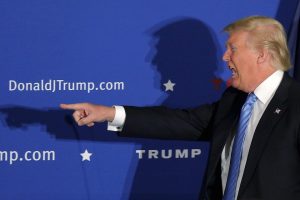
Donald Trump is both the perfect case and a cautionary model. He is one of the victims of a fully wired age. At the same time he has eagerly tapped into group tensions and antagonisms that energize his core supporters, using we/them binaries to build a political base based on a strategy of division rather than unification. Mexicans, African Americans, Mexican-Americans, immigrants and scores of women have felt the cold breath of his offensive characterizations.
When voters express concern about Trump as a role-model, this lack of self-monitoring is partly what they mean. We expect Presidents to be the personification of rhetorical sensitivity. We want them to keep their deepest prejudices to themselves. Virtually every idea of leadership works when the arrows are pointing away from division and toward inclusion. The problem with dividers with insufficient concern for the feelings of others is that they cannot govern a free and pluralistic nation. They seem only capable of making the society coarser.
_____________________
1. Roderick Hart and Don Burkes, “Rhetorical Sensitivity and Social Interaction,” Speech Monographs, 39, 1972, 75-91.
2. Roderick Hart, Robert Carlson and William Eadie, “Attitudes Toward Communication and the Assessment of Rhetorical Sensitivity, Speech Monographs, March, 1980, 1-22.
Parts of this essay are adapted from the author’s The Perfect Response: Studies of the Rhetorical Personality (2010).
We seem to love news stories built around the game of politics.
The presidential election season now takes the space of nearly three NFL seasons, where the endless journalistic fascination on the minutia of strategy far exceeds what any sane person wants to hear. Imagine seeing the musical Cats for six hundred performances, and we begin to get a sense of the fatigue factor we have built into our presidential politics.
The reasons for this endless campaign cycle are varied, systemic and ultimately not very interesting. Suffice it is say that no one is really in charge. And so a crazy quilt of organizational needs and commercial opportunities play out in repetitive loops spread over many months. Think of the chaotic rules the parties now use to set up primaries and caucuses. Most of the population centers in the United States must wait for smaller states like Iowa and New Hampshire to weigh in.
Analysis of our campaign journalism reveals that most of what political journalists give us is what communication researchers call “process reporting.”
There is one overriding feature of these endless campaigns that is especially problematic. It’s connected to how they are covered by most of the news media. Analysis of our campaign journalism reveals that the lion’s share of the reporting that political journalists give us is what communication researchers Kathleen Jamieson and Joe Cappella call “process reporting.”[1] Process stories tell us very little about what the candidates will do should they get the opportunity to govern; they tell us much more about what the campaigns are planning as they do battle with their opponents.
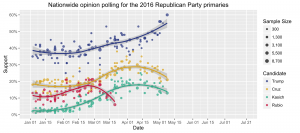
Jamieson and Cappella’s research examined print and broadcast coverage, with the goal of coding stories as either focusing mostly on substantive issues or on how various sides are playing the “game” of politics. Substantive coverage includes stories on what a candidate thinks: how he or she would govern and lead, and what policies they would propose. By contrast, the “process” or “strategy” frame of reference is a label given to individual reports focused primarily on political polling, and also what individual candidates and their campaigns are strategizing to win over voters.
Why is a candidate spending so much time in a particular “swing” state? Why did they use this location and this particular audience as a place to focus on pay differentials between men and women? Whose decision was it to keep the candidate away from interviewers at The Washington Post? The strategic questions are endless and often trivial. But as with the comments of “color” commentators broadcasting professional sports, we seem to have an endless reservoir of curiosity about the backstories of individual players. News sites like Politico or television programs like With All Due Respect (Bloomberg/MSNBC) would be nowhere without the “inside baseball” commentary that turns their journalists into connoisseurs of campaign mechanics. We love reports built around public opinion poll results, and the play-by-play on decisions on raising money, picking staffers, and the geographic deployment of the candidate. We expect and get far less analysis of major challenges the country and the newly elected leader will face in the next four years. And that’s a problem.
With this focus on process there is less journalistic curiosity about political substance. Journalists simply don’t have time to follow a campaign around the nation while at the same time getting up to speed on the diplomatic possibilities for making headway to end the Syrian civil war, or for helping the European Union ease its political crisis. The iconic journalist I.F. Stone noted years ago that journalists would do better to stay at home and write stories based on the public record: the policy positions of governments or the position papers of candidates who want to run them.
It may be considered “old school” to expect that campaigns will result in a national dialogue about the great issues facing the nation. And yet when we are consumed with the sideshows of the campaigns, we are also sacrificing the opportunity to clear away the brush to find safe passage through the thorny landscape that lies ahead.
_______________
[1] Kathleen Jamieson and Joseph Cappella, Spiral of Cynicism: The Press and the Public Good (New York: Oxford University Press, 1997) , 33-34.