Traditional residential campuses like my own are as close as the nation gets to building utopian communities. Within their leafy quadrangles they house artists, historians, philosophers, physical and social science researchers, wonderful libraries and theaters, and cadres of support staff ready to help anxious undergrads.
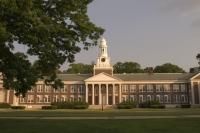
A little personal history. I had no idea that the map of my life had been laid out when my parents dropped me off in front of Aylesworth Hall at the edge of the prairie. The year was 1964, when Colorado State University was still proud that the farm animals in the Veterinary School resided at one end of the beautiful Oval. That began an unbroken fifty-four year trek from one public campus to another. To be a teacher is also to be a student. The roles sometimes blend, but they exist in a circumscribed world. To this day I have no idea what it would be like to work in a corporate office. All I know is campuses, students and colleagues. Even so, I count myself lucky that students leave our weekly sessions together usually no worse for the experience. They are (mostly) a pleasure to work with.
Some of my former campuses were small. For a year I taught at what is now the University of Worcester in the English Midlands. The campus was a mix of simple red brick buildings and a few metal quonset huts–all that some public universities could afford, given the spartan budgets of post-war Britain. What the college lacked in amenities was easily made up by a pleasant group of academics who became friends and colleagues. The only sour note was the college’s new “principal,” who could barely abide the yearly arrival of another American exchange professor. Colonial upstarts pained him; it registered on his face as clearly as if you had just driven a car over his foot.
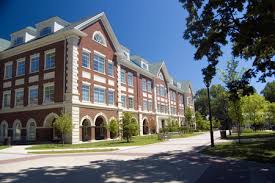
But I digress. I finished my undergraduate years at Cal State at Sacramento, a sprawling collection of blocky buildings surrounded by lush gardens that you would expect at a posh Miami hotel.
All of the five campuses that have been my homes where public universities. And Cal State typified some of their best traits, with faculty interested in teaching (not a given in American universities), students aware that this was their moment to make a better life, and modest fees made possible by the flourishing California system. The early generosity toward higher education in most states was reflected in my tuition, which was sixty-three dollars a semester.
When I moved on to graduate study at the University of Pittsburgh, the good citizens of Pennsylvania paid for living expenses and the much higher tab for tuition. The deal was that I would be a diligent student of rhetoric, and that I would teach some courses in public speaking (not very well, as it turned out). I like to think that I’ve partly repaid the faith shown to a stranger by later giving back to students on another nearby public campus. But the consequences for state-supported campuses will be dire if local governments continue to disinvest in higher education.
_____________________________________
Quimby’s Prairie John Davis
Conventional residential campuses like my own are as close as the nation comes to building utopian communities. Only half of America’s college students have the benefit of these self-contained islands. Even fewer have the advantage of a good liberal arts education. In spaces between their leafy quadrangles they house artists, historians, philosophers, physical and social science researchers, wonderful libraries and theaters, and cadres of support staff for our increasingly anxious undergraduates. Many academic landscapes were designed to be park-like and sheltering, often with quirky results. On my campus “Quimby’s Prairie” is a rich carpet of green grass ringed by neo-Georgian structures, but it is also near another quadrangle called “Green Lawn,” which is mostly a prairie.
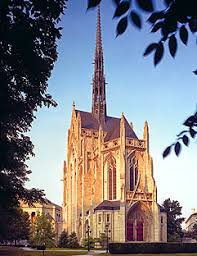
Pitt’s Heinz Chapel
Even in cities most campuses even are designed to allow students to exercise their birthright as pedestrians. Cars are usually pushed to the periphery: a physical manifestation of the metaphysical idea of a space for contemplation. A campus is usually a series of “commons” meant to facilitate these frail but vital functions. Nearly every space is a communication platform of one form or another: classrooms, of course, but also theaters and recital halls, restaurants and student centers, seminar rooms, group-work areas in a library, lounges in dorms and academic buildings, picnic groves, benches under old oaks, chapels, offices and purpose-designed spaces for all forms of media. The best campuses unfold as a series of indoor and outdoor “rooms” that encourage direct unmediated communication. It’s a wonderful thing that some progressive cities and tech giants have tried to capture for themselves. But it is easy to overlook what we may be losing.
The idea of constant connectivity trivializes these spaces. Smartphones never leave a student psychically alone.
Changing times mean that these refuges devoted to the exploration of human and natural phenomena must cope with a culture that intrudes in unhelpful ways. There is no question that the frailties and addictions of the larger world need to be visible, but the idea of constant connectivity trivializes these spaces. Smartphones never leave a student psychically alone. Large blocks of space and time were meant to make possible the sequential thinking that reading Aristotle or McLuhan require. Now, those hours are riddled with the temptations of the screen. These days a stroller around any campus will pass too many walkers who are unable to muster a simple greeting because they are on their phone. Their bodies may be in the most stimulating community they may ever know, but their heads are elsewhere.
Recently improved Wifi coverage in my campus building brought a wave of delight that I found hard to share. Rhetoricians trained in oral traditions are naturally sensitive to environmental elements that sabotage attention. You can guess that some of my students occasionally have to sit through admonitions to “live in the moment.” Too few notice what they may be missing the possibilities of their mini-utopia by focusing on digital devices that rob them of their time and peace of mind.
Americans pay a lasting price for shuttered newsrooms. Fully 40 percent of New Jersey’s voters know “very little” about their two candidates for Governor. They know even less about how the state constructs and spends its budget. What we have instead is rants from local talk radio, fueling hard-right fantasies of government that are a long way from the realities of governing.
The press has rightly been called “the fourth branch of government.” It’s a given that any open society benefits from a free and vigorous journalism. Reporters are our eyes and ears, especially when their reporting shines a light on questionable governmental actions. A diminished local press impairs our need to be engaged and informed citizens.
These conclusions combine to make a familiar civics lesson. But the ideal of a “watchdog press” stands in stark contrast to the disappearance of news outlets and staffs around New Jersey. The state is not alone in facing diminished local reporting; with some exceptions it reflects a national pattern. Where there used to be hundreds of reporters spread over newsrooms in Trenton and Newark, there are now just a few dozen. The parent company of both The Star Ledger and The Trenton Times has cut staffs to the bone and lost over half of their subscribers. Advance Media now has a staff of just 30 in Trenton, closing even their nearby State House bureau. “Beat” reporters who used to focus on crime, education, and politics must now scramble to write shorter stories on fewer topics.
It is still true that “if it bleeds it leads.” Murders, fires and traffic accidents often get some coverage. But stories about trends and long term patterns—or basic news about governmental initiatives, policy shifts, state and local funding cuts—often fall between the cracks. As a capital, Trenton is in a relative blackout compared to some capital cities like Denver, Sacramento, or Des Moines. This is more ironic because New Jersey is an affluent state with a well-educated population. In numbers of citizens, it is about the size of Israel. But compare Trenton’s capital paper with the Jerusalem Post, where there is much more daily reporting.
The problem has been made worse by the abandonment of a New Jersey coverage at the New York Times. It’s now the case the a huge population center in the Garden State hardly exists on the Times’ news pages. That’s a bigger deal that it might seem. Many subscribers are residents of New Jersey, but they are given more stories from Brooklyn or Queens than from Jersey City or Newark, which are easily within eyesight of Midtown.
Of course, print media everywhere are struggling. But it is also reflected in the sparse online stories that remain. Young Americans do not have a newspaper habit. What news they see tend to come from aggregators like Facebook or Google Play. The only bright spots are a few websites like Politico-New Jersey or NJ Spotlight. But these are far less visible to the average citizen than a source like television’s News 12 New Jersey. The cable channel is helpful in filling some news gaps, but it offers less prime-time policy discussion than was available before the ill-advised sale of the New Jersey Public Broadcasting Authority. There is some coverage of the state from public stations in New York and Philadelphia. But it’s not enough.
We will pay a lasting price for shuttered newsrooms. Fully 40 percent of the New Jersey’s voters know “very little” about the two gubernatorial candidates less than one month before heading to the polls. They know even less about how the state constructs and spends its budget. What we have instead is rants from local talk radio “jocks,” whose hard-right fears of government are a long way from the hard realities of governing.
Reporter David Chen recalls recently walking down the hallway known as “press row” in Trenton’s State House, only to find it “eerily still:” the closed doors in the corridor resembling a series of “janitorial closets.” It’s perhaps a small sign, but nonetheless an indicator of why civic life has gone from being one of the glories of the American experiment to one of its perpetual embarrassments. The politics we get in this new atmosphere of willful darkness is perhaps the politics we deserve.

 All of the five campuses that have been my homes where public universities. And Cal State typified some of their best traits, with faculty interested in teaching (not a given in American universities), students aware that this was their moment to make a better life, and modest fees made possible by the flourishing California system. The early generosity toward higher education in most states was reflected in my tuition, which was sixty-three dollars a semester.