
Donald Trump has degraded the secular-civic style of traditional political discourse with self-aggrandizing memes.
Journalists are trained to be careful observers and students of the institutions they report on. But we now have a new wrinkle in presidential journalism where the actual substance of an event is nonsense or so thin that its the press is forced to assess the theatrics. Exhibit A is Donald Trump’s post of himself in an A.I. image as a healing Jesus. The absurdity of the image can’t really be explained with the usual and traditional news frames that might include the discussion of administrative or policy considerations. A journalist has no choice but to “read” the items like these in visual terms. Clearly, the visual orientation of Trump’s mind favors expressive content that owes more to the theatrical rather than analytical, adjusting brief statements and images to valorize himself in the garb and scenery of the Pope, a freedom fighter, a king, and so on. With these images he is not solving problems of governance as much as laying out pathetic examples of self-promotion.
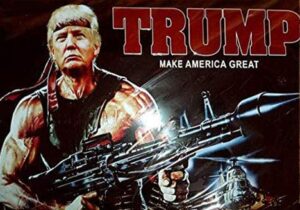
One solution is to treat these attention-getting posts as pure pop art displays, forcing any story about them into a form of meta-journalism, which is reporting about what others are seeing and observing. In the formal language of the Encylopedia of Political Communication, “metacoverage is news about the news media itself or about publicity processes, some of which . . . are covered in terms of how well they succeed at garnering favorable news coverage.”
Thinking broadly, alternate frames of analysis of visual memes might include the perspectives of
-Politics as theater
-Art criticism
-Symbol analysis
-Evidence of Trump’s state of mind
-The traditions of political cartooning
All are possible, but usually beyond what daily journalism is comfortable “reporting.” And all require interpretation, assessment and critical analysis: not what staffers at the AP, or a local television or newspaper operation are accustomed to doing.

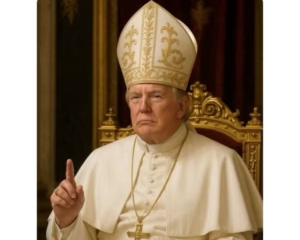
Arguably, Donald Trump has changed the vernacular for political discourse with his self-aggrandizing memes. “Dress Up” is usually a thing that might be seen in kindergarten or adult daycare. Obviously, fantasy role-taking is not a good option for a grounded national leader. It’s narcissim has infantilized his Presidency even more.
Political cartooning from journalists and activists has long been a part of our political discourse, but it is rare to see a leader portray themselves as models of righteousness and adoration, without a hint of irony. Trump’s memes that carry this function are grotesque miscues far removed from conventional forms of presidential leadership. It suggests what we know: prior to winning office the first time he had no administrative experience, little interest in the details of government, and an aversion to understanding the norms and traditions of national leadership.
Is this a trend? Political rhetoric used to carry the imprimatur of thoughtful deliberation for the benefit of all. Presidents were once quotable. We can hope he is just an example of one.
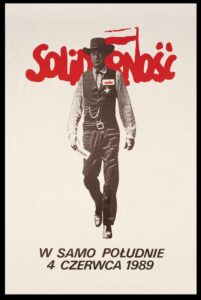 Many remember the famous Solidarity poster originally made for the August 1980 Lenin shipyard strike which took place in the Polish town of Gdansk. The lone image of a defiant Gary Cooper from the film western film High Noon was meant to suggest the resolve of the workers to win their fight against the anti-union government. It was rare and eloquent: very different from the overuse of the sloppy imagery now, which resembles a Marvel Comic more than a call to meaningful action. For sure, this kind of imagery has always been scaled up by activist groups. But a functioning civil society requires so much more.
