Given the unpredictability of digital media producers, there is something reassuring about holding on to a hard copy of a recorded performance that is beyond their reach.
There is good news to report about how we use modern media. True, online digital media still dominate. The way things are going, we wonder if smart phones may soon be surgically grafted into the right hand. Even so, reports from a number of credible sources indicate that Americans are returning to an earlier pattern of collecting physical media: a change from the dominance of on-demand outlets such as Spotify, Amazon, Apple, or local libraries. There is nothing wrong with a lending system, other than their embedded and ever-accumulating fees. But physical copies of a document or performance are indeed having a moment. We are again becoming owners as well as borrowers.
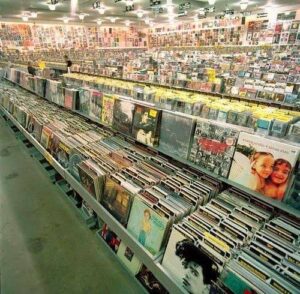
As is obvious, buying a “record” album has again become a thing. Vinyl record sales have been climbing steadily for the last 19 years. And CD sales alone have climbed almost 50 percent in the first half of this year. In addition, the number of new bookstores in the U.S. has started to increase again. More American consumers want media they can own, no strings.
The cases of CDs and vinyl recordings are especially instructive. Owning an original release by a performer or group is close to having a physical master of the music that was originally approved by all involved. The product is a fixed record of a moment in time, and in the case of new vinyl, sometimes marginally improved with better engineering and manufacturing.
As a private person, a record or CD is yours to keep and copy for personal use. Like many, my CDs end up downloaded to an easy-to access home server, in addition to a thumb drive feeding a second home stereo, and another one that sits in a USB port in my car. The only moral imperative here is to pay for the original performance. That keeps a person on the right side of the Digital Millennium Copyright Act, as well as the recording artists who rightfully expect compensation for their efforts.
The media giants have done a great deal to follow a “rent” model of use represented by e-library books or Spotify music lists. But both make a title impermanent. And to keep the music coming, streamers require a payment of a monthly subscription. For their part, public libraries will download books to borrowers without charge for a few weeks.
Films are slightly different. It may be enough to pay for viewing a streamed film once. Except for the most devoted, films don’t easily bend to the idea of multiple view playlists. But music is different. We learn new music and, in many cases, come to love it. A physical copy on hand is like furniture in our head that does not have to be rented or moved. With the right device, it is always ready to recreate the magic that a person may experience with each replay.
It is interesting that studios usually go to great lengths to preserve master copies of their projects. Some of those masters sit in protected warehouses or distant caves that guarantee their safety. The closest a consumer gets to a valuable piece of audio or visual art is their own shelf that contains what I think of as a kind of consumer “master” of a performance. Given the unpredictability of digital media producers, there is something reassuring about holding on to an original form of the product that is beyond the reach of later remastering.
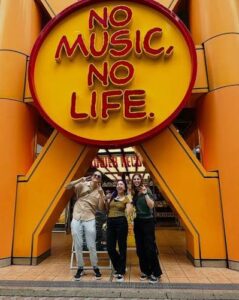
Sadly, we may never see the likes of Tower Records, HMV, or Virgin record stores again. But lucky is the city or town that still has a few bookstores, a record shop, and perhaps one of the 600 Barnes and Noble stores still functioning. Unfortunately, the original Tower Records store on Watt Avenue in Sacramento is gone. If had I spent any more browsing time there while going to college they could have asked me to pay rent. But they still do mail order and, if you are in Japan, there are several multi-level stores. As with so many things, the Japanese got it right. They have never waivered in their love of CDs and records.
Was I wrong in 2016? What does it mean when virtually every American in the country can listen to any radio station, music streaming or podcast service anywhere at any time?
A forum of public radio executives on The College of New Jersey campus in December of 2016 made it apparent that the medium was generally holding its own. Panelists included the Chairperson of the Board of NPR and news executives from WNYC in New York and WHYY in Philadelphia. Then, audience sizes were larger, contributions from sustaining members were up, and many stations were benefiting from powerful streaming technologies. True, there were hints that storm clouds. The broadcast medium that was at the very center of the American experience during and after World War II was beginning to see more restless audiences and enterprising operators who delivered content digitally, without the need for a broadcast license. We now take for granted that Alexa and Spotify will deliver more customized content at any time, with far less effort from us. In 2016 I didn’t appreciate how this storm might arrive. A post I wrote that year optimistically declared that “Public Radio Thrives.” But even then, WNYC’s Dean Cappello nailed what was changing in this new era of media abundance: “The audience is in charge now.”
Our forum centered National Public Radio, with an astounding 1000 affiliates in every corner of the country. Most nations have somewhat similar non-commercial radio networks, including France 24, Germany’s Deutsche Welle and Britain’s multi-channel BBC. They usually adhere to the broad mainstream of their own societies, usually with a slight tilt toward a more progressive view of politics and human affairs. But all must now contend with other audio sources who can gain access to listeners simply by having a studio and an internet address.
Add into this vastly enlarged field the fact that “legacy” print and “broadcast” media are in the fifth decade of a disordered contraction. In the U.S. newspapers have declined to the point of disappearing in many cities. Traditional Network television news from ABC, NBC and CBS no longer dominates as they once did. Formerly influential magazines like Time and The Atlantic see their futures mostly in non-print digital forms, while most still covering the national scene, like Slate and The Daily Beast, are struggling to pay their reduced staffs through total or partial paywalls. In terms of access, it is the best of times for a person ready to try their hand in digital journalism. But in terms of making a comfortable and secure living at it, it may be the worst of times.
Against this background, in some ways NPR looks less robust than it did a half decade ago. It has been under pressure to diversify its staff and audience. And, indeed, there is a greater variety of voices on its air. But as the trade magazine Current noted, “NPR’s newsroom is more diverse than its listener base.” Those listening at least once a week have dropped from 60 million in 2020 to 42 million today. In March, the network laid off close to 10 percent of their staff in an attempt to close a $30 million budget gap. And recent internal data made available to the New York Times showed that NPR’s audience was 76 percent white, 11.9 percent Latinx, 9.2 percent Black and 5.1 percent Asian.
To be sure, attracting younger and non-white listeners has always been a challenge. It is apparent that social media have swallowed up the attention of younger Americans, mostly for the worse, since much of it’s content is light years away from the public service perspective that has defined public radio.
Even the idea of a radio network has changed. Formerly, a listener that wanted to listen to landmark content like All Things Considered, Fresh Air or Wait, Wait, Don’t Tell Me needed to tune in to a local station. Now, all of those programs are available as podcasts, frustrating affiliates who traditionally raised money from listeners to those network shows.
If these challenges of streaming, podcasting and America’s declining appetite for straight news were not enough, grumbles about salary discrepancies between the old guard and newer staffers have added tensions. Cultural nerve endings rising from increased awareness of past injustices against women and racial groups, altering what a media organization can program without triggering a backlash. In January of 2021 three high profile hosts and women of color–Noel King, Lulu Garcia-Navarro, and Audie Cornish–all left the network, with organizational tensions and unequal pay as reasons. And last month a senior producer made complaints about a “liberal bias” that were picked up by the growing numbers of journalists who follow the media exclusively.
Understandably, in media circles declines in audience numbers are always taken as a bad sign. And yet it is trend not just for NPR, but radio in general, and for theatrical films and publishing as well. The days of legacy sources like city newspapers, national magazines, and massive television audiences are perhaps gone for good. While there are still big media “players,” a period when any single source can function as a big tent matching the reach of, say, CBS News in the 1960s and 70s, seems gone as well. Back then, a program like the CBS Evening News could attract a huge 27 million households. The nation came together for this and the other legacy network programs. But that does not happen any more. We don’t have “mass media” in the ways we used to. And no doubt that will include NPR, which will have to build its audiences from a more fragmented pool of Americans.

 As a private person, a record or CD is yours to keep and copy for personal use. Like many, my CDs end up downloaded to an easy-to access home server, in addition to a thumb drive feeding a second home stereo, and another one that sits in a USB port in my car. The only moral imperative here is to pay for the original performance. That keeps a person on the right side of the Digital Millennium Copyright Act, as well as the recording artists who rightfully expect compensation for their efforts.
 It is interesting that studios usually go to great lengths to preserve master copies of their projects. Some of those masters sit in protected warehouses or distant caves that guarantee their safety. The closest a consumer gets to a valuable piece of audio or visual art is their own shelf that contains what I think of as a kind of consumer “master” of a performance. Given the unpredictability of digital media producers, there is something reassuring about holding on to an original form of the product that is beyond the reach of later remastering.