
[A 2016 piece originally titled “Happily Misinformed” cites a feature  of our age that seems even more appropriate now than when it was first published. Is it possible that our President doesn’t understand how pathetic it is to claim intellectual prowess after passing a test given to people who may have dementia? ]
In his sobering 1989 study, Democracy Without Citizens, Robert Entman dwells on the irony of living in an information-rich age among uninformed citizens. There is a rich paradox to a culture where most members have a vast virtual library available on their computer, yet would struggle to pass a third grade civics test. According to the Annenberg Public Policy Center, only one in three Americans can name our three branches of government. And only the same lone third could identify the party that controls each of the two houses of Congress. Fully a fifth of their sample thought that close decisions in the Supreme Court were sent to Congress to be settled.
Add in the dismal results of map literacy tests of high school and college students (“Where is Africa?,” “Identify your city on this map”), and we have just a few markers of a failed information society.
As Entman noted, “computer and communication technology has enhanced the ability to obtain and transmit information rapidly and accurately,” but “the public’s knowledge of facts or reality have actually deteriorated.” The result is “more political fantasy and myth transmitted by the very same news media.” We seem to live comfortably without even elementary understandings of forces that affect our lives.
This condition is sometimes identified as a feature of the Dunning-Kruger effect, a peculiarly distressing form of functional ignorance observed by two Cornell psychologists. Their basic idea is that many of us seem not to be bothered by what we don’t know, producing a level of ignorance that allows us to overestimate our knowledge. Dunning and Kruger found that “incompetent” individuals (those falling into the lowest quartile of knowledge on a subject) often failed to recognize their own lack of skill, failed to recognize the extent to which they were misinformed, and did not to accurately gauge the skills of others. In short, a person’s ignorance can actually increase rather than decrease their informational confidence. If you have an Uncle Fred who is certain that former President Obama is a Muslim born in Kenya, or that vaccines cause autism, you have an idea of what kind of willful ignorance this represents.
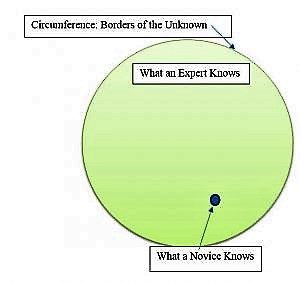
Think of this pattern in an inverted sense: from the perspective of individuals who truly know what they are talking about. Even for the well-informed, the more they know about a subject, the larger the circumference of the boundaries that delineate the unknown. It takes considerable knowledge to know what you don’t know. That’s why those who have mastered a subject area are often the most humble about their expertise: their expanded understanding of a field give them a sense of the many areas that remain to be explored.
All of this makes listening to the truly ignorant a measure of our forbearance. And it brings us back to the President. His recent comment to Fox’s Chris Wallace about his intellectual prowess based on passing a dementia test is incomprehensible. Can he really not recognize how sad his apparent and earnest pride actually is? Would any other President of the United States want to point out that he can recognize an drawings of an elephant and other animals, or that he can count backwards? Can one’s own narcissism be so total as to lack even a minimal level of other-awareness that would permit him to imagine what others might think?
Of its self-evident that we don’t know what we don’t know. But we do expect that a fully grounded adult has at least acquired a sense of what a basic claim to competence might look like.

 As the eyes strain with the load, it can be a relief to sit back and let Fred have a go at your mangled prose.