The challenge for all of us is to know when we are part of a true audience: when our presence is part of the presenter’s consciousness.
The Broadway actress Patti LuPone is apparently at the end of her tether. As was recently reported in the New York Times, during a performance of a play at Lincoln Center she grew frustrated with an audience member who texted continuously through an entire act. The texter was downfront, just a few feet from the actors. Finally, at the conclusion of the last scene LuPone grabbed the offending phone from the audience member as she left the stage.
The problem of audience members otherwise engaged has been more common in recent years, notwithstanding pleas from theater managers that audiences shut down their arsenals of personal hardware before the lights go down.
As for LuPone, the multiple Tony winner reports that she is utterly defeated by audience members staring into blue screens. With dismay she notes that she may give up working in live theater.1
Anyone who makes any kind of presentation to a group knows how daunting it can be to remain effective when an audience member visible to the presenter has decided to opt for an electronic environment over the one they are in. Any electronic surrogate that gets more attention than the human who striving to connect is bound to produce some justifiable anger. Making a choice in favor of the device not only signals a kind of aggressive indifference to the performer, but other audience members as well. In its own small way, it’s an tacit act of sabotage against a presenter who has a right to expect at least minimal responsiveness.
To say that as a culture we have a problem with granting others our sustained attention is obvious, and not completely attributable to our growing obsession with constant connectivity. Commanding the interest of others always requires the mastery of a very narrow path that threads its way between vast spaces of boredom and distraction.
Cayleigh Goodson aptly illustrates this lack of focus that seems to make attention deficits an emerging norm .
Research on the nature of the fickle human attention span includes a lot of cautionary conclusions. Among them,
Attention Is Intermittent Rather Than Continuous. We make a serious mistake if we believe that humans give themselves over to just one thing at a time. This only happens in times of emergency. Otherwise, our attention to one object wonders, turning on and off faster than lights on a traffic signal. This is why oral presentations need some tactful redundancy.
Demands On Americans For Attention Are Enormous. It comes as no surprise that we have immersed ourselves in environments that flood us with messages. In the pre-electronic world it was not always this way. Previous generations more or less chose their communication moments, especially when work was a more solitary process. Now the arrows are mostly reversed. Those moments mostly choose us: a result of the constant connectivity of e-mail, texts and other proliferating forms of social media.
The Rate Of Decay For The Retention Of Content IsVery Steep. We could not function effectively if burdened with the cognitive consequences of all that we take in. So our brains protect our sanity by discarding most of the data that washes over us. With its emphasis on ceaseless mayhem, news alone would drain our abilities to act on the premise that every event is potentially transformative. So our restless information-processing requires that we ignore a lot, sometimes making us useless as engaged interlocuteurs.
From this last perspective, Patti LuPone is just another momentary intrusion in a continuous parade of incoming stimuli. But she has a right to be ticked off. The challenge for all of us is to know when we are part of a true audience. There’s a simple imperative we need to honor: When our presence is part of the presenter’s consciousness, we should act on the clear obligation to be responsive to their efforts.
______________________
1Erik Piepenburg “Hold the Phone, It’s Patti LuPone,” New York Times, July 9, 2015.
Sometimes the best that a concert-goer can hope for is a power failure that will require that we listen using only the sweet air between us and the performer.
It goes without saying that we’ve made great strides since the advent of electric recording in 1925. Recordings, films, broadcasts and every other medium used to capture the nuances of voice and music have opened our ears to the world. Even so, the rush into digital technologies for communicating at a distance have ironically taken us backward in the quest for lifelike sound. In fact, in most cases the routine audio quality of cell-based communications, MP3 players, Bluetooth links, and streamed content from the web can’t match the better audio quality of analogue recordings made in the 1970s. The nadir was perhaps reached years ago when rockers deliberately added distortion as a “musical” component.
Try this simple test. Download an album from from an online music seller and compare it to its CD or vinyl counterpart. You will find that you purchased something less than all the music. The technical reasons for the degradation of sound can be tricky to explain, but in general terms the villains usually include narrower bandwidths, lower sampling rates and higher levels of audio compression. If you can’t immediately identify a caller on a mobile phone, the problem is primarily compression. The timbre of their voice has been stripted of its uniqueness. Most people with golden ears will also note that a compressed audio music file lacks a sense of “openness,” “detail,” and a kind of crystalline clarity that instruments like violins and cymbals require. The MP3 format and its variants used on many phones and Ipods makes it possible to put a lot of music in compact digital files, but it performs this task by discarding musical overtones and other sonic information. The additional problem of a relatively low sampling rate is frequently what makes music sound “harsh” or “gritty” to golden ears: a common complaint about early CDs.
Add in what is now the standard setup for almost every kind of live music event—a heavily miked and amplified stage—and it becomes harder to remember the baseline of pure natural sound. With the exception of classical music played indoors, few professional musicians in performance rely only on the natural acoustics of their instruments or voices. Everything is amplified, “augmented,” compressed and processed, most of it badly. Over my lifetime I’ve only attended one concert (jazz) where the musicians stopped and chewed out the sound engineer for the god-awful noise coming from over-driven, over-amplified stage speakers. It should happen more often.
Even in intimate venues musicians and audiences seem to endure this tin ear treatment without protest. The best a listener with golden ears can hope for is that a power failure will intervene, requiring that we listen only via the sweet air between us and a performer.
In more specific terms, the problem is that a musician’s skill on a particular instrument is usually not matched by either the sound engineer’s, or their equipment. The portable systems that are used are often riddled with deficiencies: microphones and amplifiers that distort, cheap or damaged speakers that fail to keep things musical as the sound is projected from the stage, and high volume levels that overwhelm the delicate sensory cells of the inner ear that convert minute changes in air pressure into neural signals. It’s possible to experience more peace at the end of an airport runway than at some overamplified pop concerts.
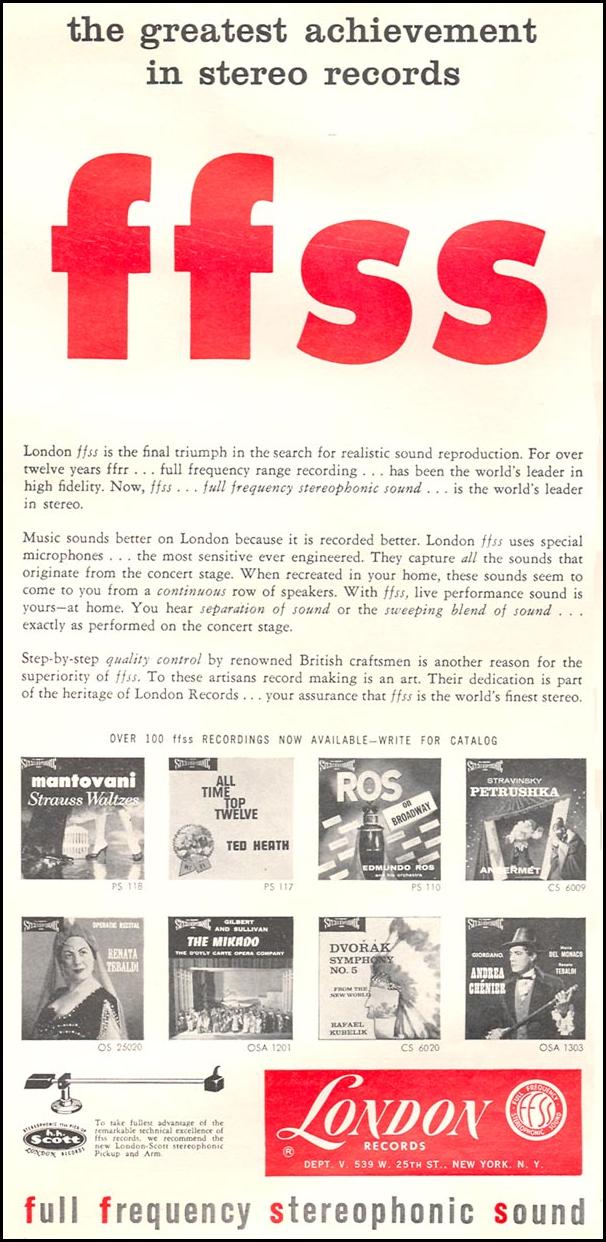
An early ad for London Record’s “Full Frequency Sound,” 1958.
This ubiquitous degrading of pure sound is mostly a function of making money by burdening performances with overlarge spaces. The resulting need for heavy amplification often drives the electronics chain into “clipping,” the audio engineer’s term for the mess of sound that results when the chain is driven to produce more volume than it can accurately deliver.
The money motive also affects the sound of even good recordings, if the available bandwidth of a medium is too narrow. For example, most forms of streaming, and even newer forms of broadcasting such as satellite radio, all sacrifice high audio precision in the upper frequencies because of costs associated with using a wider channel. “Lossless” streaming is possible, sometimes available, but still rare.
The overall effect is that we have generally trained ourselves to have tin ears, accepting highly processed music that we supposedly left behind when “high fidelity” arrived in the late 1950s.
Kids are born with golden ears. A good antidote to prevent turning them into tin is to encourage listening to unamplified music. Having young children around is a good reason to dust off the acoustic guitar or tune the piano in the living room. I also like Paul McCartney’s solution: Get out the ukulele and sing.