“If you don’t get that photo, it’s like, what’s the point of the trip?”
We should be interested in recent news from Japan about the crowds traveling southwest from Tokyo to Fujiyoshida, a town of 42,000 that offers good views of Mt. Fuji. Millions come every year, mostly for one reason: to get a picture of the famed peak from the town itself or an adjoining park. Their presence is not so different from the scores of photos friends send us or post affirming that they visited somewhere interesting. But, increasingly, the pictures seem like a surprise visitation from relatives who make it their habit to ignore the usual courtesies that Japanese hosts have so carefully ritualized.
Smartphones have given their users cameras that need a reason to exist. What better use than to turn them into identity markers that include a selfie and, ideally, a backdrop intended to provoke some envy. I recall previous older relatives being a bit more cautious about putting themselves in the picture. But now “selfitis” can wear others down. It is a kind of narcissism that is not so different from the Evil Queen’s search for reassurance of her worth in a mirror. A modern variant in a scenic backdrop may also carry a more detailed message: “I was here and you were not: I’m in the presence of a recognized icon, which confers jealousy and maybe prestige.” Getting the picture as a photo tourist spares a person from doing anything more than moving on to the next recognizable meme.
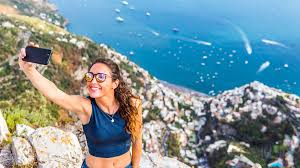 As for Mt. Fuji, “I saw this gorgeous photo on social media,” noted Julia Morrow from Ohio. “If you don’t get that photo, it’s like, what’s the point of the trip?”
Oh my. That is a level of shallowness that in prior times might have come with some shame. Ms. Morrow should consider the implications of her view.
Reports in the New York Times and elsewhere describe the frustration of the locals in the town who take a few pictures, and then apparently leave without visiting any of the merchants along its busy commercial street. The new tourist rule seems to be to go and capture an image that is some facsimile of what is commonly seen elsewhere. Better, too, if your face is in the shot.
What a weird and shallow form of tourism.
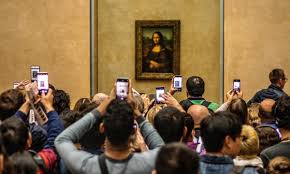 Look at photos of the Salle des États Gallery in the Louvre, which features the iconic Mona Lisa. Too many visitors are struggling to take a second-rate picture of an object that should be taken in with one’s own eyes. To many, the first-hand experience seems expendable, leading to an obvious question: why not buy a good postcard of the da Vinci painting? If museum employees curate their galleries, it should be equally true that the rest of us should do a better job of curating the experiences we sometimes go to great expense to create.
I marvel at how our sense of place has changed. In a public gallery a crowd often dominates and affirms the value of the spectacle itself. That is odd, because we were never meant to see the Grand Canyon or the rugged Pacific coastline only from Seat 14a on a tourist bus. A photo may indeed represent a location we may never get to fully inhabit in person. But it is yet another case of asking too much of a small-capacity medium to represent the 360-degree experience of a place in its natural state. If it means anything, living life to the fullest should include engaging all of the senses.
Sometimes a picture is just a picture. But the self-curated photograph that suggests that “I’m here and I matter” is perhaps assuaging feelings of invisibility in a world with too many ingenious ways to ignore others. We should want more.