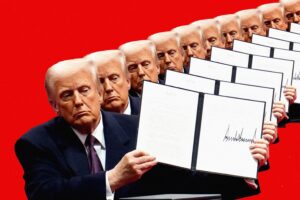
The dead hand of the executive order substitutes for a collaborative style of leadership. These orders form a pattern of authoritarian overreach by a President quick to identify domestic enemies.
German academic T. W. Adorno was the lead researcher of the first major analysis of social conditions that give rise to populations overly enamored with authority figures.* The researchers, some of whom had escaped from Europe at the start of World War II, traced the origins of a multitude of personality traits, including anti-Semitism, “susceptibility to antidemocratic propaganda,” ethnocentrism (judging others by one’s own values), and predispositions toward fascism. The rise of the Nazi Party and its wide acceptance even among well-educated Germans was the puzzle they wanted to solve. Are certain kinds of citizens overly susceptible to appeals based on authority, especially “official” sources? Are some types of audiences too willing to ignore the natural ambiguities of everyday life in favor of the rigid ideological certainties of a demagogue (i.e., Hitler’s stereotypes of Jewish “failings”)? And what psychological needs are satisfied when total allegiance is given to such a leader?
One product of their work was a paper and pencil questionnaire called the F-Scale (Fascism) inventory probing for signs of “authoritarian submission” and “uncritical attitudes toward idealized moral authorities.” It consisted of claims, such as the ones listed below, to which a respondent would be asked to agree or disagree.
Obedience and respect for authority are the most important virtues children should learn.
Every person should have complete faith in some supernatural power whose decisions will be obeyed without question.
What this country needs most, more than laws and political programs, are a few courageous, tireless, devoted leaders in whom the people can put their faith.
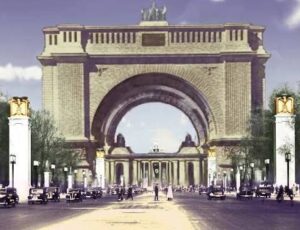
Speer’s proposed arch for Berlin
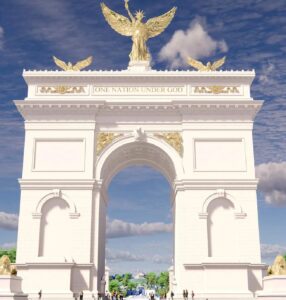
Authoritarian leaders typically go beyond their formal powers, distrust the press, and incite citizens against alleged internal enemies. Countless acts of hubris are now part of the official record: everything from renaming whole regions to destroying government property under the guise of making it better. The man the seems to love gaudy monumentalism as if he were channeling Albert Speer, Hitler’s architect.
Trump’s proposed arch
The researchers found that anti-Semitism, rigidity, ethnocentrism, undue respect for power, and other traits tended to cluster within many of the same people. They theorized that the clustering was tied to styles of family life. They also learned that authoritarianism can be identified in segments of almost any population. Some people may be psychologically hardwired to seek a “place” in a clearly defined social order led by a dominating leader. It also seems clear that many authoritarians–who can be followers or leaders–want to take ambiguities and uncertainties out of their lives. They prefer simple answers to complex problems. As with Adolph Hitler and many others since, authoritarian leaders typically overreach their formal powers, distrust the press, and incite citizens against alleged internal enemies.
Our current political turmoil is a reminder that many among us also want simple and magical answers to entrenched problems: all the better if the explanations include scapegoating others. We have lived through a seemingly endless number of false alternate narratives told and retold about stolen elections, pedophile Washington elites, dead voters who managed to cast a ballot, and more. Presently, what is left of the MAGA right simmers with fantasies of these fears, as is evident from the compliant silence of his staff. More alarmingly, it is clear that our unexpectedly frail constitution and a supine Supreme Court has made this political nightmare a reality.
Americans need to be smarter about weighing the claims of leaders who are willing to trade accuracy for certainty. We have let down previous generations by allowing American leadership and respectability to be eroded by a criminal president.
_________________
*The Authoritarian Personality. New York: Harper and Row, 1950.
One British shop owner’s reaction after the election of Donald Trump in 2016. London Evening Standard
We may no longer have the patience to read ourselves into the implicit contracts we must make to meld the private with the public.
I was in high school in April of 1962 when an angry President Kennedy delivered remarks to the nation, expressing his displeasure with the steel industry for raising prices that he thought would prolong a recession. Who remembers presidential comments while running the chaotic maze of high school? For many of us the landscape of national life was different then. Kennedy’s criticism of the steel industry caught our attention because presidents typically did not make disparaging comments about core businesses. With unexpected fury as he noted that “simultaneous actions of United States Steel and other steel corporations, increasing steel prices by some 6 dollars a ton, constitute a wholly unjustifiable and irresponsible defiance of the publicinterest.” As was his habit, he talked about the national values. Hence, the rhetorical blow against “big steel,” which still supplied most of the American carmakers. “Some time ago I asked each American to consider what he would do for his country, and I asked the steel companies. In the last 24 hours we had their answer.” The famous Kennedy style of understated affability had been momentarily wiped away by his revulsion. The chill was consequential even for a high schooler. At the time it seemed as if the nation fell silent for just a moment to ponder the weight of his words.
I offer this example in representative contrast to what has unraveled in the years since then. In 1962 Americans noticed a President’s atypical displeasure. How times have changed, with the words of Donald Trump falling like so many lit matches in a dry and empty forest. The pulse quickens from the spectacle, but fewer seem shocked by a national figure who has constructed his persona around daily taunts and obscene asides. Forget a major American industry like steel, no person has been too small to be picked off in a shooting gallery of rhetorical assaults.
The use of presidential rhetoric for incitement and harassment was rare in 1962. Kennedy and his 1960 presidential campaign opponent, Richard Nixon, kept their comments to each other and their supporters civil. Neither sought to use the plentiful indecencies of rhetorical attack to impugn the character of the other. In the end, the steel price hikes were rescinded, and the nation moved on.
Now, it seems, words from former president Donald Trump seem to rush into the vacuum of what passes for civil discourse. We no longer pay much attention because the nonstop roar of hortatory language in the digital world is more distanced and transactional. In a culture of professional shouters we have apparently come to believe that we don’t have time to care. It seems not to matter that a candidate for the Presidency of the United States can suggest that a heckler should “get the hell knocked out of her,” or that he would deploy the military to handle the “enemy from within,” meaning “radical-left lunatics” like former House Speaker Nancy Pelosi. No wonder former Chairman of the Joint Chiefs of Staff, Mark Milley, has recently noted that the President he served under is “fascist to the core.” And we should remember that in 2016 Trump indicted himself and the nation even more in the comment that he could “shoot somebody and not lose voters.” As The Atlantic’s Anne Applebaum recently wrote, he “has brought dehumanizing language into American presidential politics.” He has made language a disposable afterthought.
As a rhetorician I have a professional distaste for his sloppy indifference to the advantages of a tempered response. As for his brazen palaver, the acceptance of it by a sizable portion of the county is its own national crisis: maybe less than Kennedy’s confrontation over Cuban Missiles, but certainly more than JFK’s showdown with big steel.
Because government reaches further into our lives, its rules and stipulations provoke in some a barely dormant impulse to celebrate chaos.
It follows that his conviction for multiple felonies and an assault on at least one woman seems not to be disqualifying. A discouraging number of Americans have dismissed the details of the former President’s crimes of rebellion against the rule of law. It is no coincidence that the British chose a hasty exit from the EU at about the same time Americans first elected Trump. Both societies behaved like bored middle-schoolers searching for a sense of identity in a confusing world.
The influential conservative writer David Brooks has noted that the United States is “a democracy in decline,” in part because more Americans with lives shrunken to the size of their personal devices are ill suited to deal with pages and paragraphs that are needed to make sense of a complex society. Primary sources have been overwhelmed by influencers and interpreters. With news readership and viewership at record lows, too many distracted owners no longer feel compelled to confront the stressed political environment. It is easy to get comfortable with the realization that no one is really paying much attention.
There are also other forces at work. Speaking in broad strokes, because government reaches further into our lives, its rules and stipulations provoke in some a barely dormant impulse to feed a backlash that celebrates chaos. Many no longer have the patience to read themselves into the implicit contracts with civil institutions such as schools and libraries that meld the private with the public. The ubiquitous use of film violence targeting men offers a clue. It seems to function as an opportunity for vicarious release from the work of living in an interdependent and culturally diverse society. To self-identify as dispossessed is reason enough not to care.




 interest.” As was his habit, he talked about the national values. Hence, the rhetorical blow against “big steel,” which still supplied most of the American carmakers. “Some time ago I asked each American to consider what he would do for his country, and I asked the steel companies. In the last 24 hours we had their answer.” The famous Kennedy style of understated affability had been momentarily wiped away by his revulsion. The chill was consequential even for a high schooler. At the time it seemed as if the nation fell silent for just a moment to ponder the weight of his words.

