Tag Archives: conversation as insight

Developing a Default Critical Style

arguing people

This is the most interesting kind of rhetoric, and a style to be used by anyone who wants to be a better communicator.

We think of everyday communication as the passing of information from one to another. That is often true, but listen carefully, and it is clear that more is going on. It’s one thing to receive directions for driving to a new restaurant. But its another when the “information” being passed on by a friend is, incidentally, a judgment on its quality.

Yah. I know the spot you are talking about. It’s at the corner where Awful meets Expensive. Actually, keep going straight and its about a mile on the right.

Maybe you know fewer wise guys. But we get the point. We embed attitudes, judgements, and evaluations in almost everything we say. Most of us have an endless store of descriptive adjectives to employ. Those silos never seem to be drawn down by overuse. And in the company of friends, it can be affirming to our egos to have an opinion. But everyday rhetoric that is essentially a string of opinions is its own ersatz style. And it seems to be the norm as we “converse” more and more in very truncated messages. Talk to your uncle Fred or listen to the President, both of whom should pay a surcharge for all of their dismissive one-liners. It’s too much. A few more samples:

This novelist never had an original character. End of story.

He’s a nice guy but is only good for three chords on that guitar.

Her dozens of movies in the 1950s were pretty mediocre.

Except for the Bolt, Chevy never made a good car.

The problem here is partly that we are smuggling unearning attitudes into a conversation, skipping the obligation to explain ourselves. We owe others the courtesy of having real reasons. Because we are blessed with the vast resources of ordinary language, our conversational partners deserve at least a little more substance and less attitude. A renewed obligation to explain turns what is may be a truncated introjection into a clearer critical stance.

By the use of the term “critical” here, I mean judgements and information that include useful detail. All we need is the will to do it and an interlocuter with a little patience. A person is not a drama critic if their view is represented in one simple dismissal. They are not a thoughtful judge of a musician if their efforts can be reduced to the brevity of a social media troll. Good criticism paves the way to more understanding and insight.

If we become more aware of assertions that should be explained we are using a critical style to elevate an exchange with another. We often let ourselves off the hook too easily when we offer a blustery contention that too often signals that no more need be said.

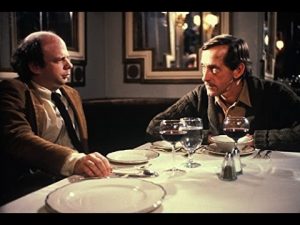
The classic film My Dinner with Andre (1981) offers a sense of what it like to use conversation to fully interrogate our thoughts. As the film suggests, good conservation is a worthy goal of two souls trying to make sense of their place in the world.

As Researcher Deborah Tannen described in the 1990s, the genders may be wired differently. With many exceptions, a pattern of clipped dismissals may still be more typical of men than women. Whether there is still a preference for opinion giving in lieu of more dialogical communication is open to debate. But I have no problem identifying male friends or even the current President with a communication style front-loaded with declarations, and final judgements: all without a hint of putting them to the test by hearing from others.

To be sure, a critical style is bound to retain loose ends and unexplored contentions, but if it is augmented with evidence and good reasons, it is a more useful way to relate to others. The style requires having the will to explain oneself rather than merely recycling one easy summation.

One route to thinking in terms of a critical style is to get in the habit by reading more thoughtful writing about areas of special interest, which could range from art or architecture, or novels and music. Critics and columnists online or in print are paid to explain their opinions. We read them because we want to hear their reasons, not just a curt thumbs up or down. This is the most interesting kind of rhetoric, and a style to be emulated by anyone who wants to be a better communicator. One-word judgments just don’t cut it.


Long bar

Lunch Anyone?


I’m always interested in the response of my friends to a simple question. If they could conjure up anybody from the past or present, who would they like to have a leisurely lunch with? 

Sometimes we could use some new conversation-starters.  In my circle the usual topics run all the way from A to B, from the cool and wet summer, to the latest norm-violating behavior of our President. There are also some local issues that are good for a few minutes of hand-wringing, including plans to build an unwanted pipeline through our valley, or the always-good-for-a-comment angst about our state’s high property taxes.

But sometimes it’s worth taking a leap into the unknown, or even the frankly impossible. I’m always interested in an acquaintance’s response to a simple question:  if they could conjure up a meeting with anybody, who would they like to join for a leisurely lunch? A meal can not only satisfy an appetite, but ruminations with a good conversationalist can stay with us a long time.

All of us come into contact with remarkable people, friends or strangers with wonderful stories to tell or experiences that extend well beyond our own. It is usually just an intellectual exercise to imagine what it might be like to spend time over lunch with a famous person. But people we already know can be just as interesting. Think of the conversations with familiar companions that bubble up in Louis Malle’s My Dinner with Andre (1981) or Richard Linklater’s Before Midnight (2013).

To be sure, it sometimes works out that someone with intimate knowledge of a notable achiever may come away from a meeting chastened. More than a few writers have admitted that their living or deceased subjects remained interesting, but not necessarily as candidates for a fantasized social outing.  Biographer Nell Painter remembers working on a study of the famous slave preacher, Sojourner Truth.  But several years ago Painter told a C-Span interviewer that her “closeness to me receded” as she worked her way deeper into Sojourner’s life.  She respected her subject to the end, but finally doubted they would connect in a conversation. Sometimes a little distance keeps the great and good on a pedestal where we want them.

In a recent dinner with friends the question drew various responses.  Singer-songwriter Paul Simon came  up as  a good lunch companion.  He  has been a stream-of-consciousness poet for several generations.  And some of those enigmatic lyrics in Graceland: what do they mean?  Another liked the idea of sharing a meal with Jesus, and  it’s hard to quarrel with that choice.  But the guest of honor would probably make me a nervous eater. Did I order to much? Should I have shared it? Why didn’t I suppress the joke about turning my water into wine? Another mentioned Barack Obama.  He’s articulate and sometimes funny.  And his off-the-record perspective in this political moment would be fascinating  to hear.  Would he make us feel better about where the nation is headed?

Another person suggested the African-American blues musician, Daryl Davis. Davis seems to have a knack for drawing in listeners, including KKK members.  He told an NPR interviewer that in some cases he was the first black American these white men had spoken to socially. One measure of his success is that he has a pile of KKK robes that his newly sensitized friends have sent him after they renounced their membership in the Klan. Think of what he might teach us about the subtleties of face to face conciliation.

American culture exists most vividly when we focus on agents of insight or change.

My choice tends to change by the week.  But right now I’d love to have lunch with the arranger, musician and producer, Quincy Jones. He is in his 80’s, with a career that spans playing trumpet in several great 50’s bands, to arranging and conducting some of the best performances caught on record: everything from Sinatra at the Sands, (1966) to Michael Jackson’s Thriller (1982). He’s a walking history of American music: big-band Jazz, R&B, Pop and Funk. In interviews and a growing list of tributes (including 26 Grammys) Jones is unfailingly generous and interesting. Can a person still be hungry when sitting next to a national treasure?

There’s a useful point to this exercise. It’s a reminder that American culture exists most vividly when we focus on agents of insight or change. They may be famous or obscure.  But more than we think are close by,  their lives are testimony to the value of pluralizing our world beyond the shallow celebrities that sometimes narrow rather than broaden our horizons.

Since the fantasy lunch with the fantasy check is on me, who would you choose?