Tag Archives: CBS News

Protecting Your Freedom to Know: An Accessible International News Directory

A good hedge against narrow-minded reporting is to access foreign news outlets that provide insightful perspectives on American social and political life.

The news media in the United States are still robust, but under threat from an authoritarian president and a Supreme Court that has given him more power over agency heads, some of whom have licensing authority over network broadcast affiliates. We have also witnessed a decades-long decline of CBS News, as well as dangerous consolidations of individual media companies.  If it succeeds, the recent purchase of Paramount and, with it, CNN, will be consequential. The conservative-leaning iHeartMedia already holds a gigantic 870 radio stations. And most of the formerly great American newspapers have fallen into the hands of billionaire owners, including The Washington Post, The Wall Street Journal, and the New York Post. The heavy hand of the owner and editors at the Washington Post has been especially noticeable. Many of their best reporters have left. The old saw that you don’t want to argue with someone who buys ink by the barrel applies, even if pixels have replaced ink on paper as the most common medium.

Interestingly, Disney/ABC is pushing back against the chronic complaints of the Trump administration. But its affiliate stations are vulnerable because they must operate with licenses from the recently politicized FCC.

There are still important mainstream or somewhat progressive internet and broadcast outlets, including The Atlantic, The New York Times, Harpers, The Nation, The New Yorker, Washington Monthly, Politico, and Axios. They are still agenda setters, but their audiences represent a smaller share of the American public.  And, of course, there is some good reporting everywhere. But it is also clear that editors are steering more coverage to conservative and investor-friendly positions.

BBC

A good hedge against narrow-minded reporting is to include easily accessible foreign journalists who provide different and often insightful perspectives on American social and political life. When living in England, I found British views of American affairs a refreshing change from worn-in American habits of thinking. Even beyond the U.K., a declining United States is still too big and powerful to ignore. Print outlets from around the world are obviously available on the internet. We are also in luck that cable and YouTube access provide many chances to see many English language video segments worth viewing. Some are from state-run public broadcasters, and some are from privately owned outlets. But all are usually reliable and refreshingly different. Here is an incomplete but suggestive list:

France 24

-France 24  Fair-minded and thoughtful coverage of Europe and the United States.

-DW (Germany) Like France 24, a reliable guide covering social and political events in the United States and Europe.

-Al Jazeera (Qatar) A Non-western cable news outlet with usually reliable reporting.

-BBC (U.K.) Perhaps the most honored international broadcaster and a British mainstay.

-Channel 4 (U.K.)  The kind of news analysis that is harder to find in American media.DW

-LBC British podcast format adapted to television. Often critical but thoughtful critiques of US leaders and policies.

-Times Radio (U.K.) video podcasts featuring a range of expert opinions and commentary.

-CBC (Canada) Especially good for science news and summaries of Canadian adaptations to Donald Trump’s rages against our northern neighbors.

-Australian Broadcasting Corporation A public broadcaster with many news features packaged for YouTube.

-Reuters This British new agency has hundreds of journalists and scores of awards.  It seems less visible on YouTube, but remains a staple for reliable print and photo journalism.

AP

-Associated Press (American/international) a compilation of credible straight reporting from local journalists around the world. This makes it more like a news-cooperative than an outlet with a dominant point of view.


black bar

The Murrow Play: A Timely Reminder

The play is a timely and generous act of public service by the 63-year-old film actor.

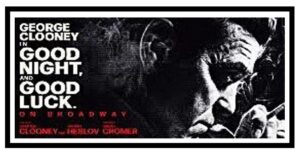
George Clooney is appearing on Broadway at the Winter Garden Theater next month in a theater piece adapted from his screenplay written twenty years ago with Grant Heslov. Good Night and Good luck is based on the successful 2005 film about Edward R. Murrow, easily the most honored news broadcaster in the history of the medium. Murrow’s name is still tied to references to journalistic courage that went from radio in World War II to the first full decade of commercial television. A group of young news reporters known now as “Murrow’s boys” saw him as a model, with most going on to develop important careers at all of the networks.

The action takes place in a tense CBS television studio in the bowels of Grand Central Station, as Murrow unleashes a broadside against Wisconsin Senator Joseph McCarthy. It is 1953, and Murrow and producer Fred Friendly are ready to take on the senator known for reckless attacks on scores of civilians and celebrities imagined as “communist sympathizers.” At this time in the cold war the charges stung: the rough equivalent today of passing state secrets to the nation’s enemies.

“McCarthyism” still stands for career-destroying accusations by the powerful that have little validity. Sound familiar? Then, the specific issue was over the senator’s false accusations of communists in the Army, State Department, and probably the Girl Scouts as well. If he were more self-aware, our current president would hotly deny the many unflattering comparisons made today. Delivering lies and false accusations with abandon never seems to go out of style.

The uncomfortable coincidences are a reminder that the Fourth Estate will to have to stand strong against our accusatory President and his followers. The banning of the Associated Press from the White House is a case in point. They are soldiering on anyway, along with The Atlantic, The Wall Street Journal and the New York Times, among others. Ditto for several cable news outlets as well.

The play is a generous public service offered by the 63-year-old film actor who has never done live theater, tackling the role of Murrow for the first time. In a clip from the 2005 film a younger Clooney plays producer Fred Friendly, and Murrow is played with uncanny accuracy of David Strathairn.

The film and the play involve two key moments in Murrow’s career: a single program setting the recording straight about a mistaken charge  by McCarthy leveled against Milo Radulovich, a former member of the Air Force. The second event is a few years later in the form of a speech to peers warning about not caving in to soft news stories.

To be branded “pink” then was to be a national pariah and a false charge against Radulovich.  A See It Now program carefully prepared by Friendly and Murrow was a chance to call out this particular conspiracy theory that included allegations of communist collusion. This was no sure thing. The network and its sponsors were mighty unhappy that Murrow and Friendly wanted to take down McCarthy in prime time. CBS Chairman William Paley liked Murrow best when he did celebrity interviews for the popular Person to Person. But he was less enthusiastic about CBS Reports and See it Now when the Murrow team aired controversial programs on subjects like the blight of farm workers, or the empty attacks made by the rabid senator.  Here is a sample of Murrow at work in the Radulovich program:

The second moment emphasized in these dramas is a speech delivered in 1958 to a gathering of Radio and Television News Directors in Chicago’s Blackstone Hotel. In my study of Murrow in Persuasive Encounters (1990) I described the speech as a the rarest and most interesting kind of public address: a warning—a Jeremiad—to peers and colleagues. Murrow made it clear that the young medium of television was failing in its most important mission of providing nationally important and significant news.  With a bit of sarcasm he told his peers that their work is worthless if it does not help their audiences sort out fictions from hard fact. The address infuriated Paley, who favored light comedy in prime time.  But it was typical of Murrow.

Our history will be what we make it. And if there are any historians about fifty or a hundred years from now, and there should be preserved the kinescopes for one week of all three networks, they will there find recorded in black and white, or perhaps in color, evidence of decadence, escapism and insulation from the realities of the world in which we live.

For surely we shall pay for using this most powerful instrument of communication to insulate the citizenry from the hard and demanding realities which must indeed be faced if we are to survive. And I mean the word survive, quite literally. If there were to be a competition in indifference, or perhaps in insulation from reality, then Nero and his fiddle, Chamberlain and his umbrella, could not find a place on an early afternoon sustaining show. If Hollywood were to run out of Indians, the program schedules would be mangled beyond all recognition. Then perhaps, some young and courageous soul with a small budget might do a documentary telling what, in fact, we have done–and are still doing–to the Indians in this country. But that would be unpleasant. And we must at all costs shield the sensitive citizen from anything that is unpleasant.

It might now be obvious to accuse television of “escapism and insulation from the realities of the world.”  But this was Murrow when the medium was still establishing its own conventions. And it suggests that his kind of journalism could still teach us something today.