Tag Archives: ad hominem attacks

red and black bar

When the Chief Celebrant is Also a Full-Time Hater

The rhetorical signature of this committed hater.

One of the burdens Americans have had to carry for some years now is living with a figurehead–the nation’s leader, citizen number one, the country’s official spokesperson–who at the same time can rarely keep himself from unleashing the tired arts of denigration and retribution.  At the risk of delivering old news, his output of public vituperation is off the charts and unlike any “leader” the nation has known. On occasion our leaders have unkind things to say about someone else. But they usually choose carefully when to share those negative judgments, reserving the public realm for silence or faint praise. It is hard to fathom how the nation managed to put a chronic bully in the role he inhabits.

To be sure, we know his type from any number of movie thugs. We can’t say that we haven’t heard his stale taunts before, but not from the person atop our political system. Even as a child he had a reputation as a bully that even placement in a private school apparently could not tame.

Trump professes to like “nice” things. People: not so much. He is a nonstop trash-talker. It does not help that the President’s grasp of language is limited. He and all of us are captives to the same name-calling that recycles endlessly. You know his favored terms of invective by now: “corrupt” “evil,” “crooked,” “failing,” “dishonest,” “crazy,” “phoney,” “Lyin,”  “weak,” “vermin,” “wacko,” “nasty,” and so on. These are used in various combinations to describe the miriad ways others manage to spoil his world.

Tragic comic masks roman mosaic 2

This is vitriol 101: the simple and tired language of a hater who lacks the capability to expand thoughts into more complex formulations. He uses Old Testament certainty that bolsters his own self-regard while diminishing others.  People like Nancy Pelosi or Adam Schiff are “horrible persons.” Journalists are from outlets that are “crooked,” “fake news” or “Lyin.'” Hecklers should be “roughed up.” Political enemies are “Communists, Marxists, fascists, and radical-left thugs.” It is our misfortune that Trump thrives on ad hominem attacks that would be considered out of bounds by any high school debater.

A key presidential role is to act as a celebrant of all things American. It is not compatible with a person who needs to use the language of a misanthrope. Presidential rhetoric usually includes references to the generosity of others, the grace to not make every moment about oneself, and the impulse to resist another’s victimization in favor of pointing out the humanity they share with all others. For example, John Kennedy generally refrained from attacking any individual in personal terms. Instead, if he needed to, he focused on the faulty ideas that the individual favored, preserving his chances to protect his office. This norm of generosity is now violated every day.  Will we remember what we lost?


black bar

Regaining a Capacity for the Rigors of Dispute

consulting pixabay
                                        pixabay

We seem increasingly comfortable shunning forums that allow advocates time to develop their contrasting views.

There is frequent talk about a sharp American divide, with polarized and partisan groups shouting at each other across a wide chasm.  MSNBC analysts fret about the “MAGA crowd” in Congress.  Citing “progressives,” Fox News returns the favor. Anger on both sides spills out on Twitter and comments to countless blogs, news sites and mega-media like the Washington Post.  Even legacy news organizations of all sorts condense ideas to present facsimiles of what the other side has said on issues related to abortion, the behavior of our former President, or what our grade-school kids are permitted to read. Our cultural map looks like an endless chain of Tetons: a landscape of sharp peaks that leave little room to sit astride a place that would allow a view of all sides.

Part of our current dilemma is our withering sense of how to engage in a civil society. Various media platforms have made it easy to carve out connections with mostly like-minded others, leaving us underprepared for the work of making coherent arguments to those with different views.  In place of the agora—an ancient place where the public met and interacted as one body—we now see others mostly at a distance, via the narrow shooting galleries of media opinion makers with platform-specific ideologies. In the process, we’ve lost all or most of our abilities to sustain a discussion made of fleshed-out arguments and counter-arguments.

As noted in these pages several years ago, an argument can take many forms. But its basic structure is simple,  containing at least two parts: (1) An assertion or claim and (2) supporting evidence or good reasons. In schematic terms it can be laid out like this:

Claim: American Elections are Mostly ‘Clean’

(Evidence:  Because. . .)

    I. There are few documented cases of modern election fraud.
   II. Nearly all recounts confirm the original result.
  III. Election officials from both parties rarely find fraud.

That’s it. In its most basic form, an argument is an assertion supported with statements of proof to back it up: perhaps expert testimony, representative examples, solid research, statistical summaries, and so on.  By itself, the asserted claim is not enough, unless it is so obvious that no one would disagree. But we are focusing here on consequential assertions that others have doubted or denied. For these, we must relearn a basic tenet of civil affairs that a claim by itself is insufficient.  Repeating the same claim does not make it true.

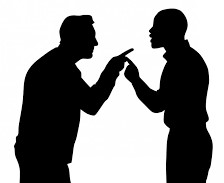
arguing people 2

For example, consider the claim that “the 2020 presidential election was stolen.” If someone stops there–using a formal term of argument—it lacks “force.” To be sure, we are only too happy to display our opinions like flags. They signal our attitudes and beliefs. And we have a knack for mistaking variation of the same assertion as “evidence.” But controversial assertions alone have no logic to bind the open-minded.  That can only come when someone cites relevant evidence–logically tested by the insertion of the word “because”–using a source that is worthy of belief. When the assertion and the evidence flow together as a coherent argument, we are beginning to build a reasonable case.

It’s not enough to take aim on the true believers via the shooting gallery that fires out disparaging names. This short and convenient solution of using ad hominem language (i.e., “The fools who have made a career out of claiming election fraud are motivated by money and fame”) lacks force.  Ad hominem comments attack an advocate rather than their ideas. While we get pleasure out of calling our ideological opponents clowns, the rewards are self-serving, substituting personal invective for ideas that should be able to stand up in a democracy’s ‘the marketplace of ideas.’

Ironically, we generally shun the obvious format that allows for adequate public testing of ideas.  Simple debates where opponents speak, and then are given enough time for follow-up and offer refutations, can help those who want to understand what the preponderance of evidence supports. A true debate does not need a newsperson gumming up the works by turning the process into a joint interview. True debates only require two or three advocates, a moderator to keep things on track, and a clock that controls for equal time.  Using this format, the debaters soon learn that they will have to add substance to their claims: they know they will need “good reasons” more than more repeated opinions.

Schoolkids easily learn and enjoy this format. They like to document their views with evidence. In past years, programs of straight debates used to run on PBS (The Advocates and Firing Line, to name two).  But now we mostly choose to live in echo chambers that let us hear variations of our own views.

two color line

cropped Revised square logo

flag ukraine