For many of us “connecting” has become synonymous with “communicating.”
The two basic social functions of communication are to sustain our sense of place and our sense self. A diverse group of thinkers ranging from sociologist George Herbert Mead to communication theorist John Peters have noted that we are sustained by anchors to others we interact with directly. Those others may be met at home, in the neighborhood, at work, in community groups or through contact with friends. And of course there are the digital approximations of small pieces of us that we send and receive. Indeed, for many of us “connecting” has become synonymous with “communicating.” The tiny artifacts of ourselves we send to others are increasingly assumed to be enough.
One of the reasons parenting is so affirming—if sometimes more in theory than practice—is that the dependency relationship between parents and children is concrete and defining. Parenting is a reminder of the burdens and rewards that come from the monumental task of shaping the world of another human being. No wonder some experience the remorse that can come to the “empty nester.” They have had to relinquish most of the nurturing, guidance and witnessing that–as the cliche has it–gave their lives meaning.
There is also another narrative. Workers will sometimes admit to feeling guilty about escaping to an office where one’s place is seemingly secure and affirmed. While many parents can’t imagine entrusting their toddlers to a sitter or daycare, others seem to adapt easily. Indeed, a number of workers report that life can be more predictable and supportive in the office than at home, where the new and unformed ego in their care has yet to learn that others matter. With either parenting narrative note that we still end up at the same spot; it’s the direct contact with others that matters.
Can playing video games at a normative six hours a day turn an adolescent into the kind of person he will need to be in ten or twenty years?
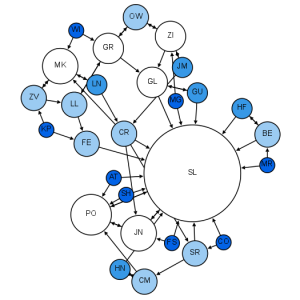
Research twenty years ago pointed to television as the mostly likely threat to the maintenance of self through direct contact. The concern then was frequently framed in terms of the one-way nature of television, whose characters cannot return the interest we freely give to them. In this world of “para social” relationships, a person who cares about whether Rory Gilmore will finally succeed as a professional writer–a long plotline in the popular Gilmore Girls–has made a small but consequential shift toward a world that is at once more predictable and attractive than may be the case with one’s own family. Rory always looks great, is unfailingly polite, and has very clever things to say. Who might not be tempted to “live” in her simplified universe? But at best the “relationship” between a television character and viewer is “para-social”–only an approximation of the real thing. Rory can never be who we may need her to be. She can never be there for us. In terms of a sociogram (above), she could only be represented with a dotted line, an arrow going toward us, but not being returned.
Here’s the challenge: if electronic media allow us to put our heads in one place while our bodies are in another, are we destined for relatively barren emotional lives? Does this fact of contemporary force us to sacrifice important social anchors? To shift examples, can playing video games six hours a day (a gamer norm) turn an adolescent into the kind of person he will need to be in ten or twenty years?
This critique made years ago by Neil Postman and Joshua Meyrowitz, among others, may still hold. And, of course, the dual pathways outlined here are more complex and blended. But in fact most of us have committed ourselves to interaction at a distance via various social media platforms where feedback is minimal. We even have a president who seems more comfortable issuing tweets than knowing how to act in the presence of others.
In short, where we are physically is arguably less important today than the digital drop boxes where we have deposited the contents of our heads. We use these as social substitutions in what is sometimes a long and perilous digital chain. The key question is whether they can provide enough in return to affirm that we still matter.
A daily sampling of the worst that humans can do is not good for us.
If I told you there is a media outlet anxious to report the very worst examples of inhuman conduct, you’d probably be thankful to stay clear of that source. Who needs a daily reminder of the most vile acts persons can perpetrate on each other? There are surely better ways to sustain our sanity and hope.
But of course what I’m describing is a simple operating assumption for legitimate and mostly well-intended news organizations. News is the unusual: events that are not only out of the ordinary, but sometimes sadly brutal or cruel. We readily know the kinds of emotional and physical violence that violate the most elemental norms of human decency. It’s also obvious that only the weakest society would turn its back on entrenched problems that it must resolve. But there are limits to what we can process on a daily basis.
I was reminded of all of this on the first day of June when National Public Radio and many other outlets reported on a hangman’s noose left by a visitor in an exhibition space at the Museum of African American History in Washington. It was an ugly act perpetrated by an anonymous thug and, as on any given day, it was the kind of dark non-sequitur that made our hearts sink a little lower. Racist instances like these are frequent enough to remind us of America’s original sin of racial intolerance. It rarely recedes from the nation’s collective consciousness. There can be no doubt that we need reminders that we still have a long way to go.
But here’s the thing. Something odd happens with humans when given a single horrific example of almost anything. Something inside wants us to search for its place in a larger and perhaps growing trend. We have a natural compulsion to generalize upward, turning any event into what rhetoricians call a synecdoche, where a single case stands for all cases. By definition a synecdoche is a representative case.
The defense is simple enough; we sometimes need to take a vacation from the journalism of atrocities.
Few thoughtful Americans could believe that racism across the culture has mostly subsided. On the other hand, we can give too much publicity to a sick act by an individual who must cover their deviance with anonymity. With these kinds of daily reports of aberrant single-agent behaviors we have to decide how big of a marker we will allow them to be.
To be sure, synecdoches often help us make sense of the world. Bull Connor’s dogs used against civil right marchers in Birmingham are a perfect condensation of what the movement was up against in 1963. And another contemporary case of a police shooting of an unarmed African American man is another. Each instance stands as reminder of a serious and embedded problem. But different cases can also be false markers. If a one-off hostile act is allowed to stand as a representative case it can have the effect of making us all the victims rather than beneficiaries of synecdoches, extinguishing our interest in valid and significant trends.
And so in the interest of our mental health we should heed a common reminder about accepting a daily dose of news featuring the latest and the worst. One defense is simple enough; we sometimes need to take a vacation from the journalism of atrocities.