Category Archives: Problem Practices

Communication behavior or analysis that is often counter-productive

Who Gets to Tell Our Story?


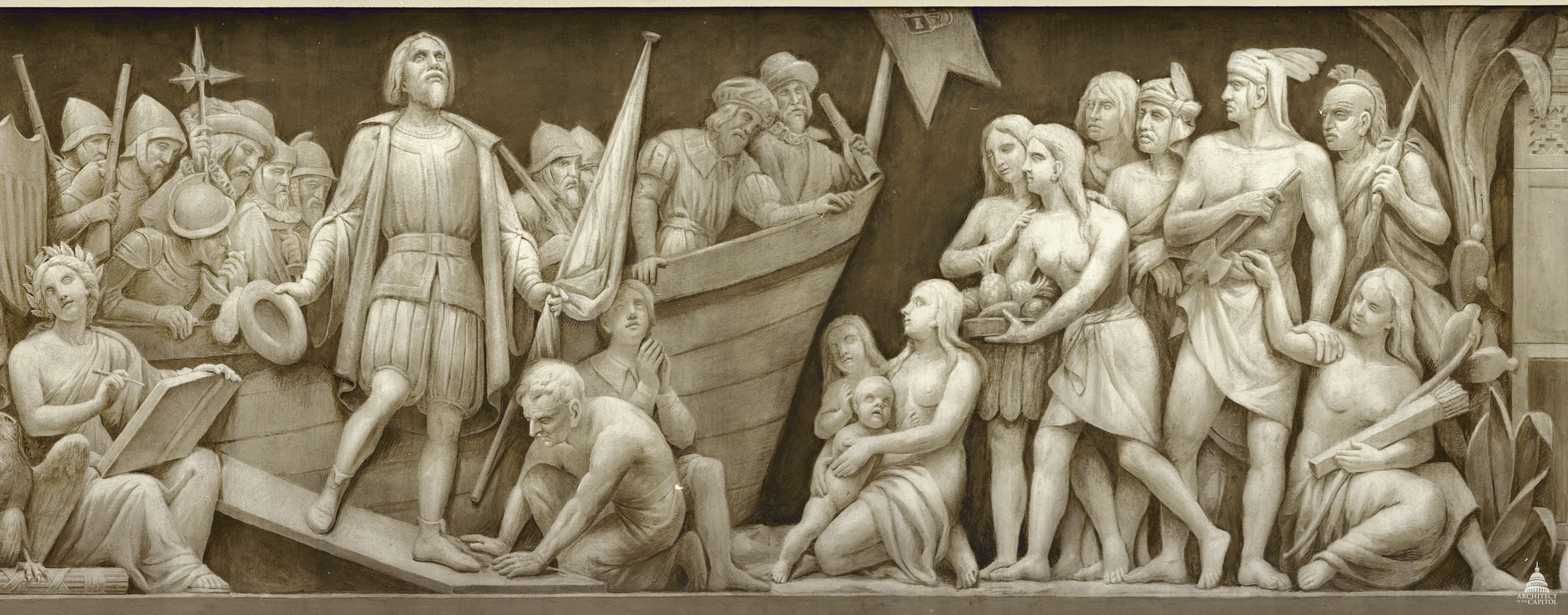
Frieze of Columbus in the New World, US Capitol
Frieze of Columbus and Indigenous Americans in the New    World, US Capitol Rotunda

 There is truth in the irony that our most cherished possession is not exclusively ours to own.

We think that our most precious possessions are the things we have acquired or the relationships we have.  But for many people the “right” to tell their own story looms just as large.  Narratives of our personal or tribal lives may be the keys to understanding who we are and where we came from.  But in fact they are not exclusively ours to tell.  We don’t have proprietary rights to our own personal histories.

This is both self-evident and enormously consequential.   It’s not just that we can’t easily agree even about the foundational stories about our collective past.  What Christopher Columbus or Thomas Jefferson or Abraham Lincoln actually achieved will always involve contentious narratives.  We can also be unpleasantly surprised by accounts of ourselves offered even by friends or relatives.

It’s apparent that anyone can write someone else’s biography.  Even biographers who are out of favor with their subjects or never met them are frequently eager to weigh in with their own versions.  For example, we are presently surrounded by multiple narratives that recreate the life of Apple co-founder Steve Jobs.  There’s Walter Isaacson’s 2011 best-selling biography (Steve Jobs, 2011) and the forthcoming Aaron Sorkin film based on it.  Both recognize Job’s  vision for turning computing into a necessary life skill.  And both portray a garage innovator with a knack for ingenious design and an inability to acknowledge his co-visionaries.  Then there’s Alex Gibney’s very different documentary (Steve Jobs: The Man in the Machine, 2015) detailing a single-minded marketing genius reluctant to engage with the unpleasant facts surrounding the Chinese factories that produce Apple products.  Amazon currently lists about ten books on Jobs. The point is that we can count on each version to offer a different person to readers.

The same is true for groups that seek power or legitimacy in the larger culture by presenting what are sometimes very different accounts about their pasts and their aspirations.  What’s the story of Scientology? It depends on who you ask. How has the institutional life of Catholicism evolved since revelations of widespread child abuse were widely reported at the beginning of the new century?  Skeptics and admirers routinely compete for attention to relay their stories.  In many ways the fissures that are spread across the culture deepen over time, often expanding into complete fault lines as interested parties vie for media access to “get their story out.”

There’s a whole lexicon of useful terms to represent these divisions.  We talk not only about “narratives,” but also “contested narratives,”  “counter-narratives,” “preferred narratives,” “backstories,” “storylines,” “myths,” “legends,” “lore,” “rumors” and “histories” that are disputed as “more fiction than fact.”  Facebook champions an individual’s own preferred narrative: a kind of carefully constructed window display of one’s life. Most other digital outlets focusing on the culture of celebrity capture readers by taking a very different turn:  favoring counter-narratives and backstories.  Sometimes they are even true.

Novelists who would seem to have the advantage of exclusive use of the products of their imagination are inclined to end up in tangles of their own making when readers find possible connections to the writer’s biography.  Readers can also be unforgiving if a scribe borrows another’s particularly traumatic narrative.  A few years ago the prolific Joyce Carol Oates came under criticism in New Jersey for embellishing on a news story about a college student found dead in a campus garbage container. The short story, Landfill, was published in the New Yorker, to the chagrin of the student’s family and others in the region.

For all of our hope that our stories can be communicated in ways that bring us the credit we seek, the fact is that we can never claim rights to exclusivity.  Ask anyone who has recently been in the news how well their views have been represented or how they were characterized. You are apt to get a response of mild frustration.  What we see in ourselves is probably not what those who retell our stories are going to report.  For individuals or groups without power this is sad to witness. Groups lose something basic when they lack the means to communicate their preferred narratives.  The rest of us battle on, even occasionally discovering a narrative that gives us far more credit than we deserve.

Comments: woodward@tcnj.edu

Perfect Response logo

PMQs: What Americans are Missing

Dispatch Boxes (Lecturns) in the House of Commons Parliament.UK
Dispatch Boxes (Lecterns) in the House of Commons
Parliament.UK

What many in Britain consider a stale feature of their system would be nothing less than a breath of fresh air in ours.

The beginning of a presidential election season in the United States is now greeted by voters with an understandable amount of dread. To be sure, we want to celebrate the idea of elections. No one should be cynical about a system that insists on the consent of the governed. But it is hard to look at the truly awful media spectacle that has unfolded thus far and still be optimistic about our national political life.

Most Americans know that something is seriously amiss, even if it’s not clear how to redeem the campaign process to become what it currently is not: an opportunity for a great national awakening. We have “debates” that are really just joint press conferences, as well as seriously reduced coverage of any candidate that isn’t a poll leader. The reliable Tyndall Report notes that to this point Donald Trump has gotten nearly half the press coverage among all the Republicans seeking their party’s nomination. Moreover, we are saddled with prime-time stories from cable news outlets that constantly verge into “he said-she said” name-calling, as well as too many reporters spending most of their time interviewing other reporters. With the exception of a few serious news organizations, even larger news outlets seem to be averse to boring their audiences with substantive discussions of candidate responses to pressing national and international crises. It’s become so bad that what many in Britain consider to be a stale tradition within their system would be nothing less than a complete breath of fresh air for ours. We could really use something like Parliament’s weekly round of Prime Minister’s Questions (available for viewing at C-SPAN.org).

Every Wednesday Britain’s Prime Minister is obligated to appear in the House of Commons and face questions from leaders of other opposing parties, with the greatest number of queries coming from the leader of the largest faction out of power, and possibly the next Prime Minister. This is the system in most western parliamentary systems, working reasonably well in Australia, Canada and a number of other countries.  What it allows is a lowering of the Constitution-mandated wall between the legislative and executive functions that exists in the United States. Reducing that wall makes possible the kind of discourse that is needed in times when leaders need to be on the hook to find solutions to serious national problems, such as our chronic lateness in passing a federal budget. Frequent and direct debate between the leader of the government and those in opposition has a way of reminding everyone of significant issues in dispute.

Prime ministers generally have a good idea of what they will be asked about. And those doing the asking are not above framing questions to score some easy points against the party that actually has to govern. But Question Time has two huge advantages over American divided government. One is that questions in the House of Commons are not filtered through journalists scrambling to get screen time while also trying to function as surrogates for the other side. All that exists between the “dispatch box” of the Prime Minister and the leader of the opposition is a distance of two sword lengths, a prudent design decision made long ago by British parliamentarians. The second is that name-calling and personal attacks won’t cut it in PMQs. It’s easier to call an opponent a liar to a reporter than to the opponent’s face. Direct debate without intermediaries means that questions will have to deal with affairs of state. Discussing anything less looks like evasion.

It’s a weakness in our system that nearly all of the political “debate” that occurs happens in the circus of campaigns, or sequentially through speeches by Presidents and congressional leaders given to their most ardent supports. Except for the yearly trek to Capitol Hill for the State of the Union Address, we simply have no mechanism for our national leaders to publicly argue the merits of their ideas in the presence of each other. The debates that do occur are usually private, when congressional members or their staffers meet with White House officials to iron out compromises. In the process, robust public discourse in the world’s greatest democracy withers. On most great issues the best we get is yet more sequential press conferences and the empty posturing that comes with them.

The problems hinted at here are myriad and complex.  But its hard to not conclude that our governmental system is broken in part because it depends too much on the press–what optimists used to call the “fourth branch of government”–to report the excruciatingly tough issues that those who govern must address.

Comments: Woodward@tcnj.edu