There’s no surprise in the fact that no human wants to take our call at banks, government offices, or the vast number of other services that have set up robotic phone routing systems.
Cultural observers have been noting for some time that we are at the beginning of a revolution in robotics. The prediction has it that machines will do what has previously been done by people, even in many service industries. In truth this transformation has been going on for a long time. Ask anyone who has tried to reach a service provider such as a utility or cable company. Robots now “answer” the phones in the nation’s largest customer service centers and many smaller businesses as well.
It is up to us to push buttons and envision menus to find approximations to the questions we need addressed. No live human really wants to greet us at our banks, government offices, or any other of the dozens of services that have set up routing systems that might save a little money. But it’s worth pausing to notice what we’ve lost.
At best, the human/automated system “interface” is often frustrating, time consuming and—could it be otherwise?—dehumanizing. Everyone has horror stories about the company that touts its customer service, but still manages to tie us up for the better part of a morning. Indeed, long phone queues are becoming the norm for many firms, especially those who have already sold their services to a customer.
Medical insurance companies seem to be the worst. Anyone who must reach them to clarify a payment or seek permission for a medical procedure will run the equivalent of a sports decathlon. Professionals who must deal with them as part of their work now equip themselves with phone headsets, antacids and other work that can done while they wait out a company with no financial incentive to deal with a claim. This is a new kind of political-style filibuster found in many businesses after a point-of-sale exchange is finished.
There are a few faceless giants for whom contact with another sentient creature is virtually impossible. Trouble with Google e-mail? You are on your own. Hit the “?” key and the best you can get is a link to little generic “help” essays that mostly end in useless cul-de-sacs. Google is a huge “service provider” without service. Apple’s iTunes can be as bad. Apple’s famous “closed system” philosophy is, well, not much help to those of us without Steve Job’s intuitions.
If we want a visual reference to these faceless giants, think of a downtown telephone exchange building in a large city, perhaps 12 stories high with no windows, no markings, and no welcoming access for pedestrians. (There’s a large one owned by A.T.&T. in Tribeca at 33 Thomas Street) If you have business inside, it will have to be conducted through a wire.
AT&T Long Lines building in lower Manhattan
A friend actually has a phone contact at super-giant Amazon.com. and can report that there are live people who can deal with a customer. But she guards this hard-won secret with her life.
There are positive stories as well. I am happy to report that the electronics maker Onkyo will connect a customer to an engineer who will troubleshoot a problem over the phone. They actually seem pleased to be able to help, even though the buyer may have purchased a modestly priced item. The same is true at my local Ford dealer. A person always responds to a call. That’s really no surprise. The owner is a gifted salesperson. Potential sales or repairs are not opportunities he wants to farm out to an electrical router.
An old switchboard or its electronic equivalent requires a human to connect us to another human. No integrated circuit is trying to be a person.
But it’s mostly true these days that someone who wants to experience customer service will probably be most satisfied calling 911 or eating in a restaurant. Save the emergency call for an emergency. As for restaurants, longtime owner Jeff Benjamin notes that he tries to hire people who have a “hospitality gene.” These are people who get genuine pleasure in making their customers happy. (Front of the House, 2015). Alas, with notable exceptions, the gene isn’t found in the management or customer service staff at a lot of businesses.
There’s a generational difference as well. My students don’t expect much help from other humans in service positions. In fact many prefer to raise questions about a product or order food without any direct human contact. They are “digital natives” used to the equipment and “apps” that are supposed to make life simpler and self-correcting. But here’s the requisite “I remember when.” In my student days soon after California became a state my duties included working in a dormitory with the responsibility ofrunning a modest switchboard. That meant that someone was in charge and on call to help if there was a problem. When they were in wide use, every staffed switchboard at an organization or business was its own local 911. An old switchboard or its electronic equivalent requires a human to connect us to another human. A live body is at the center of the network. No integrated circuit is trying to be a person. We surely lost something when operators and phone receptionists more clearly knitted people to each other.
For many of us “connecting” has become synonymous with “communicating.”
The two basic social functions of communication are to sustain our sense of place and our sense self. A diverse group of thinkers ranging from sociologist George Herbert Mead to communication theorist John Peters have noted that we are sustained by anchors to others we interact with directly. Those others may be met at home, in the neighborhood, at work, in community groups or through contact with friends. And of course there are the digital approximations of small pieces of us that we send and receive. Indeed, for many of us “connecting” has become synonymous with “communicating.” The tiny artifacts of ourselves we send to others are increasingly assumed to be enough.
One of the reasons parenting is so affirming—if sometimes more in theory than practice—is that the dependency relationship between parents and children is concrete and defining. Parenting is a reminder of the burdens and rewards that come from the monumental task of shaping the world of another human being. No wonder some experience the remorse that can come to the “empty nester.” They have had to relinquish most of the nurturing, guidance and witnessing that–as the cliche has it–gave their lives meaning.
There is also another narrative. Workers will sometimes admit to feeling guilty about escaping to an office where one’s place is seemingly secure and affirmed. While many parents can’t imagine entrusting their toddlers to a sitter or daycare, others seem to adapt easily. Indeed, a number of workers report that life can be more predictable and supportive in the office than at home, where the new and unformed ego in their care has yet to learn that others matter. With either parenting narrative note that we still end up at the same spot; it’s the direct contact with others that matters.
Can playing video games at a normative six hours a day turn an adolescent into the kind of person he will need to be in ten or twenty years?
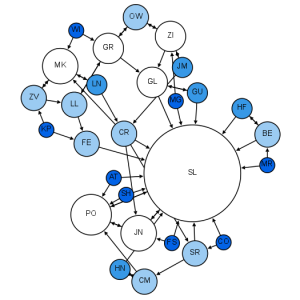
Research twenty years ago pointed to television as the mostly likely threat to the maintenance of self through direct contact. The concern then was frequently framed in terms of the one-way nature of television, whose characters cannot return the interest we freely give to them. In this world of “para social” relationships, a person who cares about whether Rory Gilmore will finally succeed as a professional writer–a long plotline in the popular Gilmore Girls–has made a small but consequential shift toward a world that is at once more predictable and attractive than may be the case with one’s own family. Rory always looks great, is unfailingly polite, and has very clever things to say. Who might not be tempted to “live” in her simplified universe? But at best the “relationship” between a television character and viewer is “para-social”–only an approximation of the real thing. Rory can never be who we may need her to be. She can never be there for us. In terms of a sociogram (above), she could only be represented with a dotted line, an arrow going toward us, but not being returned.
Here’s the challenge: if electronic media allow us to put our heads in one place while our bodies are in another, are we destined for relatively barren emotional lives? Does this fact of contemporary force us to sacrifice important social anchors? To shift examples, can playing video games six hours a day (a gamer norm) turn an adolescent into the kind of person he will need to be in ten or twenty years?
This critique made years ago by Neil Postman and Joshua Meyrowitz, among others, may still hold. And, of course, the dual pathways outlined here are more complex and blended. But in fact most of us have committed ourselves to interaction at a distance via various social media platforms where feedback is minimal. We even have a president who seems more comfortable issuing tweets than knowing how to act in the presence of others.
In short, where we are physically is arguably less important today than the digital drop boxes where we have deposited the contents of our heads. We use these as social substitutions in what is sometimes a long and perilous digital chain. The key question is whether they can provide enough in return to affirm that we still matter.