A caution about avoiding the use of a common sanity-saver could not help but raise the dissonance level of already stretched parents.
The concern to raise kids that are well launched into this world remains high on the list of goals parents set for themselves. This seems especially true for those first-time owners of a brand new infant who have also been exposed to the behavioral sciences. Little did they know at the time that those required college courses in psychology would firmly plant the seed for the view that early child-rearing choices may have monumental consequences later on.
This is one reason parenting has gone from being something that just happens along the bumpy path of life to becoming a consequential obligation that must be mastered. There is the added realization that even a decades-long commitment is no guarantee that a near-perfect original will emerge. Parents have always wanted the best for their kids. And there are many routes to successful childrearing. But the current financial and existential squeeze especially on the middle class creates adds pressure to deliver children to the world who are ready to compete on the fastest tracks of success.
No wonder modern families are stretched. In addition to higher child-rearing expectations, many external factors add to the burden. In more regions of the country it now takes two incomes to support a household. Add to the mix the required tools of competent child-rearing—a virtual armada of furniture, expensive child carriers, monitors, pediatricians, learning toys and the right food. And then there are the mostly self-induced distractions that still define the aspirations of early adulthood: showing a game face on social media, meeting the needs of relatives and grandparents, child care costs, having a social life, and fulfilling the desire to take advantage of what media and the larger culture can offer. No wonder these working parents feel stretched to the limit.
So it’s no surprise that a widely discussed piece of advice coming from the prestigious American Academy of Pediatrics would be greeted with a wince more than an embrace. The wording of a caution about avoiding the use of a common-sanity saver could not help but raise the dissonance level in this already stretched group. The advice? The academy cautions parents to not expose their toddlers to screens of any kind.
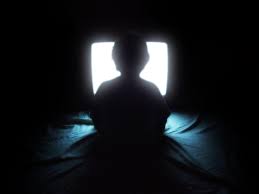
Television and other entertainment media should be avoided for infants and children under age 2. A child's brain develops rapidly during these first years, and young children learn best by interacting with people, not screens.
We are accustomed to recommendations from medical professionals that put the squeeze on cherished habits. But this one cannot help but create ambivalence in parents who know well the pacifying tendencies of glowing screens. Has the Academy never noticed that a child in complete meltdown rejoins the human race if bought off with a youtube video or a favorite cartoon show? Isn’t that why the tablet was invented? What unwired planet do the members of the Academy inhabit?
There is a serious issue here. Screens are addictive. And they do tend to still a restless and active child.
There is a serious issue here. Screens are addictive. And they do tend to still a restless and active child. That restlessness is the source of endless daily cycles of curiosity and exploration that are essential to the growing process. Childhood is where self-motivated learning is either fostered or mostly extinguished.
I’ve written many times about the effects of “screen thrall,” the semi-frozen state of immobility that comes over most children and adults caught by the need to follow others continuously on a video. To be sure, much of this content engages. But the level of engagement is better labeled para-social rather than fully “social.”1 Our involvement with screen characters is obviously stunted by the “one-way” nature of the medium.
One effect extended into older childhood shows up in one telling observation that many older adults report: the near absence of children playing alone or with others outside their homes or in nearby parks. It seems that too many American children have vacated the safe open spaces that these adults remember and romanticize from their own pasts.
_____________
1Joshua Meyrowitz, No Sense of Place (New York: Oxford, 1985), 118-121.
It’s natural that we will place ourselves and our institutions in the driver’s seat. We assume we can be in charge because our language lets us imagine it.
Rhetoricians like to say that language has its way with us. The phrase is meant as a reminder that everyday language steers us to conclusions that usually promise more than we as individual agents or nations can deliver. Word choice can easily create perceptions that can make the unlikely more likely, the improbable possible, the fantasy an imagined outcome that will surely happen. We can tie a wish to an action verb and we are off and running, creating expectations for things that probably will not materialize. Who knew that simple verbs like “is” and “will” can be phantoms of deceit?
I was reminded of this by a recent article in The Atlantic by Stephen Biddle and Jacob Shapiro. Their thesis is the title of their piece: “America Can’t Do Much About ISIS.” (April 20, 2016). The article includes a solid analysis of the roots of ISIS in the civil wars affecting Syria and neighboring states. Their point is that internal struggles like these have to “burn out” from the inside. This kind of civil war cycle might take nine or ten years to complete, an outcome outsiders can’t change very much.
What seems inescapable is that the rhetorical ease of committing ourselves to the control or transformation of complex political forces is too easy. That’s something we’ve come to know all too well since the Vietnam era, reconfirmed more recently in Afghanistan and Iraq. The military and social problems associated with nation-building are unforeseeable. Substantive reasons for caution tend to get lost behind the neon glow of action verbs.
Blame our overly-deterministic language.
We construct the world as a web of causes and effects. It’s natural that we will place ourselves and our institutions in the driver’s seat. We assume we can be in charge because our language so easily lets us imagine it. Blame our overly-deterministic language, along with the hubris that comes with being the world’s preeminent military power. Both set up tight effects loops that seem clear on the page but elusive in real life.
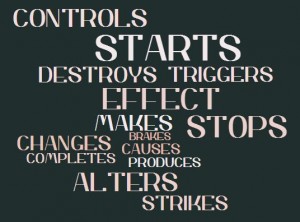
If we put individual culprits in a lineup they all look more or less innocent: verbs like affect, make, destroy, brake, results in, causes, starts, produce, alters, stops, triggers, controls, contributes to, brings about, changes, and so on.
In the right company these can be companionable terms. But let them loose within the rhetoric of a leader determined to make his or her mark on the public stage and they can turn lethal. This is the realm of the familiar idea of “unintended effects.” Fantasies of power and control impose more order on human affairs than usually exists. They depend on verbs that flatter us by making us active agents.
This is ironically aggravated by our devotion to the scientific method. As Psychologist Steven Pinker has observed, we can’t do science without buying into the view that we can identify first causes. That’s surely fine for discovering the origins of a troublesome human disease. But even though this logic is diffused through the culture, it cannot hold when we immerse ourselves in the infinite complexities of human conduct. Discovering the reasons and motivations of others is far more difficult. Add in entities such as nations or tribes, and first causes are often unknowable. And so strategic calculations based on efforts to influence or control behavior are bound to produce disappointment.
It’s a great paradox that we are easily outgunned by ourselves: by the stunningly capricious nature of the human condition. Take it from someone who has spent a lifetime studying why people change their minds. We have models, theories, tons of experimental research and good guesses. But making predictions about any specific instance is almost always another case of hope triumphing over reality. We may be able to say what we want, giving eloquent expression to the goals we seek. Our verbs may sing their certainty, but forces we can’t predict are going to produce their own effects.