
Has Music Become a Second-Tier Backup?
The popular music YouTuber Rick Beato recently posted a short piece asserting that kids—including his own—have devalued music in their lives by tying its delivery to their smartphones. In his 60s and completely sound-centric, Beato remembers his own youth when collecting and listening to music was a prized means of expressing their own identity. As I noted in the last post, recordings, record stores and radio airplay meant a lot. But his point that 4G and 5G technology as applied to smartphones has changed a lot. I would add that the phone screen partly changed the ratio of our dominant senses by giving communication in general a more visual and less auditory focus.
Sight now dominates over sound in almost all media forms: games, chats, texting, and social media content. To be sure, music is surely still within this mix. Headphones have become standard personal gear for many, in spite of the unfortunate “I’m not in this space” vibe that wearing them passes on to others nearby. But Beato is probably right to assert that contemporary pop music has receded in importance, used as an aural background for other activities. It is less surprising that even the younger among us might not recognize many of the performers on Billboard’s “Hot 100.”
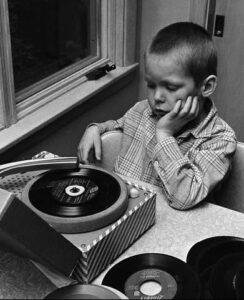 There is also a strange but revealing anomaly that used to be common. These days, no one now sits around and watches a record play. I mean that literally. The mid-century habit was once common among the young where attention was paid on what was being heard. We weren’t exactly in a trance but our visual sense was put on hold in order to focus on the music spinning out of the grooves. As was also true in the heyday of radio, complete listening could put the need to see something on pause. We have all had the experience of hearing something so intently that our eyes drift into an inactive state.
 In terms of my own previous work in The Sonic Imperative (available to download on this site), we are now much less “sound-centric.” And I’ve heard it scores of times: a student struggling with an academic subject complaining that he or she is a “visual thinker.” Learning or entertaining oneself by hearing might seem to have had its day. But it has not. For reasons explained in the book, the processing of sound still remains our first sense.
Social Media Dominates

17-year-olds average almost 6 hours a day on social media. While some of that time is allocated to “listening” to music, researchers note that this is background for other activities such as homework, gameplaying or work. In this framework, the music video born in the 1980s was an adaptation and a form of self-defense. The hooks to these videos were often the images added to remain competitive as music television expanded. Even so, it was hard to fault musicians who resisted turning their audio art into a clutter of visual memes.
Add up what is now the default youthful focus on watching short-form videos, and we would get a pretty low index of our sensory experiences. All of the accumulated visual editing yields very little that matters; not the experience of those lucky enough to still be caught by the raptures of music.
