
He has neither the mind of innovative architect nor an eye for sophisticated interiors. But he has the motivation to sell anything as a branded vision of what he touts as the Trump magic.
With the forced glee of a commercial pitchman, Donald Trump turns the most dire human issues of war and dislocation into opportunities to sell whatever is left on the showroom floor. Gaza will be converted into another Rivera. Venezuela will become a successful petro-state in partnership with the U.S. And various policy ideas or administrative actions will transform “failing” programs into new and shiny opportunities. And “shiny” is the operative term. In the light of day he tends to cover his animosity toward others in golden phrases and optimistic projections.
Apparently growing up in a tasteful Tudor-style home in Queens did not prepare him for the opulence he would discover in classical Greek architecture in Southern Europe, or the Palace of Versailles and the Arc de Triomphe in France. More recently, he has described as the “filthy” reflecting pool at the foot of the Lincoln Memorial. It is now being redone by a Trump contractor who was instructed to paint the bottom to match the pools in Miami Beach.
He has neither the mind of innovative architect nor an eye for sophisticated interiors. But he has the motivation to sell anything as a branded vision of what he proudly sees as the Trump magic. As Barry Golson of the Tampa Bay Times notes,
 Trump was a real estate guy way before he was a reality star. He built his own Trump Tower first, then bought hotels and co-op apartment buildings and seared them all with his branding iron. He pivoted to buying Atlantic City casinos, which he renamed with mounting grandiosity: Trump Plaza, Trump Castle, Trump Taj Mahal, all of which, incidentally, went bankrupt. . . .
Meanwhile, like any developer, Trump had strong ideas on interior design. This is how the Oval Office — in a White House that Thomas Jefferson insisted should reflect “republican simplicity”— was turned into a cringey, gaudy gold-leaf Caesar’s Palace high-roller suite.
The tropes of selling may seem tainted and tired, but they are quintessentially American. We all know some Willie Lomans who persist to the end. In our many commercial corridors everything has a price and a potential buyer. Clearly this dynamic still entices Trump, who revels in the maximalist language that still comes with real estate listings of everything from simple condos to high-rise apartments. This is a vernacular that pivots between the simplified supplications of sellers and the presumed needs of eager buyers. Trump’s language is rife with descriptions of “fantastic deals,” the “best,” the “biggest,” “the greatest,” or the “pristine.” “Winning” at the expense of others is the essence of this presidential swagger, delivered with a fervor that replaces what most other political leaders would offer as more somber assessments of the economic and political challenges facing the nation.
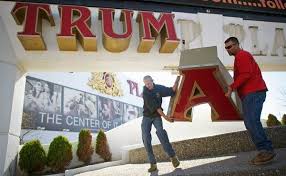 Meanwhile, diplomatic and policy failures of this administration have begun to stack up like the decks of unfinished buildings, reflecting what was marketer Trump’s habit to put his name on projects before their unsustainable finances push their investors toward insolvency. The Trump brand—everything from wine to coffee and even a Bible–was intended to be its own signifier of prestige: offered, touted to the faithful, then mostly ignored or withdrawn. For most others, 160 negative court decisions in one term would represent their own kind of bankruptcies. But not with Trump.
What is interesting about the vocabulary of selling is that it is characterized by undifferentiated qualifiers that ignore individual cases or exceptions. Adjectives for even unique products and services are represented in absolutes, where the sticky details are left for others to figure out. For example, sending Jared Kushner, Trump’s son-in-law, and real estate tycoon Steve Witkoff on missions to negotiate with Iranian officials could not help but be a fool’s errand. Deep secular and sacred values are woven into Iranian culture, light years away from the material worlds of real estate, where everything has a price. There can be little surprise that their efforts have been mostly ignored.
If the image of a speculator making optimistic promises that will not materialize isn’t ingratiating enough, Americans need only wait until sundown to experience the peculiar presence of an alternate persona that is more overtly hostile. Donald Trump spends most of his late evenings apparently alone and brooding over the real and imagined slights made by opponents. Gone are the daytime blandishments of policies that are “making America great again.” As every American knows, at night he easily surpasses the texting of a rejected teen ready to even up the score with her tormentors. His much rougher versions feature endless ad-hominem and often vile attacks on his perceived enemies. In sheer vitriol he matches the venom of the Glengarry “motivational trainer” that playwright David Mamet created to get rid of other real estate pitchmen not making the grade.
Trump’s dark version of the sundowner syndrome creates a stark contrast to the relentless good news of competence and success he sells while commuting on his plane or during the sprawling news conferences he favors many afternoons. At some levels those midnight texts are as revealing as the torments we are meant to understand from Shakespeare’s troubled kings. As was intended with their carefully revealed backstories, an inflated rhetoric of magisterial control withers when the audience is no longer buying.
