
A sudden change from the horizontal to the vertical is usually a lonely ride.
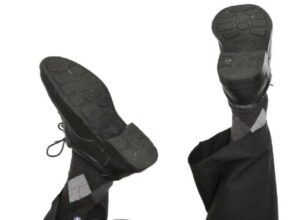
We usually look back on social or work-related miscues with a cringe. But, given enough time, they settle in as part of our history: a screw-up for sure, but also evidence that life goes on, perhaps leaving insights that may be useful. As a case study, consider this blunder from a deep well of lifetime mishaps.
In my high school years in the 1960s I was just an OK student musician. More than I probably deserved, I was selected to join the state of Colorado’s high school All-State Band. It was meant to be an honor that also came with a commitment to attend a weekend of activities at the University of Northern Colorado. The culmination of the experience was a final live concert and recording led by a noted university educator specializing in the band repertoire. If I had ever been selected for any honor up to this point, I can’t recall it. But before the whole special weekend was over I managed to reach a level of humiliation that I never thought I was capable of achieving. Somehow these things happen in high school.
My sister and mother made the trip from Denver for the event. And my fellow musicians from other parts of the state were excited to sign up to get a copy of a real LP that would contain the usual selection of marches and orchestral adaptations that we would perform. My job was to handle whatever the score required, which was going to be the snare drum parts and various cymbal strokes here and there. One of the pieces by Vincent Persichetti was especially tricky. I feared that my music-reading skill was maybe not up to the demands of his literally offbeat score. Persichetti was known for unexpected flourishes. Luckily, snare drums are not precisely tuned. I was reading the music for its intricate and unpredictable rhythms rather than pitch variations. All things considered, I survived Persichetti’s writing with my dignity mostly intact. What a relief to have finished the piece more or less with everyone else.
Since I had nothing to play in the next piece, I returned to my folding chair perhaps three feet off the ground, at the rear of the band on the highest of several risers. Most concerts use this arrangement. Audiences can see and hear players better if they are on successively higher levels. What I failed to consider, however, is how close the brown metal legs of my folding chair were to the high and unprotected back edge of the last riser, perhaps three feet above the floor. Nor did I sit like a competent musician, with all legs firmly on the platform. No. I pushed off with my front legs and leaned back, creating a precarious form of imbalance that is the birthright of every high school male. And now I was about to pay the price. Suddenly, the back two legs of my chair slipped backward and off the riser, and in a nano-second I headed to the wood gymnasium floor, taking along the chair, a snare drum and its metal stand.
A sudden move from the horizontal to the vertical is always a lonely ride. Sending a percussionist and his noise-making equipment off of even a relatively short ledge makes quite a racket: all the more if the director who was in the middle of the next piece feels compelled to stop every player mid-piece to inquire if there was any lasting damage. That made the experience worse. I could have crawled under the riser, vowing to stay until everyone went home. Surely the great Sonny Payne managed to stay on his “throne” in the great Count Basie Band. And smart actors always have a steely eye for where the front edge of the stage ends. Couldn’t I manage to do the same? Time froze in those seconds. I was stunned. The crushing embarrassment of the whole episode would only come later. There was no hope that I could convince anyone that this sad incident was actually written into the score. I quickly clambered back up to my post, repositioning myself, the chair and the snare drum in their proximate locations. Only then did the conductor continue. But the pained looks from my fellow musicians stayed with me. For days.
In that moment my sister helpfully whispered to my mother that it would be best if they pretended not to know me. Somehow, the knowledge that my humiliation was the property of Greeley, Colorado, miles away from my high school, offered some consolation. Would my friends find out that I was one of those performers who lacks even the sense to not fall off a stage? I seemed to remember pity as a common reaction. But mostly, and to their credit, those who eventually found out what happened pretended not to care. I also take consolation in the fact that Cary Grant’s jealous character suffered the same fate during his wife’s vocal recital in the hilarious The Awful Truth (1937). Even so, in my world, I respected musicians above all others. That sudden insight came then, and is still the case. The gaffe was an affront to that ideal, and perhaps a sign that I might do better with a different pursuit.
