A singular explanation that casts an entire community as unified by a secret intention explains the temptations of costly mental shortcuts.
The stories we tell ourselves can be breathtaking in their credulity. Who could respond otherwise to an account by an old John Bircher that would have us believe a member of the Senate died because the Soviets planted radium in his chair;1 or that cartoon animators were collaborating to turn Daffy Duck into a shill for communist propaganda;2 or that Princess Diana was intentionally rubbed out by the royal family,3 or that there are about 80 “Communists” in the current House of Representatives?4 or that the Ku Klux Klan is “a leftist group.”5 Singular explanations that cast entire communities in the same mold are a reminder that we articulate what we need more than what we know.
On their face, characterizations of motives are always implausible. Groups of humans are never of one mind. That usually applies to individuals as well. Anyone who has worked in a multi-layered organization or tried to get definitive answers from others probably carries some of the shrapnel thrown off from their fractured responses.6 To be sure, humans are social animals. But it doesn’t follow that they behave with the uniformity that the grammar of our descriptions implies. We are simply not well suited to think or act in complete concordance with others. The need to define the boundaries of our own worlds is strong, and a language of simple pronouns propels us into delusions of uniformity. Our thinking is enabled by the descriptive uniformity made possible by the language of “them.” Add in the trio of “us,” “we” and “they” and we have the core terms that can map the boundaries of alien territory.
On those occasions when groups seem to be functioning as one, we are willing to pay handsomely to watch it happen: at a football game, attending a performance by a great orchestra, or perhaps watching a play, where what the writer and actors intended more or less unfolds as planned. The attractions of perfect coordination are undeniable. Synchronicity creates the impression of coherence. And from the illusion of coherence we look for shared intentionality.
The more enlightened assumption is surely to expect natural divergence. Descriptions of behavior have more credibility when they are understood in their uniqueness and variability There is even something pleasing when unimpeachable fact sabotages the smothering weight of a glib assertion. Good histories often provide this function: for example, when reminders of the impressive civil rights legacy of Lyndon Johnson defeat the instinct to place him in a rogue’s gallery of regressive Southern “pols,”7 or when we discover that Hollywood was largely invented by Eastern European Jews who were determined not to proselytize for their faith, but to create fantasies of middle-American normalcy.8 Unassailable details like these have a way of wringing out the excesses of condensed and fantasized narratives.
The justifiable caution against defining others in categorical terms is nothing less than an offense to our human nature.
Even so, the well-grounded caution against defining others in categorical terms is nothing less than an offense to our human nature. Talk gains force from categorical certainty. Against the realist’s impulse for shunning overstatements there is the even stronger compulsion to find glib generalization that will add urgency to our arguments. Aggregating “their” presumed motives tantalizes us with the kind of intelligibility that allows making sense of factions that matter, including those from whom we want to stand apart. It’s our nature to enter the fray of ordinary conversation ignoring caveats about what a gloss of simplified characterization will miss.
Interestingly, we are always willing to describe the diverse sources of action that are factors in our own biographies. We cherish our individuality and implicitly ask those around us to acknowledge it. But our search for universals that can be applied to others is unquenchable.
All of this takes on more urgency in an election year, when the compression of candidate’s comments in our news media encourages what amounts to speaking in gross overgeneralizations. This is what concerns the conservative Washington Post columnist Michael Gerson, who recently scoffed at Donald Trump’s insinuation that “President Obama might be a secret jihadist.” In addition, he went on, Trump has raised the possibility
that Ted Cruz’s father might be implicated in the assassination of JFK; that Hillary Clinton might have been involved in the death of Vince Foster; that a federal judge, presiding over a case against Trump University, should be disqualified by his ethnicity.9
Arguments and evidence tend to vanish from this kind of rhetoric, replaced only by highly inaccurate characterizations of groups and individuals reduced to single markers like age, gender, their own religious traditions, political affiliations, and their home regions. We usually know this faulty logic when we take the time to assess it. Even so, it’s always tempting to imagine uniform intentions, using them as shortcuts through a thicket of real-world complexity.
________________
Adapted and updated from Gary C. Woodward, The Rhetoric of Intention in Human Affairs (Lexington Books, 2014).
Steven Goldzwig, “Conspiracy Rhetoric at the Dawn of the New Millennium: A Response,” Western Journal of Communication, Fall, 2002, 492.
Karl Cohen, “Toontown’s Reds: HUAC’s Investigation of Alleged Communists in the Animation Industry,” Film History, June, 1993, Ebsco Communication and Mass media Complete, accessed April 17, 2012. Nicholas Witchell, “Fayed Conspiracy Claim Collapses,” BBC News, April 7, 2008, http://news.bbc.co.uk/2/hi/uk_news/7326311.stm, accessed April 2, 2012.
Jeffrey Lord on CNN, quoted in Salon, June 10, 2016, http://www.salon.com/2016/06/10/good_lord_what_a_fiasco_cnns_shameless_trump_surrogate_is_poisoning_our_national_discourse_partner/
For Franklin Roosevelt, the villains were the Departments of the Treasury, State, and the Navy. To “change anything” was nearly impossible, he noted. See Emmet John Hughes, The Living Presidency (New York: Coward, McCann and Geoghegan, 1972), 184.
Robert Caro, “The Compassion of Lyndon Johnson,” The New Yorker, April 1, 2002, 56-77.
Neal Gabler, An Empire of Their Own (New York: Crown, 1988).
Michael Gerson, “A Delegate Revolt has Become the Republicans only Option,” Washington Post, June 21, 2016.
The First Amendment is the best part of our flawed constitution. It’s also an essential license needed to secure the discussion that every society needs in order to renew itself.
I don’t share the unqualified enthusiasm that others express for the timeless relevance of our Constitution. It’s enumeration of congressional and presidential powers is badly out of sync with our political times. And as a roadmap for a republic, it retains some of the offenses to the idea of direct democracy that were built in its earlier iterations. For example, Article One enshrines the fact that states like Rhode Island and California will have the same levels of representation in the Senate. Irrespective of population size, all states get two Senators. But in terms of modern ideas of direct proportionality, California should have at least 35 more members in that body than the lovely but minuscule Ocean State.
In addition, the elaborate checks and balances the founders wanted as a remedies against warring political “factions” have produced just the reverse. For many reasons gridlock is now structured into the system. The young adults I teach may represent the first American generation to never see the kind of Congressional leadership that was capable of partnering with a President to effectively govern. Examples of impressive Senate leadership–Johnson, Fulbright, Baker, among others–come from the not-so-recent past. Little wonder that for my students the body politic barely has a pulse.
What saves our Constitution is mostly its liberalizing Amendments, with some (The First, Thirteenth and Nineteenth) much better than others (The Second).
One could argue with some oversimplicity that, along with the idea of the national parks, the best idea we have given to ourselves and the world is The First Amendment. Its wording is refreshingly simple and free from a long list of exemptions. The Founders never gave the world a better model for freedom than this short and unambiguous paragraph.
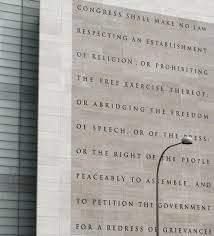
Congress shall make no law respecting an establishment of religion, or prohibiting the free exercise thereof; or abridging the freedom of speech, or of the press; or the right of the people peaceably to assemble, and to petition the Government for a redress of grievances.
This is a good time to celebrate the Amendment, which has most recently given aggrieved citizens in Ferguson Missouri the right to march and be heard. Members of the community knew they had that right, and so far many–though not all–have exercised it reasonably. As in Ferguson, the challenge is to restrain the natural but sometimes misplaced interest by law enforcement officials to rein in crowds with uncertain intentions.
Sometimes the Amendment is used to justify vast and uneven distributions of media power, as in the Supreme Court’s 2010 Citizens United vs. the F.C.C. ruling. The decision essentially the use of money in a campaign as a form of speech. Even constitutional lawyer Floyd Abrams, who inexplicably likes the ruling, concedes that the court’s obliteration of legal limits on campaign spending will give the wealthy vastly greater access to America’s voters.
I think Abrams is wrong to accept the court’s logic. Who knew the Justices could so blithely misread the Amendment as a franchise to the wealthy to dominate campaigns? So far most corporations have been more or less circumspect about funding the “superpacs” the decision allows. But we’ll be lucky if our democracy survives the tsunami of campaign cash that will come to favored candidates from trade and ideological groups.
All the more reason, perhaps, to raise a little hell as invited by The First Amendment. We are free to rally, march, write, publish, blog, carry signs, hold meeting and vigils, criticize, seek out lawmakers, pray and meet with who we please.
Of course, anything like throwing explosives at party-goers should not be a protected. That bit of misplaced hell-raising is part of my family’s lore. Many years ago my uncle supposedly made his way into Denver from the family mine in the nearby mountains to register his frustration over the slight of not being invited to a party. He scattered the crowd quickly by tossing a lit dynamite starter on to the dance floor at a downtown country club. In his mind he was perhaps just using the tools for the family trade to register his objections. But “speech” it wasn’t. I’m proud to report that he later redeemed himself as a prodigy geologist at The Colorado School of Mines, moving on just before he died to help Japan set up its own Bureau of Mines.
But the point remains. The First Amendment is the best instrument for a vigorous civil society in an otherwise flawed constitution. It’s also an essential license needed to secure the right of discussion that every society needs in order to renew itself.