Tag Archives: digital media

Are we Done Collecting?

Capture digital sampleOwnership of the thing itself—an urgency that kept postwar teens in book and music stores for hours on end—seems to be a fading passion.

I wonder about the future of the personal library: those numerous shelves lined with books and music that still line the walls of many of our homes. Owning a physical copy of the work of a writer or performer was, until recently, a sometimes obsessive pursuit for devoted listeners and readers. For many these displays of neatly organized works are a badge of honor, meant in part to suggest membership in certain aesthetic tribes within the culture.

I’m writing in a room cluttered with stuffed bookcases.  It’s the same in other parts of the house, where CD cases sit on table tops and stand upright on shelves.  We are clearly vestiges of the Edison past. In the early days of recording the idea of capturing sound was completely engrossing. Thomas Edison was as much in awe of the idea as everyone else. Add in the possibility of owning a disk of a performance that could be played at will, and the nation collectively swooned at the chance. Shellac cylinders and flat disks soon became their own fetishized possessions. Every middle class parlor had a record player and a growing collection of relatively expensive 78 r.p.m. records. Jump ahead several generations well into the 1990s and teens were still heirs to this passion of record collecting. British novelist Nick Hornby enshrined three clearly recognizable obsessives in his wonderful 1995 book, (and, later, a film) High Fidelity.  In our own ways we were Jack Black:  voracious readers of album liner-notes, and dead-certain of what to display with pride and what to hide.

Ownership is its own reward: something many of us still feel as we purchase a book we will read and perhaps re-read at a later time.

The personalized library has been memorialized by the wealthy with its own room in turn-of-the-century mansions. The rest of us starting  out as impoverished students usually exercised the less baroque option of bookcases made from bricks and boards. In either case books were considered intellectual and decorating necessities.  Their presence meant that you were a serious collector.  Robert Pirsig on one shelf and Miles Davis on another conferred status.

Now the tide has receded. To more younger consumers in most places (except Japan, with its continuing love of CDs) these music and print libraries seem to be an anachronism, like the player-piano rolls I remember as a child collecting dust in a corner of my grandmother’s lace-curtained living room. Digital “natives” are just as happy essentially leasing access to commercial libraries, such as those offered by Amazon, Spotify, Netflix, Apple and others.  Even the e-book, which is sold as the digital equivalent of a hard copy, is never quite the owner’s in the ways that the paper version is.  It can’t be easily loaned or resold because its storage is usually in a proprietary “cloud.”  Digital “immigrants” used to owning works are not quite convinced that we will have access to the work in perpetuity. A cloud-based purchase of an author’s book or a composer’s symphony seems less permanent.

Communication scholar Joshua Meyrowitz partly explains what has changed in his use of the phrase, “the Association factor.”  When we own a hard copy of another’s work—when it is in our physical possession—we more readily identify ourselves with it.  It’s an artifact tied to our identity, an outward representation of our place on the human map.  So if I am carrying around a copy of a particular novel or have a copy of music cd sitting in the living room, I’m probably prepared to defend its presence in my space.  I’ve “associated” myself with it. By contrast, a person may feel no responsibility to defend a song that presents itself to houseguests on Spotify. The lease of a channel of media content seems less personal than outright ownership, even though custom music sources have the advantage of opening our ears to much larger libraries.

My own adult children are mostly consumers of these digital services, and just as passionate in their own ways about their music and books as earlier generations. But ownership of the thing itself—a fact that kept postwar teens in book and music stores for hours on end—seems to be a passing signifier of the avid appreciator. No doubt that for many modern consumers walls of CDs and books look archaic. Why hold “hard” copies if they are all available in digitized files?  Perhaps the only answer is that some books and performances are too precious to not hold in one’s hands.

Comments: Woodward@tcnj.edu
The Disciplined Consumer

wikimedia.org
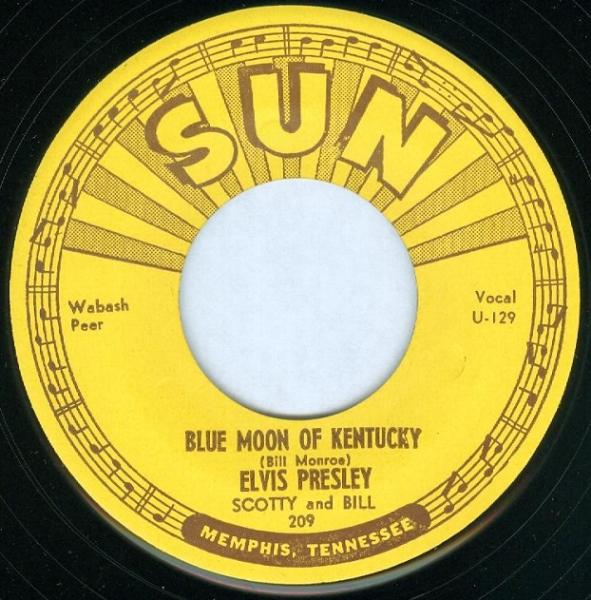
A Presley “45”           wikipedia.org

Human brains which have been alternately addled and enhanced by the machinery of the electronic age are accustomed to limits imposed by time and space.

There probably aren’t many times Elvis Presley and Giacomo Puccini are mentioned in the same sentence. But they did have at least one musical problem in common. By extension, it turns out to be the same problem we all face. Both needed to produce pieces that would last no more than four minutes. That time length was about the limit for the 78-rpm records that were beginning to revolutionize music during Puccini’s lifetime. And so it is thought to be more than an accident that his melodic operas include dozens of arias that would just fit on a 10 or 12 inch disk.  For a sample try out the great Tenor aria, Nessun Dorma from the opera Turandot.  Among other things, it is a virtual FIFA/World Cup theme song.

To this day the four-minute song remains more or less the standard for music producers guiding a commercial musician into lots of radio airplay. It was a similar kind of brevity that was required on RCA’s smaller new 45-rpm disks that fully launched the pop “single,” and Elvis Presley’s career soon after. Jazz performers might riff on a song for seven or eight minutes. But they would need to wait a few more years for Columbia’s “long playing” record that could handle a solid 25 minutes per side.

Though our preferred media have continued to evolve, the media squeeze on time hasn’t really changed.  Brains which have been variously addled and enhanced by the machinery of the electronic age have gotten used to time and space limits imposed by physical and commercial constraints. Music, news, conversations, advertising; it hardly matters. All pop in and out of our lives in rapid succession. And while we can keep shifting our attention to try to accommodate all of this clutter, we have no chance to expand the hours of the day to fit more in.

True, digital media can store and retrieve the largest works of writing and music with ease. Today anyone with an internet connection and even a modest computer also has, by default, a library, a museum, a performing arts theater, and nearly unlimited access to the intellectual output of the world’s cultures.

But we still mostly prefer to stay with the familiar, and with it, the same time and space limitations that our grandparents would have recognized: news articles cut to “short reads,” television journalists given only three minutes to tell a complex story, or expert commentators whose video sound bites still hover at an average of just under ten seconds.  And don’t even get us started on Twitter’s measly 140 characters.

What’s a consumer of this cultural maw to do?  One response is to try to swim with the tide by becoming perpetual information-grazers. We breeze through media content quickly before moving on to other new enticements. In communication terms, most of us are “peripheral information processors” most of the time.  Like restless children moving from toy to toy, there is a constant search for new stimulation. Many advertisers and content providers feel lucky to get even a minimal level of attention. Web sites like this one struggle to hold a reader’s interest, measured by Google as a site’s “bounce rate” and its average “session duration.”  (This site averages about two minutes per visit.)  Print advertising gets even less time from restless readers. As for traditional television viewing: family members frequently migrate to separate screens.  Even so, the remote channel selection button for a family’s 60-inch television is probably the most cherished piece of real estate in a household.

But there are advantages to also swimming against the tide. We arguably gain a great deal by consciously giving up grazing in favor of more purposeful media use. Exchanging breadth for depth usually brings clearer rewards. The goal ought to be to find time for long-form content.

Think of the monumental intellectual and artistic achievements that endure. They are not just arias, but entire operas; also the entire books, symphonies, cinematic masterpieces, epic poems and novels, lectures, paradigm-shifting monographs and essays that keep inviting us back to explore their wonders.  These are brain-shifting media forms that challenge and reward in equal measure. Given the ease of access we have to most of these materials, they only await our decision to sometimes forgo the transient for the permanent.  We just need the raised consciousness to know when we are wasting our time.

Comments: woodward@tcnj.edu