
Our sense of being adequately entertained has grown dependent on amplified sound.
During the recent World Cup games this summer in North America, spectators had many chances to see some amazing soccer in the frenzy leading up to the final championship game. But some of the games on television left me relieved that I was not in the loudest stands. Punishing sound levels were off the charts and easily sustained for several hours.
Our lives need to unfold in environments where ambient noise is significantly less than 100 decibels (dB), which is well under the sound energy of most sporting events and rock concerts. For those keeping track, apparently the loudest game was in Gillette Stadium in Foxborough. That June 13 match between Scotland and Haiti at times registered an ear-damaging 125 dB. And that was not a record of recorded noise, which is still held by Kansas City’s Arrowhead Stadium at 142 dB! These sound levels amount to a severe attack on the tiny bones and hair cells that make up the middle and inner ear. The cost of such noise is usually permanent hearing loss, most of which cannot be repaired by the body over time. The visual equivelant would be staring into the sun.
Predictably, sports fans, musicians, and members of large crowds suffer from some hearing loss over their lives. Some may wear ear protection. Many do not.
It is sobering to note how hearing loss correlates with a person’s sense of isolation and social withdrawal. The challenge is to convince young concertgoers and earbud users that the other end of their life will be faced with missed opportunities to hear what was once so easily taken for granted.
Our sense of being adequately entertained has grown dependent on amplified sound. As every musician knows, even if performing in a small intimate space, a group will use microphones to augment their acoustic output. Somehow they have become badges of authenticity. As a former drummer, 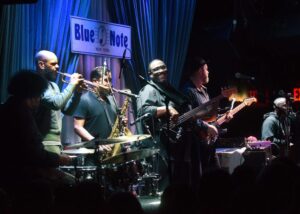 I can testify that there is usually no need to surround a standard jazz drum kit with a set of pickups hovering over cymbals and toms. Some famous clubs, like New York City’s legendary Blue Note are small enough to not need amplification. Recording is one thing. And arenas are obviously an exception. But in many venues playing live could easily be done without playing loud. Sadly, the drama of performance now brings the expectation that it will occur at greater sound levels north of 100 dB that voices and instruments alone may not produce; reasonable hearing levels be damned. In addition, a wall of amplified sound usually the sacrifices the natural harmonics of many musical sources. The next time you are near someone playing a good grand piano, listen and you will hear overtones that are often crushed by amplification.
What Have We Done to Our Sanity?
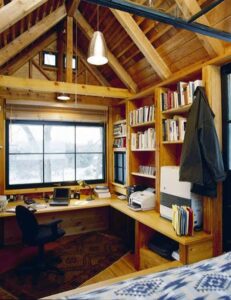 The writer and novelist Franz Kafka famously struggled to live within a noisy household in Prague while trying to write. He frequently complained that the noise of family and city life sabotaged his ability to focus. He exists in a long line of authors before and since who have sought out ways to cloister their hearing from the detritus of human activity. Gustav Mahler, Mark Twain, Virginia Woolf, Roald Dahl, and Michael Pollan are only a few samples from a much longer list. Journalist Pollan wrote A Place of My Own (1997) about his experience building a writing shed behind his Connecticut home (above). The building and the book were his homages to the life of the mind that can be saved from the clutter and distractions of the modern world.
There is also a degree of cognitive energy that is forced into overdrive by too much racket. UCLA Health cites four common effects:
- an increase in the release of stress hormones, increased risk of heart disease,
- increases in rates of depression and anxiety, and
- weakened cognitive functions. It is common to notice some elements of cognitive decline in older friends who are already wearing hearing aids.
Individuals vary greatly in their tolerance of noise. We are all different. Since the 1990s some behavioral scientists have noticed a cluster of personality traits one has described with the unusually clear name, the Highly Sensitive Person (HSP). In general, these folks may make up the ten percent or more of the general population who can be overwhelmed and overstimulated by various forms of human activity, including sound. When first coming upon this idea in a recent article in the BBC Music Magazine, it made sense, and can include a grab bag of positive indicators. Many are similar to what I have previously described as “sound-centric” persons.
With regard to music, one common positive effect HSP includes an overwhelming swoon upon hearing a particular performance, as well as a capacity to hear “into” sounds that others may miss. We have all seen audience members melt away upon hearing a portion of a performance. For film and theater director Mike Nichols it could be enough to hear an actor perfectly capture the meaning of some pivotal lines in a script. I’ve seen teen singers fight back tears singing Billy Joel’s “And So It Goes” within a choir. It is also easy to find audience members with moist eyes from listening to a performance of John William’s “Hymn to the Fallen” or the Main Theme from the film Schindler’s List. My own experience includes a quickening heartbeat in anticipation of the final third of Saint-Saën’s Organ Symphony, or the first notes of the Third Movement in Rachmaninoff’s Second Symphony.
As is so often the case, music gives and takes away. No one would want to lose the chances to experience wonderful musical highs. But those opportunities come with the proviso that we must still have enough hearing to appreciate these sonic miracles.
