
There is a curious fact about excessive noise. It has become so common that many of us don’t notice it.
 When a restaurant critic writes reviews, it’s not uncommon to read or hear about sound levels in even tony establishments that are “abusive” or “overpowering.” That’s not always the case. But high city rents dictate small rooms with many tables. And the bar culture in the same establishments approximates the sound intensity of the beachside runway on St. Maarten’s. That’s true especially for popular after-work watering holes. We have all had the experience of spending an evening with others where our time together was defined less by the stimulating conversation than our skills as lip-readers. At my age, hearing loss is expected, and the effect it can have on friends is profound. People with hearing challenges put on a good front of staying with the conversation against increasingly long odds.
 A reasonable noise level for a busy restaurant should be about 65 decibels. But many restaurants easily top 85 in their bars and main dining areas, a fact aggravated by the tendency of well lubricated patrons to talk even louder. Maybe the hard stuff should come with a noise warning as well as a proof number. Little wonder noise is the single biggest complaint leveled against eateries of all sorts. In fact, noise complaints are often first on the list of problems communicated to municipal offices.
The World Health Organization notes that the normal nighttime noise level for a large city should be no more than 40 decibels. (This measurement scale is logarithmic; every three decibel increase roughly doubles perceived sound intensity.) Continuous sound topping 55 decibels can leave a person at risk of cardiovascular disease. That’s a considerable distance from the 120 decibels that can produce permanent hearing loss: a real risk especially for musicians of all sorts, if they are lucky enough to have live gigs.
The problem is common enough to get a separate web page from the U.S. Department of Health and Human Services. Their recommendations:
-Spare your kids the noise. (Damage from too much noise is usually permanent.)
-Eat at off times.
-Request that music or the sound on televisions be turned down.
-Ask for a quieter corner away from loudspeakers or loud groups.
I would add another option:
-Leave. Nothing is more effective in demonstrating that an establishment has a problem.
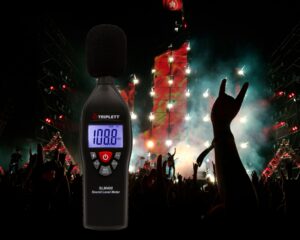 A lot of these suggestions are both common sense and also commonly ignored. Entertainment culture in the U.S.—from pro sports to restaurants to movie theaters—revel in unhealthy sound levels. Would establishments along Bourbon Street, Española Way or Beale Street still attract tourists and locals without their music spilling out onto the street? The question raises the uncomfortable conclusion that we use loud music as a signifier of the high life. There was a time when a plush hotel restaurant or subdued steak house was the epitome of cool. For an example, see the depiction of Hollywood’s Coconut Grove nightclub after hours in A Star is Born (1956). Cool then, but not now. These venues were usually better options for a group that actually wants to hear a conversation at the table. Now these rooms fill with young patrons who expect to be confronted with sonic tsunamis (and functionally isolated from their friends).
There is a curious fact about excessive noise. Many of us don’t notice it. We are used to moving through environments that push at the margins of comfort. Some of us are natural stoics, bearing the burden of too much noise until it is mentioned by others. This is one reason excessive sound volume is a contributor to stress. As ambient sound turns into a roar it stretches the natural elasticity of our patience. In the end, we feel drained and fatigued without exactly knowing why.
