It’s not only our nature to be role-players, our mental health may depend on it.
One of the more interesting paradoxes about human communication is the high contrast between our admiration for personal “genuineness” against contradictory evidence that we are really many selves. To be sure, there can be no question that a perception of personal authenticity is comforting. We express justifiable contempt for liars, phonies, and acquaintances whose deeds and words simply don’t match up. “Two faced” or “duplicitous” are among the nicer terms used to describe folks who seem to have fallen short. And yet the evidence is all around us that our ability to function in various communities requires adaptations that turn us into distinct if not wholly different persons. As exhibit “A” consider George Orwell’s well-known description of a restaurant manager in his book, Down and Out in Paris and London:
I remember our assistant maitre´ d´ hotel, a fiery Italian, pausing at the dining-room door to address his apprentice who had broken a bottle of wine. Shaking his fist above his head he yelled (luckily the door was more or less soundproof) “Tu me fats—Do you call yourself a waiter, you young bastard? You a waiter! You’re not fit to scrub floors in the brothel your mother came from. . . Then he entered the dining-room and sailed across it dish in hand, graceful as a swan. Ten seconds later he was bowing reverently to a customer.
This is a man who is simply doing his job. A maître’d’s success requires a minimum of two selves, and probably many more. And he is not alone. His situation has its counterparts in ordinary lives that barrel through full schedules that require constant adjustments to the persona we offer to others. Indeed, a video crew following us around for a few days would probably record that most of us are virtual repertory companies of one, adjusting, enhancing or concealing aspects of our elastic and complex temperaments. We know the value of making the necessary adjustments. At a party, for example, its a good bet that vegetarians will not try the meatballs. But most will still fulfill the role of the compliant guest, perhaps not even mentioning their dietary preferences.
Our expanding repertory requires the mastery of a range of suitable scripts. What can you say at a funeral? On a first date? At a job interview? As a group leader? We listen and learn, using an increasingly familiar script to match the role, all the while growing comfortable in the part.
It’s not only our nature to be role-players, our mental health may depend on it. Adaptability is a cherished social skill. We are graded on it in primary school, especially in the United States. There are countless sets of job reviews, psychological tests and ad-hoc measures of personal maturity that explicitly stigmatize inflexibility. In organizational life as in relationships it’s frequently a person’s behavioral and rhetorical rigidity that gets them in trouble. “Pathological” has become a near-synonym for the rigid thinker and obsessive behavior.
True, the single hold-out can be both the hero of a story or its villain. For heroes think of Henry Fonda in Twelve Angry Men (1957) or Lionel Barrymore in You Can’t Take it With You (1938). But in theorganizational world we often decry leaders who can’t adapt to the times, or the under-appreciated talents of their subordinates.
To be sure, there are always the inflexible who try to make a career out of an ostensibly consistent and single identity. But frequently making an issue of violated boundaries begins to look like selfish prevarication. That’s what third acts are literally about. Watching a film or play, we wait for the likely third act transformation of a character in trouble. Change is in the wind. Can they manage it? We want them to find the resources to become who they must.
Most people accustomed to the public arena have learned to not take audience opposition personally. In return, members opposed to a persuader can show unexpected forbearance.
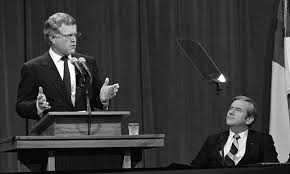
Kennedy and Falwell at Liberty University
Several decades ago I wrote a book describing a number of public figures who willingly appeared in front of “hostile audiences.” An audience is “hostile” if its known to oppose who you are or what you intend to say. Even so, these were individuals who were mostly fearless in facing their critics. I think only my mother actually read Persuasive Encounters when it was published in 1990. Yet, a least for me, the idea remains intriguing.
The book included transcripts and analyses of specific public comments made by a range of people, including Phil Donahue, Edward R. Murrow, John Lennon, Ed Koch, Ted Kennedy and psychiatrist Thomas Szasz. Szasz was an interesting case. In a number of books and addresses he went out of his way to warn his medical colleagues that they were crippling their patients by renaming their bad choices as mental health “conditions.” So much for his chances to be a future President of the American Psychiatric Association.
Senator Ted Kennedy was also a useful example. By mistake he was sent an invitation to join the “Moral Majority,” Reverend Jerry Falwell’s crusade to purge secular liberalism and governmental activism from the American political landscape. At what was then Falwell’s somewhat constricted version of higher education known as Liberty Baptist College–they still had curfews, as well as prohibitions against women going on dates–Kennedy was Exhibit “A” for why the nation had strayed from its ostensible Christian roots.
But never a person to miss the humor in our foibles, Kennedy wrote back, telling Falwell he welcomed the invitation. After long distance pleasantries to smooth over the awkward snafu, Falwell made an offer to have Kennedy address his students at Liberty. And so the Massachusetts senator went to Lynchburg in 1983, offering a general plea arguing that we should oppose “religious tests” for public office-holders. That idea remains a cornerstone of evangelicals interested in politics.
The clean-cut audience couldn’t have been more courteous. And Kennedy gave as much as he got. The speech included a generous acknowledgement of Falwell, acceptance of the value of religious belief, and a straightforward argument for tolerance of all or no faith traditions.
In my study, only New York Mayor Ed Koch responded as a rhetorical athlete, matching his audiences shout for shout. He returned a disgruntled resident’s sneer at twice its original speed and with far more topspin. At a particular public meeting held in one of the city’s districts sustained volleys between vocal citizens and the Mayor wore down even hardened veterans of municipal feuds.
Persuaders in front of hostile audiences are interesting not because they may produce charges and countercharges, but mostly because of the reverse: there is usually surprising and sudden elasticity of viewpoint in many who are involved. People accustomed to the public arena have mostly learned to not take audience opposition personally. In return, members opposed to a persuader can show unexpected forbearance.
And so a whole series of questions seem interesting. In terms of communication skills, how resourceful can a respondent be to complaints that they are “out of touch,” or are “dishonoring” the public office they hold? How focused can they remain in the face of criticism and overt disbelief? And what ideas or values can a persuader dramatize which—to quote a common phrase—affirms the idea that ‘our areas of agreement are much greater than our differences?’
Versions of this line have been delivered many times by Barack Obama and less frequently by Donald Trump. In rhetorical terms, it has been a common trope (a recurring pattern in discourse) for public figures to explicitly celebrate a common culture and shared history of beliefs. And so it reenacts what is perhaps the most universal of all communication impulses: the reaffirmation of the other’s legitimacy in the culture. Our opponents may annoy us. They might seek ways to limit our reach or effectiveness. But the basic courtesies we expect even from those with seemingly alien views are an anchor against currents that can sweep away a tenuous civility.