The averted gaze preserves our isolation until an expectation of reciprocity forces us out.
The Important Person has just turned the corner at the far end of the hall. She’s with an associate, walking in my direction. In another few seconds we will pass each other in the middle of this long narrow hall. Will the Important Person notice me? Will her glances to her associate give way to a glance in my direction? In the Important Person’s world do I even exist?
The essential ritual of acknowledging another is a cornerstone of our sociality. “Communication” can mean transferring the most complex of ideas or feelings. But stripped to its essential core, it usually includes simple gestures that confirm another person’s existence: their basic worth. This basic process of affirmation can be in real time, or communicated electronically. As with the example of the pending encounter with the Important Person, its most interesting to observe in the flesh. The body language is so clear. We are in constant search of facial cues from others that we matter to them, that we have status, that we are an agent of potential value.
This ritual has its cultural rules that vary somewhat from society to society. In American life most of the work of affirming or denying recognition is done with the eyes, where looking in the direction of another is the signature act of recognition. The establishment of this plane of mutual eye contact is essential. Saying something to another simply doesn’t work very well if we can’t catch that person’s gaze.
Imagine another common but more complex scene. With another person I am eating dinner in a crowded New York restaurant. Its layout is a typical arrangement: a continuous banquette along one wall faces a series of small individual tables, as in the photo above. Spaces between the tables amount to little more than a few inches. In this series of “table for two” arrangements I am in the chair and my partner is seated on the banquette against the wall.
Here’s the challenge. This arrangement poses a problem for waitstaff. The server’s mandate for good service means she can’t fully engage people on my side without establishing a plane of direct eye contact. But she will need to perform the physically uncomfortable task of specifically addressing us by leaning in to our sides so her face can be seen. As a customer I can make the task easier by turning my head in her direction, or next to impossible if I don’t. And I’m impressed, because doing this wrenching twist of the body to show deference must leave a server with at least a sore neck.
In a crowded place like Manhattan direct eye contact on the street provides the opportunity for more “communication” than most people want. It’s too much work and perhaps risky to try to acknowledge everyone whose personal space you invade, like those facing each other on a subway. In such circumstances we do look at people and their faces, but this gaze is usually stolen: timed to be more or less unseen by the other. This kind of stolen glance preserves our isolation until we are again among people where there is an expectation of reciprocity.
We sometimes seem to prefer the electronic facsimile of another person over the one we know directly in front of us. The result can be its own small wound of rejection.
Source: Cindy Chew, S.F. Examiner
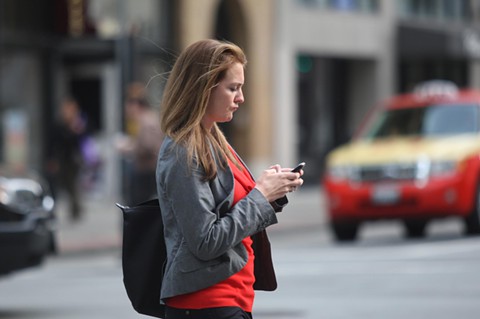
If you are in an environment that might be broadly considered a community—for example, an office, a college campus, a faith community, a school—the averted gaze in another’s presence is increasingly common and usually off-putting. With those we know we expect an offer of acknowledgement through eye contact. This is the source of the anxiety in the first example of encountering the Important Person. But communities must now also contend with competition for an individual’s attention from many sources, one of which is what I call “screen thrall:” the increasingly ubiquitous habit of community members to looking away from approaching others, shifting attention down to their cell-phones. It’s endemic in most settings, even when individuals are known to each other. My impression is that, for some people, it has turned into an automatic response: the equivalent of Bill Murray trying to avoid Groundhog Day’s insurance-selling Ned.
A practical and ironic effect of using a mobile device is that it now works as a tool not just for connection, but also isolation. The stance characterized by screen thrall says “I’m not available.” It’s another case where we sometimes seem to prefer the electronic facsimile of another person over the one we know directly in front of us. The result can be its own small wound of rejection.
Sound rather than sight is the great passageway to human experience. And the pictures are better.
In the hierarchy of sensory richness the bias of our times tends to give the top spot to the visual. People who make it their business to explore how we connect in the 21st Century describe our culture as increasingly “ocular-centric,” or image-driven. We now worry more about hours of “screen time” consumed per day than time spent in “idle” conversation.
Those who lobby for the primacy of the visual justifiably note that images are mostly free of the challenges of mastering the complexities of verbal literacy. They also rightly conclude that the body is an instrument for universal communication. “Talk” to an outsider with no knowledge of your language, and you still receive lots of meaning in visual cues and gestures that bridge cultural boundaries. Anywhere on earth we can hand-gesture our way to the idea that we are hungry.
But there is reason to affirm that our most vital sensory equipment—and also the most fragile—resides along the cochlear nerve that links our ears to the brain. More than sight, sound is the great passageway into the human experience. Sound is the primary agency for knowing and understanding others. Like so many other higher-order animals, binaural hearing provides most of the context clues we need in order to map our location in specific physical and social environments. We disguise the body in clothing and create architecture to separate ourselves from open space. But our words carry less camouflage. Even when we are in full rhetorical flight, our essential selves tend to be visible. As the saying goes, you can lie in print more easily than on a phone.
It’s also important to remember that language is acquired in the very young by hearing others. Language is speech. The visual mode of print is vital but derivative. In its subtle tonalities talk gives us feelings and attitudes that can easily be lost on the page, a fact that makes it somewhat easier for a blind person to meld into diverse communities than those with chronic deafness.
Humans have organized noise into music for the sheer pleasure of finding perfect avenues for expressing emotional intensity.
Perhaps the trump card for the importance of regaining a “sound-centric” view of human capabilities is in the unique and miraculous realm of music. Music untethers sound from its purely stipulative duties of standing for things and ideas. It is the perfect proxy for human feeling. Humans have organized noise into music for the sheer pleasure of finding perfect avenues for expressing emotional intensity. Music is the reliable substitute that takes over when the verbal fails.
To be sure, as an industry the music business is in shambles. But that is partly because the pleasures of songs must be satisfied even in the face of faltering attempts to monetize their value. Downloaded music files and ubiquitous earbuds reign with the young and increasingly the old because we need the catharsis that music makes possible.
Even in the visually rich world of film many of the deepest pleasures come from the sound design of a different class of genuine auteurs: film composers. Music creates an expressive language that is frequently more evocative than what even a master-director can make literal on the screen. Consider Alfred Hitchcock’s Vertigo (1958). The film pulls in viewers by the kind of aural “foretelling” that so often gives its slow and confusing plot an unmistakable urgency. Most of the film’s mystery lies between the staves of Bernard Herrmann’s dreamlike score (the longest of any Hitchcock film). The same can be said for Sidney Pollock’s thriller, The Firm (1993). Pollock papered his story of a creepy Memphis law office with the solo work of Dave Grusin. The film today is a reminder of how much its exquisite tension was actually created in post-production by Grusin’s piano-only score.
Music heightens and transforms the natural limits of human action. It’s a novice’s mistake when a film director treats aural elements as merely supportive of the story. Sound is more fragile. It’s easily swamped by the visual clutter of daily life. But that’s all the more reason to reclaim its special status as the realm that converts intensity of feeling into something that is both sensate and accessible.