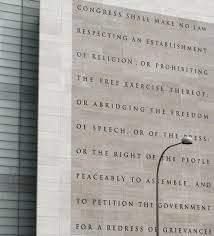
The First Amendment is the best part of our flawed constitution. It’s also an essential license needed to secure the discussion that every society needs in order to renew itself.
I don’t share the unqualified enthusiasm that others express for the timeless relevance of our Constitution. It’s enumeration of congressional and presidential powers is badly out of sync with our political times. And as a roadmap for a republic, it retains some of the offenses to the idea of direct democracy that were built in its earlier iterations. For example, Article One enshrines the fact that states like Rhode Island and California will have the same levels of representation in the Senate. Irrespective of population size, all states get two Senators. But in terms of modern ideas of direct proportionality, California should have at least 35 more members in that body than the lovely but minuscule Ocean State.
In addition, the elaborate checks and balances the founders wanted as a remedies against warring political “factions” have produced just the reverse. For many reasons gridlock is now structured into the system. The young adults I teach may represent the first American generation to never see the kind of Congressional leadership that was capable of partnering with a President to effectively govern. Examples of impressive Senate leadership–Johnson, Fulbright, Baker, among others–come from the not-so-recent past. Little wonder that for my students the body politic barely has a pulse.
What saves our Constitution is mostly its liberalizing Amendments, with some (The First, Thirteenth and Nineteenth) much better than others (The Second).
One could argue with some oversimplicity that, along with the idea of the national parks, the best idea we have given to ourselves and the world is The First Amendment. Its wording is refreshingly simple and free from a long list of exemptions. The Founders never gave the world a better model for freedom than this short and unambiguous paragraph.
Congress shall make no law respecting an establishment of religion, or prohibiting the free exercise thereof; or abridging the freedom of speech, or of the press; or the right of the people peaceably to assemble, and to petition the Government for a redress of grievances.
This is a good time to celebrate the Amendment, which has most recently given aggrieved citizens in Ferguson Missouri the right to march and be heard. Members of the community knew they had that right, and so far many–though not all–have exercised it reasonably. As in Ferguson, the challenge is to restrain the natural but sometimes misplaced interest by law enforcement officials to rein in crowds with uncertain intentions.
Sometimes the Amendment is used to justify vast and uneven distributions of media power, as in the Supreme Court’s 2010 Citizens United vs. the F.C.C. ruling. The decision essentially the use of money in a campaign as a form of speech. Even constitutional lawyer Floyd Abrams, who inexplicably likes the ruling, concedes that the court’s obliteration of legal limits on campaign spending will give the wealthy vastly greater access to America’s voters.
I think Abrams is wrong to accept the court’s logic. Who knew the Justices could so blithely misread the Amendment as a franchise to the wealthy to dominate campaigns? So far most corporations have been more or less circumspect about funding the “superpacs” the decision allows. But we’ll be lucky if our democracy survives the tsunami of campaign cash that will come to favored candidates from trade and ideological groups.
All the more reason, perhaps, to raise a little hell as invited by The First Amendment. We are free to rally, march, write, publish, blog, carry signs, hold meeting and vigils, criticize, seek out lawmakers, pray and meet with who we please.
Of course, anything like throwing explosives at party-goers should not be a protected. That bit of misplaced hell-raising is part of my family’s lore. Many years ago my uncle supposedly made his way into Denver from the family mine in the nearby mountains to register his frustration over the slight of not being invited to a party. He scattered the crowd quickly by tossing a lit dynamite starter on to the dance floor at a downtown country club. In his mind he was perhaps just using the tools for the family trade to register his objections. But “speech” it wasn’t. I’m proud to report that he later redeemed himself as a prodigy geologist at The Colorado School of Mines, moving on just before he died to help Japan set up its own Bureau of Mines.
But the point remains. The First Amendment is the best instrument for a vigorous civil society in an otherwise flawed constitution. It’s also an essential license needed to secure the right of discussion that every society needs in order to renew itself.
The rhetoric of rules places a heavy burden on the most creative among us. Too often rule-making leads to the measurement of success in terms of compliance rather than initiative.
In a debate on the explosion of American lawsuits a few years ago the famed law professor and trial lawyer Alan Dershowitz described one litigation strategy used by large corporate defendants as “papering the other side to death.” He meant, of course, that a lawyered-up organization can intimidate a plaintiff by requiring so much data and information that the cost of a “win” becomes too risky and time-consuming.
The phrase has always stuck with me as a perfect representation of a common bureaucratic impulse. Paper has perhaps been replaced by online documents and files. Even so, there seems to be a natural tendency to bureaucratize even the simplest processes, ostensibly to be “uniform.” But in fact these rules function in part to mystify others into compliance. No one, for example, reads the “conditions of use” fine-print attached to nearly every downloaded application. But the sheer volume of their legalese lends authority to the source. Or try having your car or yourself serviced at a facility that is supposed to assure us to keep things in good working order. The front desk clerk taking down your information is now likely to go through a prolonged data-entry mode that leaves little time for a description of the problem that brought you in. Filling in forms seems to be a primary function that exists for its own sake.
Our organizational life seems to thrive on hiring and promoting rule-makers: policy specialists, compliance officers, lawyers, professional writers, contract law specialists, employees charged with reviewing procedures, and especially organizational members–some with OCD tendencies that make them ready to see any free choice as a vacuum that needs a procedure. After all, someone must police the miscreants who would initiate a novel approach to a routine task.
“Procedures” nailed down in multiple pages of “steps” have the perverse effect of replacing individual initiative with a gloss of uniformity. Organizational culture naturally wants uniformity, which is not itself a bad thing. The problem is that the folks who write the rules seem to self-select, forming groups who are all too willing to “paper” the rest of us.
Alas, this compulsion toward overwrought rule-making has not produced a comparable group of specialists motivated to reverse the process. So organizational culture typically embraces a snowballing accumulation of regulations.
Even college professors aren’t immune from this tendency, especially when setting up rules defining the work status of their colleagues. The pedant in all of us loves to make guidelines, rubrics, checklists, worksheets, mission statements, instructions, directives, standards and criteria. People who might better spend their time on scholarship often drift into generating handbooks of rules for even the most simple of professional tasks, such as observing a younger colleague’s teaching. The arc of a college teacher’s professional career is now tracked, classified, quantified, compared against a rubric, assessed by insiders, assessed by outsiders, tested in online questionnaires, burdened with filings to outside agencies, and itemized in reports to higher-ups. One wonders how Princeton’s Albert Einstein would have responded if told that his career arc at the Ivy League school was out of compliance with the guidelines applied to all of the school’s disciplines.
The rhetorician Kenneth Burke called this tendency to over-produce regulatory flotsam “the bureaucratization of the imaginative.” It’s a perfect phrase. Reining in creativity by “regularizing” work simplifies organizational life, but has a deadening effect on innovators. In effect, the rhetoric of rules places a heavy burden on the most creative among us. Too often this impulse leads to the measurement of success in terms of compliance rather than initiative.