We can be surprised when an audience member begins to describe what they heard in a given presentation. It’s frequently not what we believed the presentation was about.
Most of us operate on a daily basis using what is sometimes called a “correspondence view of reality.” This approach assumes that the material world offers up an endless parade of experiences that we take in and understand in more or less similar ways. The reality on view to all has certain reliable and corresponding meanings. At least that’s the theory.
But after forty years as a rhetorical critic and analyst, I must say that I don’t see much evidence that the world we describe has much in common with what others believe to be present. We all know the experience of listening to a description of an event witnessed by ourselves and others, only to hear an account that misses what we thought were important defining features. There’s nothing new in this, but its a cautionary condition that ought to make us wary of the correspondence view.
I was reminded of this recently by a scene laid out in Lawrence Wright’s book on the negotiations that led to the historic Camp David Accords. Thirteen Days in September documents the 1978 efforts of President Jimmy Carter to find a way out of the chronic Arab/Israeli impasse, working with Israel’s Menachem Begin and Egypt’s Anwar Sadat. The President put everything else on hold in Washington to spend time with these men at Camp David in the Maryland mountains. Days passed as these three leaders looked for a way around their considerable differences.
When the talks seemed to be irrevocably breaking down, Carter decided to pack up his entourage for a quick side-trip to Gettysburg, not far the famous presidential retreat. He reasoned that perhaps a look at the bloody American fratricide that occurred on the lush hills surrounding the small Pennsylvania town would help reset the talks.
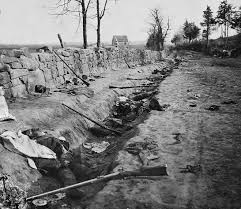
Over three days in 1863 the Confederate and Union armies saw 8,000 of their members slain and 50,000 badly wounded. This was carnage on the scale of the 1967 Arab-Israeli Six Day War. Begin and Sadat took all of this in, with detailed narratives provided by Carter and the local National Park staff. But as Wright notes, the two old warriors saw very different Gettysburgs.
Like most visitors, Sadat, known for his peace-making instincts, seemed fascinated by the strategies of the generals leading the two warring armies. The timing of attacks and counterattacks are usually at the center of most narratives about this key battleground. But to Carter’s surprise it was Begin, the old guerrilla fighter, who was sobered by the magnitude of the carnage, and especially the words of President Lincoln’s short address at the site. The Israeli leader interpreted the speech as a call for political leadership to rise above the brutal factionalism of civil war. Begin saw Gettysburg as a reminder of the horrible price that strife between neighbors can cause.
We see surprisingly different understandings play out in all kinds of prosaic ways: films we loved that others disliked, the often surprising “lessons” that individuals take away from a story about communication or interpersonal breakdown, the incomprehensibility of a cable news report.
Against the simpler correspondence view of reality that we assume, communication analysis needs something which can be called a phenomenological view of reality. The phenomenologist tends to accept the likelihood that experience is individual rather than collective,and that the material worlds we share are still going to produce separate and unique understandings. Our personal values and biographies are likely to feed into interpretations of events that are specific, distinct, and often exclusive to us. Meaning is thus not a matter of consensus among strangers, but a mixture of ineffable and lifelong influences. In simple terms, two individuals may look at the hilly terrain of Gettysburg’s Little Round Top, but may be taking very different lessons from it.
It’s difficult to judge if King knew what taking his discourse out of the public domain would mean.
The release of the film Selma this month adds meaning to the holiday honoring Martin Luther King’s birthday. But some details about what the producers had to do to put King’s courage on view add a slightly sour note to this year’s tribute.
Most Americans probably do not know that the great civil rights leader’s words may not be rewritten or replayed without payment to King’s heirs. Soon after the famous “I have a Dream” speech on the National Mall, King moved to legally retain legal ownership of it, and eventually other statements made by him throughout the years of his struggle. He copyrighted his public rhetoric in a way few would ever think possible or desirable. It’s difficult to judge if King knew what taking his discourse out of the public domain would mean.
The family’s explanation for monetizing and controlling the leader’s rhetoric is that he and they did not want his words used for commercial or unintended purposes. If you want a video copy of the speech, you will need to buy it from Amazon or some other seller of audio content. If you are a documentary filmmaker seeking footage of the era, payment would be required for any portions that include statements from King. And if you are retelling key moments from his life, his words are off-limits, even though the family has apparently licensed segments for use in commercials.
The challenge was especially great for the producers of Selma, who were forced to write their own King-like oratory to recreate the fateful 1965 march. The exclusive film rights to those words have apparently been sold to DreamWorks’ Steven Spielberg.
It even gets even more peculiar. Stanford University runs the Martin Luther King Institute that oversees a “King Papers Project.” But getting access to the papers is not easy. Here’s their online warning:
The Institute cannot give permission to use or reproduce any of the writings, statements, or images of Martin Luther King, Jr. Please do not contact us for this purpose.
Inquiries regarding the use or reproduction King's writings or statements should be directed to the manager of the Estate of Dr. Martin Luther King, Jr.: Intellectual Properties Management (IPM).
How very strange, for several reasons. First, in my years in academic publishing, I’ve rarely encountered an editor who had to pay a license fee in order to reprint speeches and statements from major political or social figures. I’m sure it has happened somewhere. But most principals or their estates understand that the nation’s civil culture is predicated on widespread dissemination of foundational documents. The general guideline is usually that it’s more about the ideas than monetizing them.
Second, when you put a price on jeremiads that called on others to join a collective struggle, claiming legal ownership of those words undermines the very ethic of personal sacrifice they are ostensibly about. King asked much of his followers, especially when they were recruited to march—as in Selma—without any police protection. Given the willingness of so many to selflessly further the cause of civil rights, It’s difficult to understand why he set up an intellectual property mechanism that would put his rhetorical legacy on the auction block. Freely sharing his words would have been better served the idea that this was a collective struggle. Surely documents that are part of a nation’s social and cultural advances deserve a better fate than being sold to the highest bidder.