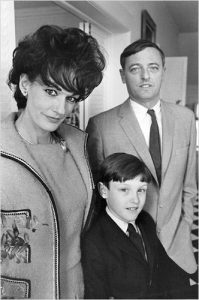
An only child who had to oversee the passage of his parents through their final “vale of tears,” Christopher Buckley also bore the role of keeper of their legacies.
Many of us who struggle with the task of finding ways to give heat to ideas can usually point to favorites: cases where a writer has put the perfect image together to make his or her point. These passages are moments of rhetorical grace, sometimes represented by economy of style or an evocative image. Writers read partly to experience these moments. They add more fuel for the long slog of putting words on the page.
One personal favorite is from an unlikely source on an unlikely subject. Christopher Buckley’s 2009 memoir of the last year of his celebrity parents is funny and wise on the demands of coping with the inevitable. In Losing Mum and Pup we see the conservative gadfly William F. Buckley Jr. and his socialite wife struggle to the end. An only child who had to oversee their passage through what his father often described as “this vale of tears,” Christopher also bore the role of keeper of the flame for their outsized legacies.
That the book could be characterized as a pleasure to read is a credit to his dry wit and effective storytelling. Humor and melancholy merge seamlessly. Among other things, his dad’s ability to cope with the death of his mother produces the kinds of serio comic episodes that any caregiver with a sense of humor would recognize.
This is not just a memoir about wheelchairs and vacant faces. The younger Buckley has the good sense to understand the end of his parents lives mostly in terms of the consequential work done in their most productive years: Bill in publishing and politics; Pat, in the upper stratosphere of New York museums and philanthropies.
“Great men have too much canvas up.”
Here’s a favorite passage seemingly about his father’s love of sailing, but also much more. It contains a wonderful image.
Pup was an avid sailor. He had learned to sail as a child in upstate Connecticut, on a not very large lake. Now we live on the Connecticut shore of Long Island Sound and kept a thirty-eight-foot wooden sloop. It was named Panic, a name my mother found all too apt. . . I now get that Pup’s greatness was of a piece with the way he conducted himself at sea. Great men always have too much canvas up. Great men take great risks. It’s the timorous soul—souls like myself—who err on the side of caution; who take in sail when they see a storm approaching and look for a snug harbor. Not my old man. Or as Mum used to put it, “Bill why are you trying to kill us?”Great men are also impatient. This particular aspect showed up most vividly in my father’s manner of docking his boats. Most people, when guiding, say a ten or twenty ton vessel toward a dock, approach slowly. Not my old man. His technique was to go straight at it, full speed. Why waste time? This made for memorable episodes.1
“Great men have too much canvas up.” It’s an apt image that seems completely faithful to the person who published the National Review. Anyone who had observed Buckley on his Firing Line broadcasts or his work as a conservative essayist could also see the literal extended to the behavioral. Fearless sailing was typical of who the father was, even when he was heading in the wrong direction.
________________
1Christopher Buckley, Losing Mum and Pup, Emblem Books, 2010., pp. 121-22.
All of us have probably engaged in some form of the dark gambit of ‘affirmation by denial.’ But it’s a long way from the more honest style of expressing only those accusations that we are prepared to own.
Sometimes we try to produce a rhetorical sleight of hand when we pretend to not notice the effects of what we’ve said. We can do this with a “stage whisper” that everyone can overhear. Or we may throw out a “marker”—an added verbal modifier—that puts a certain spin on everything else that follows, as with “the Mexican-American judge” or “the Jewish banker.” The source may pretend not to notice the obvious and intended effect created by the unnecessary word. But that feigned innocence makes as much sense as a child who tries to disappear by covering their eyes.
So it is with the simple rhetorical maneuver of “affirmation by denial.” This is usually a statement in which a questionable claim is repeated, but then innocently disavowed. The wily speaker thinks he has been able to have it both ways: repeating a slander or untruth as an innocent piece of information, then stepping out of the way and feigning a degree of neutrality. The rhetorical advantage is that the idea has been put in play.
Listen to some samples from Donald Trump and you find a variation on this. He often starts a comment in a speech with some form of the expression, “A lot of people think. . .” Then a dubious “fact” is inserted, creating just the kind of indirect assertion that wounds but leaves no fingerprints. For example, “A lot of people are think that . . .
President Obama is not even an American
Hilary Clinton in not well
the Clintons killed a former law partner
Ted Cruz is not an American citizen
Ted Cruz’s father was involved in the Kennedy assassination.”
This kind of rhetoric of innuendo is never pretty.
Sometimes he goes on to suggest that he’s not sure. Or the prior statement isn’t necessarily his view. It’s a maneuver that allows deniability. But it’s intellectually dishonest, and downright scary in a potential leader who needs to measure the effects of words carefully. This kind of rhetoric of innuendo is never pretty, especially in a president.
To be sure, all of us have probably all engaged in some form of affirmation by denial. Sometimes we want to put more cards on the table than we can play. But it’s a long way from the far more laudable style of expressing only those accusations that we are prepared to own.