We seem to love news stories built around the game of politics.
The presidential election season now takes the space of nearly three NFL seasons, where the endless journalistic fascination on the minutia of strategy far exceeds what any sane person wants to hear. Imagine seeing the musical Cats for six hundred performances, and we begin to get a sense of the fatigue factor we have built into our presidential politics.
The reasons for this endless campaign cycle are varied, systemic and ultimately not very interesting. Suffice it is say that no one is really in charge. And so a crazy quilt of organizational needs and commercial opportunities play out in repetitive loops spread over many months. Think of the chaotic rules the parties now use to set up primaries and caucuses. Most of the population centers in the United States must wait for smaller states like Iowa and New Hampshire to weigh in.
Analysis of our campaign journalism reveals that most of what political journalists give us is what communication researchers call “process reporting.”
There is one overriding feature of these endless campaigns that is especially problematic. It’s connected to how they are covered by most of the news media. Analysis of our campaign journalism reveals that the lion’s share of the reporting that political journalists give us is what communication researchers Kathleen Jamieson and Joe Cappella call “process reporting.”[1] Process stories tell us very little about what the candidates will do should they get the opportunity to govern; they tell us much more about what the campaigns are planning as they do battle with their opponents.
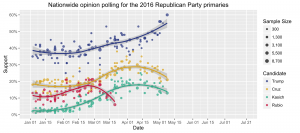
Jamieson and Cappella’s research examined print and broadcast coverage, with the goal of coding stories as either focusing mostly on substantive issues or on how various sides are playing the “game” of politics. Substantive coverage includes stories on what a candidate thinks: how he or she would govern and lead, and what policies they would propose. By contrast, the “process” or “strategy” frame of reference is a label given to individual reports focused primarily on political polling, and also what individual candidates and their campaigns are strategizing to win over voters.
Why is a candidate spending so much time in a particular “swing” state? Why did they use this location and this particular audience as a place to focus on pay differentials between men and women? Whose decision was it to keep the candidate away from interviewers at The Washington Post? The strategic questions are endless and often trivial. But as with the comments of “color” commentators broadcasting professional sports, we seem to have an endless reservoir of curiosity about the backstories of individual players. News sites like Politico or television programs like With All Due Respect (Bloomberg/MSNBC) would be nowhere without the “inside baseball” commentary that turns their journalists into connoisseurs of campaign mechanics. We love reports built around public opinion poll results, and the play-by-play on decisions on raising money, picking staffers, and the geographic deployment of the candidate. We expect and get far less analysis of major challenges the country and the newly elected leader will face in the next four years. And that’s a problem.
With this focus on process there is less journalistic curiosity about political substance. Journalists simply don’t have time to follow a campaign around the nation while at the same time getting up to speed on the diplomatic possibilities for making headway to end the Syrian civil war, or for helping the European Union ease its political crisis. The iconic journalist I.F. Stone noted years ago that journalists would do better to stay at home and write stories based on the public record: the policy positions of governments or the position papers of candidates who want to run them.
It may be considered “old school” to expect that campaigns will result in a national dialogue about the great issues facing the nation. And yet when we are consumed with the sideshows of the campaigns, we are also sacrificing the opportunity to clear away the brush to find safe passage through the thorny landscape that lies ahead.
_______________
[1] Kathleen Jamieson and Joseph Cappella, Spiral of Cynicism: The Press and the Public Good (New York: Oxford University Press, 1997) , 33-34.
President Gerald Ford speaks as Jimmy Carter listens during the first of three debates in 1976
In this election cycle there is a common misperception that it is the moderator’s job to comment on a debater’s lies or false claims. But that’s the job of the other debater. In a true debate the participants aren’t responding to reporters, but fact-checking each other.
The political season always brings out a cycle of “debates” finally agreed to by cautious candidates, news organizations, and the Commission on Presidential Debates. Though everyone involved has different motives, the one most commonly expressed is that debates offer the public the chance to compare candidates side by side. In the unfettered give-and-take of a debate we are supposed to learn about issues that divide and sometimes unify those running for the same office.
In their current form, however, debates are fettered; they can’t achieve the lofty goals we have for the form. The usual “debate” format devised by campaigns and participating media amounts to little more than a joint press conference.
A debate done correctly should deliver a purposeful clash of views, where claims and evidence are tested against a series of counter-arguments. Among others, Aristotle was certain that acts of public advocacy had a cleansing effect on the body politic. He believed we are wiser for subjecting our ideas to the scrutiny of others. This may sound lofty and abstract, but most of us do a form of this when we talk through an important decision. We often want friends to help us see potential problems to our proposed course of action.
The problem is that candidates usually fear unmediated and extended exchanges. They and their staffs believe that a serious gaff can sink an entire campaign. So they hedge their bets. They agree to “debates” if they are moderated by a panel, or at least a single journalist. This is when the process begins to go south. It’s further doomed when each side is given only a minute or two to respond to statements from the other side.
There is also a widespread perception that it is the moderator’s job to comment on lies, half truths or false claims. But that’s the job of the other debater. In a good debate the participants aren’t answering reporter’s questions, but fact-checking each other. The advocates directly address the claims and arguments of their opposites on what are usually several broad but important subject areas. When one issue seems to have been exhausted, a moderator may steer the pair to a related issue, and then get out of the way.
Perhaps one the purest political debate available on video dates back to 1992. Talk show host Phil Donahue invited Democratic Party primary contenders Bill Clinton and Jerry Brown to debate on his show. After a brief introduction and commercial Donahue simply introduced the two men and moved out of the way. The debate at a single round table was direct and mostly uninterrupted.
Lincoln and Douglas debated for hours by themselves without the assistance of others. Indeed, a prime form of Saturday night entertainment in the 19th Century was a formal debate in a town’s biggest venue. The whole process of seeing two leaders explain their ideas under the scrutiny of an interested audience could be invigorating. By contrast, the short question-based formats commonly in American political debates generally ruin the chance to see how much a candidate actually knows beyond their memorized campaign sound bites.
Our system conspires to protect candidates and allowing them to stay in a comfort zone of clichés and bumper sticker retorts. Debates should expose relevant facts and hard truths that are initially hidden by glib statements of resolve. We rarely let the candidates follow a single thread long enough to see if they really understand those truths.