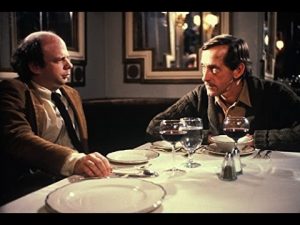
I’m always interested in the response of my friends to a simple question. If they could conjure up anybody from the past or present, who would they like to have a leisurely lunch with?
Sometimes we could use some new conversation-starters. In my circle the usual topics run all the way from A to B, from the cool and wet summer, to the latest norm-violating behavior of our President. There are also some local issues that are good for a few minutes of hand-wringing, including plans to build an unwanted pipeline through our valley, or the always-good-for-a-comment angst about our state’s high property taxes.
But sometimes it’s worth taking a leap into the unknown, or even the frankly impossible. I’m always interested in an acquaintance’s response to a simple question: if they could conjure up a meeting with anybody, who would they like to join for a leisurely lunch? A meal can not only satisfy an appetite, but ruminations with a good conversationalist can stay with us a long time.
All of us come into contact with remarkable people, friends or strangers with wonderful stories to tell or experiences that extend well beyond our own. It is usually just an intellectual exercise to imagine what it might be like to spend time over lunch with a famous person. But people we already know can be just as interesting. Think of the conversations with familiar companions that bubble up in Louis Malle’s My Dinner with Andre (1981) or Richard Linklater’s Before Midnight (2013).
To be sure, it sometimes works out that someone with intimate knowledge of a notable achiever may come away from a meeting chastened. More than a few writers have admitted that their living or deceased subjects remained interesting, but not necessarily as candidates for a fantasized social outing. Biographer Nell Painter remembers working on a study of the famous slave preacher, Sojourner Truth. But several years ago Painter told a C-Span interviewer that her “closeness to me receded” as she worked her way deeper into Sojourner’s life. She respected her subject to the end, but finally doubted they would connect in a conversation. Sometimes a little distance keeps the great and good on a pedestal where we want them.
In a recent dinner with friends the question drew various responses. Singer-songwriter Paul Simon came up as a good lunch companion. He has been a stream-of-consciousness poet for several generations. And some of those enigmatic lyrics in Graceland: what do they mean? Another liked the idea of sharing a meal with Jesus, and it’s hard to quarrel with that choice. But the guest of honor would probably make me a nervous eater. Did I order to much? Should I have shared it? Why didn’t I suppress the joke about turning my water into wine? Another mentioned Barack Obama. He’s articulate and sometimes funny. And his off-the-record perspective in this political moment would be fascinating to hear. Would he make us feel better about where the nation is headed?
Another person suggested the African-American blues musician, Daryl Davis. Davis seems to have a knack for drawing in listeners, including KKK members. He told an NPR interviewer that in some cases he was the first black American these white men had spoken to socially. One measure of his success is that he has a pile of KKK robes that his newly sensitized friends have sent him after they renounced their membership in the Klan. Think of what he might teach us about the subtleties of face to face conciliation.
American culture exists most vividly when we focus on agents of insight or change.
My choice tends to change by the week. But right now I’d love to have lunch with the arranger, musician and producer, Quincy Jones. He is in his 80’s, with a career that spans playing trumpet in several great 50’s bands, to arranging and conducting some of the best performances caught on record: everything from Sinatra at the Sands, (1966) to Michael Jackson’s Thriller (1982). He’s a walking history of American music: big-band Jazz, R&B, Pop and Funk. In interviews and a growing list of tributes (including 26 Grammys) Jones is unfailingly generous and interesting. Can a person still be hungry when sitting next to a national treasure?
There’s a useful point to this exercise. It’s a reminder that American culture exists most vividly when we focus on agents of insight or change. They may be famous or obscure. But more than we think are close by, their lives are testimony to the value of pluralizing our world beyond the shallow celebrities that sometimes narrow rather than broaden our horizons.
Since the fantasy lunch with the fantasy check is on me, who would you choose?
Listen to Debussy on an old vinyl record and you may detect the equivalent of someone tap dancing in the background. For sure, this is not what the master of pianissimo envisioned.
A new book that has created ripples this year is David Sax’ The Revenge of Analog (2016). He discusses the revival of older media forms that have been eclipsed by all things digital. Your old Pentax 35-millimeter camera is an analog device, as are the once-cherished vinyl records albums taking up space in your basement. In the case of these two forms, you can actually see what the medium was capturing in its mechanical ‘software;’ each frame of film carries a miniature impression of its content, as do the microscopic groves of a record. A high sheen visible on its surface means it carries lots of ‘close together’ grove wiggles representing higher sound frequencies. A Mozart recording will have a brighter sheen than one that gives us a more bass-heavy Brahms.
By contrast, digital forms give us files made up of electronic imprints that are mostly invisible. We now take pictures with our cameras, never giving much thought to the storage media. And many of us get our music from a “cloud,” wherever that is.
Sax wants to make the point that there is a resurgence of analog forms. In the first three chapters of his book he points out the return of what we thought was gone: the modest rise in the number of bands that release their music on vinyl, and the rebirth of film manufacturing for a steadfast group of artists and filmmakers who like the look of images on celluloid. He also notes that we still depend on the printed page. And for good reason. The book remains a supremely portable medium, though his argument that bookstores are popping up everywhere seems like a stretch.
Older Luddites are clearly not a sign of the rebirth he describes. The “revenge” of analog is happening because of the young and the cool.
I should be the kind of person most receptive to his argument. After all, I’m among those who have lamented the capture of persons by their digital screens. But I’m also in the class of “geezers” he mentions who still prowl the bins of used record stores. He makes it clear that media-use habits of older adults do not represent the rebirth he sees. Sax wants us to know that the “revenge” of analog is happening because of the young and the cool.
Fun as it is, the book leaves me mostly unconvinced. In the case of film, he misses the best argument for its preservation: that it often looks better. Watch a movie in 4K-digital and it can create a one-dimensional look that others have described as the “soap opera effect.” Colors are bright but not rich. Sets and images often look flat. There’s something about the residual blur of passing light through a celluloid image that makes a projected film so watchable. No wonder directors like Judd Apatow and Wes Anderson still use film technologies that blossomed in 1950s.
Alas, vinyl records have not aged as well. Many are fine, but among its residual problems, vinyl is a natural collector of dust, with individual particles played back as a small click. Listen to Debussy on an old vinyl record and you may detect the equivalent of someone tap dancing in the background. For sure, this is not what the master of pianissimo envisioned.
Sax gets some things right, and never more so than in an opening quote from the Toronto theorist, Marshall McLuhan. Some of the media insights from the media sage have not aged well. But McLuhan was spot-on noting that “a new medium is never an addition to an old one, nor does it leave the old in peace. It never ceases to oppress the older media until it finds new shapes and positions for them.” Those of us who are interesting in such things avidly teach this lesson. Newer media don’t necessarily eclipse the old; most co-exist, evolve, and sometimes fade.