Opera will always have La Scala and Covent Garden. And the Beatles will always be identified with EMI’s Abby Road Studios in London. But these mostly unseen Hollywood scoring stages may matter even more.
If you have wondered why a film in a good cinema can be so engrossing, more credit than you might think should go to the sonic power of the score you are hearing. The audio tracks of all sorts of older and recent movies can be breathtaking in their depth and clarity. Think of the orchestral scores of John Williams, Rachel Portman, Howard Shore, Alan Sylvestri, Bernard Herrmann and many others.
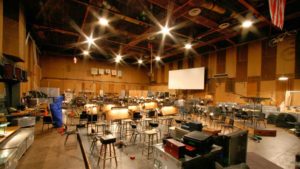
The old standby, E.T., is unthinkable without William’s wall to wall music, which was recorded at what is perhaps the most preferred venue for large groups available in the United States. The place: the venerable MGM Scoring Stage on what is now the Sony Pictures lot in Culver City. Now named for Barbra Streisand, the 6100 square-foot Stage features a short but potent reverberation time that seems to make big movie set pieces positively bloom. Musicians, audio engineers and filmmakers love how this building sounds. For most, any changes to this this barn-like room would be unthinkable. You’ve surely heard it, though probably never seen it. It played a big part in films such as Empire of the Sun, Star Wars: The Last Jedi, La La Land, as well as many classics, including Wizard of Oz, Gone With the Wind and Singing in the Rain. If it can sometimes be hard to know where film magic actually begins, this is one place to look (or at least hear). The history and glorious sound of this stage makes it one of the most beloved film industry landmarks in Los Angeles.
The film score is probably how most Americans now experience the full-throated power of a traditional orchestra.
It’s no surprise that filmmakers treat this large room filled with its forest of microphones as if entering sacred ground. It’s likely to be the spot where a composer and director will first hear a score that they have only known in piano or MIDI arrangements. Adding to the sense that this is a place of miraculous revelations, they are also likely to hear it played perfectly by an impressive cadre of studio musicians.*
Another landmark is the Scoring Stage built in 1929 on the Warner Brothers lot in Burbank. Thirty years ago studio executives were eyeing it as a tempting space to convert into production offices, but in the late 90s actor Clint Eastwood persuaded them to rebuild and preserve it. Some think that the renamed Eastwood Scoring Stage has a slightly drier acoustic, but stunning scores have been laid down within it, including those for Casablanca, Back to the Future, Days of Wine and Roses, Rattatouille, Frozen and many more.
An interesting side note: the Warner stage was also used as a location in a pivotal scene in the 1954 version of A Star is Born. Judy Garland records a song while Ray Heindorf conducts. Play the scene to the end and catch a great moment of film acting. James Mason’s private conversation with Garland’s Esther includes a proposal of marriage that has been secretly recorded by one of the stage’s engineers. Her candid list of his faults that all in the room hear during playback turns into an excruciating humiliation. The moment is a little master-class on film acting.
It seems fitting in the midst of the current renaissance of interest in film music that we also celebrate the remaining purpose-built stages on the lots of the remaining studios. Similar spaces run by Fox (the Newman Scoring Stage in Century City) and Skywalker Sound (in Marin County, north of San Francisco) contribute to the survival of the orchestra as a major tool of film-making. A film score is probably how most Americans now experience the full-throated power of a traditional orchestra.
There is also an interesting irony in how these nearly perfect spaces are meant to be used. The amazing performances are obviously heard via well-placed microphones rather than a live audience. Ask a player, and they will tell you that going to work in comfortable clothes has some virtues. But the applause that usually comes with a live performance in is not part of the picture. Our awe at their work only comes after the fact.
*Thanks to YouTube, many videos with good audio show musicians and composers at working on scores for films, television, and games. For a good sample based on the work of composer Peter Boyer at the Sony Stage see https://www.youtube.com/watch?v=O9NiicNKDGU
We expect organizations to get better at what they do. But many atrophy, sometimes because of the rules-based digital systems on which they depend.
Despite clear advances in information systems, there is obvious evidence that many organizations are faltering in their abilities to provide services to their clients and customers. We expect organizations to get better at what they do. But it seems that the older the organization, the more it is likely to atrophy, sometimes because they opt for incremental fixes for core problems. A big claim, to be sure. But the increasing longevity of Americans makes it possible for more of us to see the decline of services over time.
Medium
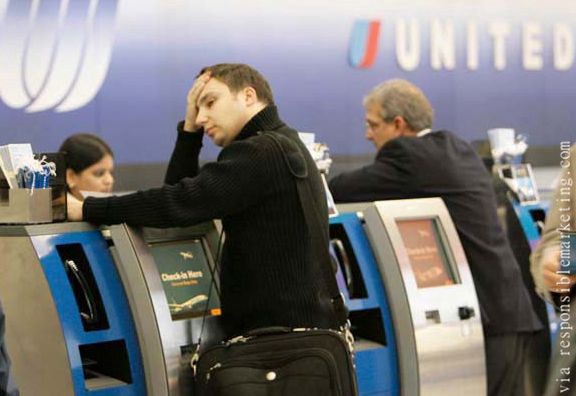
Consider a recent personal case. An direct flight from the northeast to Chicago should take just under two hours. That is what I thought when I boarded a plane in Philadelphia bound for Chicago’s O’Hare. But the United flight was delayed in leaving due to a glitch in an old Boeing 737 that was probably older than my students. We left about 40 minutes late, not that unusual. Partly because of the delay, we were effected by afternoon thunderstorms building up over O’Hare, leaving us with too little fuel to wait them out. So we eventually diverted north to Grand Rapids Michigan to get more fuel, and to continue to work on the maintenance issue.
As luck would have it, several families on the plane were actually going to Grand Rapids via a previously arranged connection in Chicago. So the fates delivered them to their city. Or so they thought. But despite the two-hour wait on the tarmac just short of a gate, the folks who could practically see their neighborhoods from their seats were not permitted to leave. Apparently security rules don’t allow people to change their routing. So they sat all afternoon, waiting with the rest of us to move on to an overcrowded O’Hare on the other side of Lake Michigan. Of course they then needed to find a new connection to get back to where we had just come from. This is surely not what previous generations meant about “American know-how.”
The problem here was the weather, a badly outdated plane, corporate indifference, and digital security systems constructed as a series of binaries. These days you are captive to your airline until you reach your final destination. But not that many years ago baggage could be pulled from the hold if a passenger’s plans changed.
As it happened, our return later in the week was not much better, leaving Chicago after 6:00 p.m. and not reaching our home until the next day at 2 a.m. because of more ground delays.
Crowded skies and over-scheduled airlines now make flying an endurance test for travelers that are amazingly passive and compliant. One friend described a direct flight from Albuquerque New Mexico to New Jersey that went from a scheduled four hours to nearly three full days and two unscheduled hotel stays.
Don’t fault the young; it’s all they know. But my independent-minded ancestors would have never stood for it, surely ending up on no-fly lists if they were still with us.
To be sure, travel horror stories aren’t new. But they are representative. The point is that, like the airlines, more organizations seem to be expanding their “services” by setting up systems that can’t deliver on what was originally promised. That’s sometimes true in bank and financial services, consumer loans, appliance repair, medical insurance and governmental services: everything from basic road repairs to enrolling for Social Security. Even appliances in need of simple fixes are now tossed rather than submitted to the vagaries of a service gauntlet.
These days most corporate dollars seem to go into marketing rather than customer service.
We sense the problem when a call to a service provider for help. The usual routine is that a robotic phone or online system takes over. It typically allows for only a certain number of categories of response. Questions that are preset by the service provider are a cheap if deficient solution for “listening” to what another wants to say. Short of buying a yacht, no one in most organizations really wants to talk to you. These days most corporate dollars seem to go into marketing rather than customer service.
There are notable exceptions. One reason the behemoth Amazon is so popular it that it usually delivers on its what it promises. UPS has also been a part of that success. Others report good results with some car makers, insurance providers like AARP, and a large number of streaming services. These are in sharp contrast to essential human services that have been squeezed by tight state budgets and plain old bureaucratic ineptitude. For example, it’s a small kindness to not ask commuters in New York of Washington D. C. to ask about their subway commutes. These publicly financed systems are struggling. But service problems are often just as bad in large businesses with bloated management costs and under-paid line personnel. If you have challenges using the Post Office or a government body, look to the top, not the bottom. Problems with mail or Amtrak or the Affordable Care Act should be laid at the doorstep of our politicians, not their workers.
A sorry solution for organizational atrophy is to find refuge in the software of amusement. It’s tempting to ‘visit’ places online rather than bother with the physical trip. The tether of a screen seems to function as our escape route. Even so, and as challenging as it is, flying is still an amazing experience. The thrill of seeing our world from the other side of the clouds should always matter. And yet I traveled in a blackout on my trip to Chicago. Passengers near me on both sides of the plane kept their window shades down so they could play games on their phones.