The authors call them “chaos voters.”
Watch enough You tube videos of Britons willingly severing ties with their European neighbors, or voters who seem comfortable channeling their free-floating anger into disrupting common political norms, and you begin to wonder. When did burning down the house become the preferred solution for sorting out a society’s various problems? In 2016 I labeled this preference for disruption our “iconoclastic moment,” a conclusion since borne out by a recent study by several political scientists.
 The research paper “A ‘Need for Chaos’ and the Sharing of Hostile Political Rumors in Advanced Democracies” is the work of Danes Michael Petersen and Mathias Osmundsen, along with Kevin Arceneaux at Temple University. The paper’s thesis is that “chaos Incitement” has become its own political objective for some voters in western democracies. This often means abandoning the value of consensus-building and at the same time demonizing enemies and violating long standing political norms. While the conclusion of the paper isn’t surprising, it is sobering to see that many citizens, especially in the United States, are more interested in the destruction of institutional values than the refinement of them. The authors found significant agreement among supporters of President Trump with the following kinds of agree/disagree items:
-
I fantasize about a natural disaster wiping out most of humanity such that a small group of people can start all over.
-
I think society should be burned to the ground.
-
When I think about our political and social institutions, I cannot help thinking “just let them all burn.”
-
We cannot fix the problems in our social institutions, we need to tear them down and start over.
-
Sometimes I just feel like destroying beautiful things.
Not everyone gave an affirmative response to all these assertions. But nearly half did. The authors call these folks “chaos voters,” who are ready to ignore the benchmarks and norms of a civil society. Alas, in tight elections they can make a difference.
The question remains as to whether these democratic stalwarts will right themselves after having been steered onto dangerous shoals.
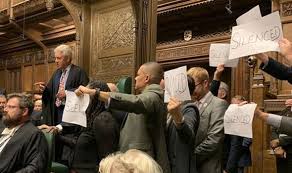
And it’s not just the United States. As we have noted, part of Britain’s civil life has been trashed by the never-ending serial drama of Brexit. Boris Johnson’s purge of 20 MPs in his own party, including former Chancellors of the Exchequer Nicholas Soames and Ken Clark, was an unprecedented act in recent British history. This act of putting a gun to his own feet, along with his inflexibility on a Brexit withdrawal date, has left the British leader with no governing majority: a fact made worse by the House of Commons reluctance to trust him to conduct a fair election.
Fault the “leave” campaign for hobbling the once powerful colonial power. And forget the empire where “the sun never sets.” A slim majority has begun to isolate the former powerhouse of Europe. The nativism of mostly rural and older Britons now seems destined to make our closest ally the Dis-United Kingdom.
American nativism is playing out in much the same way, with increased tariffs, punitive immigration policies, and sabre-rattling that unsettles our friends. Equally bad, there are signs that American businesses are becoming hard-pressed to find enough service workers: a former entry point for many emigres who aspired to live the American dream.
In different ways the yellow jackets of France are another manifestation of popular disruption disturbing the placid surface of French culture. Immigration, jobs lost to mechanization, and a generally dystopian view of politics has humbled many western nations who could count on a degree of optimism to quell periodic rumbles of unrest.
France’s Emmanuel Macron clings to a vision of a thriving and diverse France. But Boris Johnson in Britain and Donald Trump in the United States seem to have become untethered from the usual obligation of a great leader to nurture their nation’s best values, among them: the pluralism that comes with being open societies. Neither are even close to being institutionalists like former leaders George H. W. Bush, Barack Obama, Tony Blair, or John Major.
The question remains whether Britain and the United States will right themselves after falling victim to unsteady hands that have steered them onto dangerous shoals.


 A person with high social intelligence has a set of ‘antennae’ that can be a guide for behavior that will give another more comfort than pain.