A goal of any presenter should be to show up early and troubleshoot all of the equipment. That cuts your chances for a problem by perhaps half.
If you give presentations to groups you know the anxious moment when it dawns on you that the equipment you counted on is not working. A teacher confronts this more every year, with no shortage of PowerPoints, streamed content, websites and cued videos to manage while still keeping a class on point. These external elements can be so numerous that almost every class needs its own ‘pre-concert’ sound check. Lucky are the lecturers and old style speakers who must simply offer a well-organized presentation in a package that is pleasant enough to hear. The rest of us who teach regularly seem to have fallen into the habit of running ersatz Youtube channels.
A recent address at Harvard represents this older style. House of Commons Speaker John Bercow explained his role and this peculiar moment in British politics to a packed room with a magnificent timing and his usual panache. His prose has the spaciousness of someone who knows he need not rush or show pictures.
In the meantime, the rest of us are scrambling for the clicker to keep our students engaged.
In a larger auditorium the chance for things to go wrong is greater. Microphones can be unreliable and sometimes, work only intermittently. Outside noise can intrude. Large spaces can have challenging acoustics. And ad hoc set-ups of projectors, cables and computers can easily let us down.
A goal of any presenter should be to show up early and troubleshoot all of the equipment. That perhaps cuts your chances for a problem by half. For the risks that remain. . . well, you are pretty much on your own. At a minimum, prepare by forcing yourself to consider what you will do if a key piece of equipment resists all attempts to revive it. Think of this as your Plan B.
A few tips:
- Be sure the mic works as its supposed to, without feedback noise and with as much clarity projected into the room as possible. But also be aware that if you are wearing it, you may be ‘live’ to the audience longer than you intended. In addition, repeat any questions that come from the audience. They may not be able to hear each other.
- Resist turning PowerPoints into a written lecture. Remember that you need to remain the primary agent of communication.
- Never set PowerPoint slides to run on a timer. I think the most dysfunctional presentation I ever saw used just such a timed sequence which, of course, set a pace the speaker could not keep up with. She faded into total confusion as pictures behind her appeared and vanished, seemingly at random.
- If a space is noisy, ask if the air handling system can be turned off just for the length of your presentation. As the presenter you need to assume the obligation of making sure you can be easily heard.
- Put new batteries in the wireless remote you may be counting on. Double As are the usual size.
- Ask the audience to move closer if the room is not full.
- Keep your sense of humor. Nerves or a flash of anger can make audiences uncomfortable. Think of an equipment failure as your chance to show that you are a change agent for all seasons.
- As a last resort, a little tap dancing might buy some time.


 In true debates, the press simply listens like the rest of us. In an authentic debate there may be moderators, but not questioners.
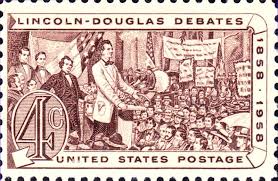 Lincoln and Douglas debated for hours by themselves without the assistance of others. Indeed, a prime form of Saturday night entertainment in the nineteenth century was a formal debate in a town’s biggest venue. The whole process of seeing two leaders explain their ideas under the scrutiny of an interested audience could be invigorating. By contrast, the short question-based formats commonly in American political debates generally ruin the chance to see how much a candidate truly knows, beyond the memorized sound bites that they repeat at every stop. Just when follow-up rebuttals might begin to test a candidate’s knowledge of an issue, the questioners usually interrupt and move on to a new topic.