A body welcomes the chance to hear from a consciousness that is not interrupted. Walking or taking a hike without devices is a good start.

A declining capability to focus on just one thing takes us away from a useful form of consciousness that allows discoveries that a fragmented thinker may never find. We may claim full in control of our own awareness. But modern life means that we are now up against devices that too often succeed in vying for our limited and precious attention. Losing track of our own thoughts and feelings is always too high a price to pay. To cite just one measure, American adolescents reportedly check their phones one to several hundred times a day. This is part of the digital treadmill makes us less centered than we should be.
By definition, distractions of this sort are usually detours away from focused attention. The resulting fragmentation of our time happens when the optimal continuity of some effort is broken by the wish to shift attention elsewhere. I see the pattern in myself when I notice that I am less anxious to sit through a full-length film. Short videos or articles can seem more inviting. But this website is dedicated to communicating in “the age of distraction”—be it advertising, social media, too many texts or e-mails. In the interests of our sanity, we should seek to join the declining numbers of individuals who find ways to resist most of this cultural noise. Some may try meditation, mindfulness exercises, or even taking a nap.
Of course, the goal of continuous attention to one thing must pay off with something that is worthy of the time. Given my own preferences, this would rule out video gaming, endless video watching of the ‘lowest common denominator options,” or any other sponge on time that has greater costs then benefits.
 One answer to this problem is to discipline ourselves to follow a more linear pattern of involvement, even though cultivating this kind of thinking cuts against the grain of the culture. Walking or taking a hike sans phone can be a start. Your body would welcome the chance to hear from your uninterrupted consciousness.
Linear thinkers take many forms: avid readers content to devote large chunks of time to a single work, artists happily left alone to sort out decisions that will end up on canvass or as musical notation, writers who must carefully consider their words. And of course, we’ve enshrined the image of the “mad scientist” as a loner following the threads of their research with long hours in the lab, leaving family and friends to fend on their own.

Distraction puts us behind our ancestors, who were often better at action, meaning ownership of capabilities to deal with our place in the physical world. By contrast, we cope with distraction by reaction to continuous inundation from the digital world.
George Frederick Handel wrote the great oratorio Messiah in spurt of nearly unbroken concentration, finishing in just over three weeks. And imagine the sustained effort required by William Lamb’s architectural firm, who designed and prepared drawings for New York City’s Empire State Building in an incredibly short two weeks. The iconic skyscraper was completed in just over a year. Such dedication to a single task can be scaled down to what many writers sense when they don’t notice the passage of time because of their focus on their work.
Linear thinkers look forward to clearing the decks sufficiently to be able to see an unobstructed view of the horizon. Undisturbed concentration gives them the powers of insight and discovery. This is a realm of a consciousness that a fragmented thinker may never find. Unbroken attention to a task allows a first effort to build on the synergies that gather when clarity allows us to see connections that others may miss.
This ability to concentrate is more or less the reverse of the kind of segmentation of effort that is now embedded in our work and so much of our media. A reader’s time on a single web page is usually under a minute. And we are getting cues from all over that we’re not noticing our preference for hyper-compression. Consider, for example, the New York Times reporter who recently noted in passing that an individual “argued” a point on what was then Twitter.” Really? Can a person “argue” in the traditional sense of the term—which includes asserting a claim and its good reasons—in a verbal closet of what was then a limit of 160 characters? This kind of limit is common on television news, where news “sound bites” from policymakers have been averaging around eight seconds. Meanwhile, standard editing for entertainment television has the length of individual shots lengths of two or three seconds. It is still a cinematic novelty to see a tracking shot that runs close to a minute. We now think of a Ted Talk with a maximum running length of 18 minutes as an “in depth” discursive form. No wonder college students typically dread the idea of a 70-minute lecture or a 40- page chapter. These relatively open expanses of investigation seem like the same kind of alien experience a person might experience if asked to walk for miles in Death Valley.
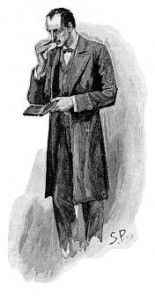
Interestingly, one of the features sometimes seen in a person at the higher end of the autism spectrum scale is a consuming and total passion for one thing. Autism can produce laser-focused interests, making a person a challenging fit for a culture that rewards constant pivots to completely different people and activities. Psychological historians believe we can thank mild forms of autism for the achievements of Mozart, Beethoven, Charles Darwin, and Lewis Carroll. And it seems to be the dominant trait of the world’s favorite sleuth, Sherlock Holmes.
Given the misplaced importance of multi-tasking across the culture, it makes sense that there is building interest in novel ideas like the self-driving car. Negotiating roads and traffic should be linear processes. But phones, google maps and searchable music files have impaired us. Focused navigating and defense driving are increasingly at odds with what have become our current trained incapacities. Soon it will probably be better to let a computer handle a task that we used to manage themselves. Distraction puts us behind our ancestors, who were often better at action. Now we must engage in reaction to deal with the continuous inundation of electronic media.
If we think we have identified a significant problem here, we probably should be humbler and note that these few words on the attributes of linear thinking illustrate the reverse. The concept deserves a book more than a short essay.