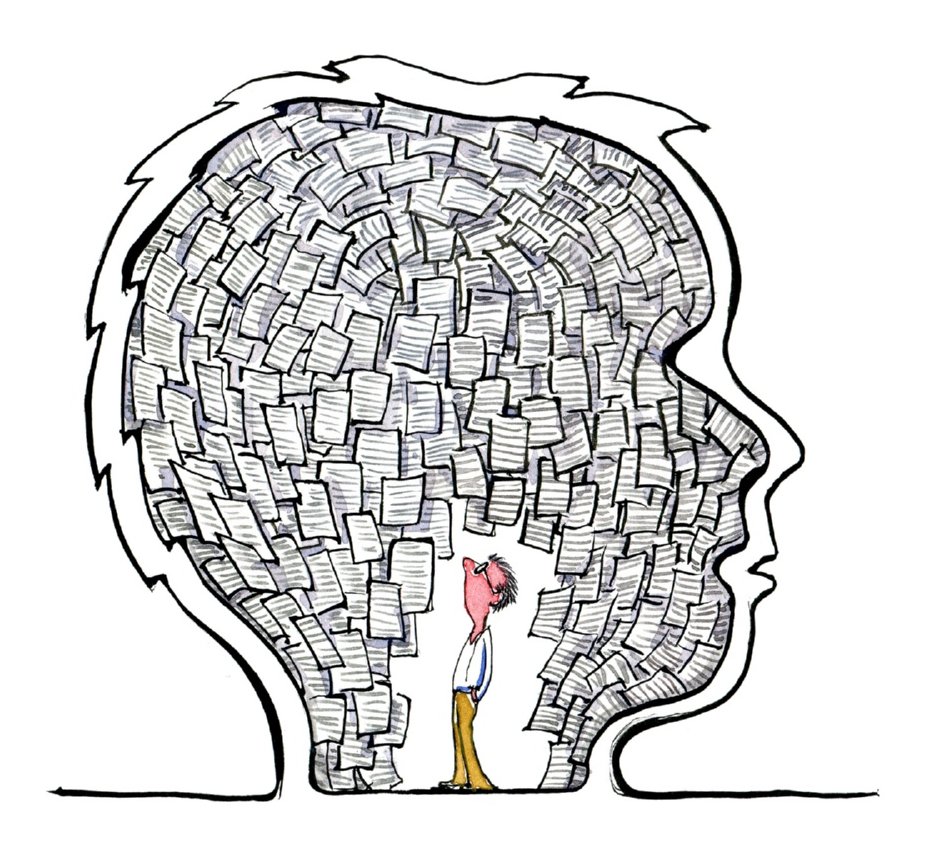
This pattern of misperception is actually so common that if all of us drove cars about as poorly as we listen to others, our roadways would be strewn with wreckage.
We all have had the experience. We are explaining a piece of our world to another, and the other person seems to be listening. But their response indicates that they have mostly missed our point. Instead of a reasonably accurate rendering of our thoughts, their comments reveal that they are projecting what they want to believe about us. For example, you may be talking about the challenges of your job, while a listener–for whatever reasons– may need to hear that you dislike your work. Or you tell them about your first visit to a novel new destination. And the most you can conclude from their response is that they need to hear that the site of the visit is overrated. At the end of such conversations we often walk away puzzled, perhaps concluding that the listener already had a mental map of us that they needed to confirm. This pattern of misperception is actually so common that if all of us drove cars as poorly as we listen to others, our roadways would be strewn with wreckage.
To be sure, we can be unclear or ambiguous. “That’s not what I meant” ranks with “hello” as a well-worn locution. But sometimes the listener has seemingly willed their own preconceptions on to our rhetoric. And it’s interesting to ponder why.
One explanation for this kind of selective perception is that conversation is mostly a process for seeking the familiar. This motive to retain what we already know is sometimes known as “motivated reasoning” or “confirmation bias,” both representing the idea that we have the urge to place incoming information in a familiar map that we have already worked out.
Beyond the obvious economy of reverting to a well-traveled neural pathway, other reasons are possible: Envy? Maybe the guilty comfort that comes with knowing that another person’s life is going less well than our own? And there’s more.
We all construct fantasy themes about others that fill in the unknown gaps of their personal biographies. In communication terms, fantasizing is not a mental health problem, but the natural result of the inductive reasoning we must do to create a more complete picture of another. Psychologists focused on social intelligence sometimes call this “theory of mind,” meaning that humans make estimates of others’ probable mental states based on the circumstantial evidence of prior experience. Add in the projection of the listener’s values onto the details of our life, and it’s easy to understand how we hear responses that can clearly puzzle us. As a general rule, any subject’s actions cannot help but be filtered through the receiver’s perceptions.
Put all of this together and we have an accumulating library of biographies with separate volumes for virtually every relative, friend, coworker and celebrity who is part of our cognitive world. As with any library, one of its rewards is the chance to revisit the familiar.
When things are off base enough you may be tempted to tell an interpreter of your own life that can you can’t recognize yourself from their descriptions. Fair enough. My guess is that we begin to offer a correctives to others by our fifth year. It’s the birthright of every person to freely assert their uniqueness, and sometimes to remind interlocuteurs that they’ve missed the point. Such is the nature of rhetoric that persons who are ostensibly mirroring our ideas may really be saying more about themselves.
When did the idea of a direct conversation with another become so problematic?
For those of us who study human communication, direct face to face conversation is usually the fundamental model for understanding all other forms. When two or more people are in the same space addressing each other, their exchanges are likely to contain all of the critical yardsticks for measuring successful interaction. These essential processes include awareness of the other, the potential for immediate and unfiltered reciprocity in an exchange, and access to all the visual and verbal feedback that comes with direct person-to-person contact. All other channels of communication—including the devices that extend the range of human connectivity—alter or diminish one or more of one of these processes. And though it may not seem like it, altering or reducing a conversational asset is a big deal.
Until the advent of widespread electric telegraphy in the 1850s direct communication with another in the same space has always anchored human communities. The very idea of a sociology of human relationships is mostly predicated on the expectation that we have direct and real-time access to each other.
Even so, the default model for understanding how we maintain our social nature is increasingly at odds with the ways we now live. What has changed most dramatically are the preferences of younger Americans who are less eager to seek out conversation as a problem-solving tool.
We are kidding ourselves if we believe the false equivalency that lets “social media” substitute for living in the social world.
The most interesting research on this subject is from Sherry Turkle at M.I.T., who has been documenting the well-known drift of the young away from direct interaction to alternate channels that enlarge connectivity but diminish communication richness (Reclaiming Conversation, 2015). The platforms are well-known, including Instagram, Facebook, Twitter and other forms. Under the misnomer of “connectivity,” changes in technology and adjustments to them are slowly schooling younger generations to prefer communication that is mediated and intentionally isolating. We are kidding ourselves if we believe the false equivalency that lets “social media” substitute for living in the social world.
Turkle notes a wholesale flight away from direct conversation and toward electronic messaging. In the words of many of her interviewees, meeting directly with someone is “risky,” “too emotional,” “an interruption,” and “anxiety producing.” As a high school senior she interviewed observed, “What’s wrong with conversation? I’ll tell you what’s wrong with conversation! It takes place in real time and you can’t control what you are going to say.”
Responses like these suggest a desire to escape the burdens of acquiring the essential rudiments of what psychologists sometimes call “social intelligence,” meaning the ability to navigate through many essential and unavoidable relationships that unfold in real time.
It has always been true that some conversations are difficult. But this kind of face-work is also the essential work of a complex adult life. As Turkle notes,
Many of the things we all struggle with in love and work can be helped by conversation. Without conversation, studies show that we are less empathic, less connected, less creative and fulfilled. We are diminished, in retreat. But to generations that grew up using their phones to text and messages, these studies may be describing losses they don't feel. They didn't grow up with a lot of face-to-face talk.
Of course there is always a risk among the old to assume that progress has been overtaken by regression. To paraphrase the Oscar Hammerstein lyric from Oklahoma!, it’s easy to believe that “things have gone about as far as they can go.” Even so, it’s worth remembering that forms of mediated communication are usually not additive, but reductive. Texts, e-mails, and even video games start with various fundamentals of communication, but almost always take something away. It may be immediacy. It may be full interactivity. But the most consequential of all is a reduced intimacy that happens when humans are not in the same space breathing the same air.