Category Archives: Problem Practices

Communication behavior or analysis that is often counter-productive

The Grammar of Hubris

verb word cloudIt’s natural that we will place ourselves and our institutions in the driver’s seat.  We assume we can be in charge because our language lets us imagine it.   

Rhetoricians like to say that language has its way with us. The phrase is meant as a reminder that everyday language steers us to conclusions that usually promise more than we as individual agents or nations can deliver.  Word choice can easily create perceptions that can make the unlikely more likely, the improbable possible, the fantasy an imagined outcome that will surely happen.  We can tie a wish to an action verb and we are off and running, creating expectations for things that probably will not materialize. Who knew that simple verbs like “is” and “will” can be phantoms of deceit?

I was reminded of this by a recent article in The Atlantic by Stephen Biddle and Jacob Shapiro. Their thesis is the title of their piece: “America Can’t Do Much About ISIS.” (April 20, 2016).  The article includes a solid analysis of the roots of ISIS in the civil wars affecting Syria and neighboring states. Their point is that internal struggles like these have to “burn out” from the inside.  This kind of civil war cycle might take nine or ten years to complete, an outcome outsiders can’t change very much.

What seems inescapable is that the rhetorical ease of committing ourselves to the control or transformation of complex political forces is too easy. That’s something we’ve come to know all too well since the Vietnam era, reconfirmed more recently in Afghanistan and Iraq. The military and social problems associated with nation-building are unforeseeable.  Substantive reasons for caution tend to get lost behind the neon glow of action verbs.

Blame our overly-deterministic language.

We construct the world as a web of causes and effects.  It’s natural that we will place ourselves and our institutions in the driver’s seat.  We assume we can be in charge because our language so easily lets us imagine it.  Blame our overly-deterministic language, along with the hubris that comes with being the world’s preeminent military power.  Both set up tight effects loops that seem clear on the page but elusive in real life.

If we put individual culprits in a lineup they all look more or less innocent: verbs like affect, make, destroy, brake, results in, causes, starts, produce, alters, stops, triggers, controls, contributes to, brings about, changes, and so on.

In the right company these can be companionable terms.  But let them loose within the rhetoric of a leader determined to make his or her mark on the public stage and they can turn lethal. This is the realm of the familiar idea of “unintended effects.”  Fantasies of power and control impose more order on human affairs than usually exists.  They depend on verbs that flatter us by making us active agents.

This is ironically aggravated by our devotion to the scientific method. As Psychologist Steven Pinker has observed, we can’t do science without buying into the view that we can identify first causes. That’s surely fine for discovering the origins of a troublesome human disease. But even though this logic is diffused through the culture, it cannot hold when we immerse ourselves in the infinite complexities of human conduct.  Discovering the reasons and motivations of others is far more difficult.  Add in entities such as nations or tribes, and first causes are often unknowable.  And so strategic calculations based on efforts to influence or control behavior are bound to produce disappointment.

It’s a great paradox that we are easily outgunned by ourselves: by the stunningly capricious nature of the human condition. Take it from someone who has spent a lifetime studying why people change their minds.  We have models, theories, tons of experimental research and good guesses.  But making predictions about any specific instance is almost always another case of hope triumphing over reality. We may be able to say what we want, giving eloquent expression to the goals we seek.  Our verbs may sing their certainty, but forces we can’t predict are going to produce their own effects.

Comments: Woodward@tcnj.edu
cropped-Perfect-Response-logo.jpg

Looking for a Paper in Baltimore

800px-Newspapers-20080928 commons wikimedia
                      Commons wikimedia

A news site online is a step back from journalism on display in a public space.

Recent work took me to a hotel on the edge of the Inner Harbor in downtown Baltimore.  Those few square miles have everything a city might want: one of the two finest aquariums in the United States, scores of restaurants and shops, classic wooden ships moored in the small rectangular harbor, and a ring of convention hotels. Just a few blocks back sits the legendary Camden Yards baseball field, just an over-the-fence shot from Babe Ruth’s birthplace.  And further up Platt St: a stunning cathedral-sized train shed full of fascinating remnants of the Civil War.

One  morning I needed a news hit beyond the chatty hosts of the morning talk shows.  And I was tired of reading headlines from my tablet, with its cramped size and its jumpy touch-screen.

What I didn’t expect was that it would be a major challenge to buy that simple artifact of the civil society, a real newspaper.

Of course it’s old news that hard copies from nation’s biggest journalistic institutions are on the way out. The thought of a newspaper subscription never comes up among my students, though some find their way to these outlets online.  According to the Pew Research Center, only a quarter of millennials show any interest in political or civic news; a fact that doesn’t bode well for the future.

 If we think an occasional glance at Gawker or CNN or Fox News will keep us in the loop, we’re badly mistaken.

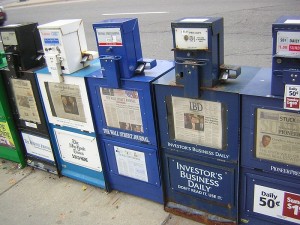
Even so, one would expect to pass street kiosks and stores still hawking hard copies of papers from the many cities in the nation’s populated northeast corridor.  After all, half of all news subscribers in the nation still read paper-only versions.  Yet on that day this vital instrument of the open society was mostly absent from the public square.

The clerk in the store on the first floor of my posh hotel didn’t flinch when she said they carried no papers.  None?  So I started a slog across the harbor plaza, passing the tall ships, the overpriced chain restaurants selling all things fried, and perhaps another fifty establishments waiting for buyers of what most of us don’t really need (i.e., a candy store the size of a supermarket).  Surely there would be a corner box selling The Baltimore Sun or USA Today, or The New York Times or perhaps the Washington Post.  No luck.  Then into a Barnes and Noble in its stunning Power House venue next to the National Aquarium.  Yet again I seemed to be striking out. Then a staffer told me to ask someone behind the check-out counter.  And, sure enough, from under a desk in a corner of the store came a copy of The Post.  Why it was hidden from public view I will never know.  I felt like a citizen of Soviet times picking up some illicit samizdat from a dissident.  Even pornography seemed to have better placement in the store.

This is all dismaying.  Access to a news site online is not the same as news displayed in the places we frequent. The front pages especially of the nation’s tabloids were always written to draw in the passerby.  Their “screamer” headlines were meant to turn recent events into news you somehow needed.  Anybody walking down a street in the 1970s or 80s got a register of the nation’s pulse even if they weren’t buying.

Seeking out these sites online against mountains of competitors is a step towards the isolation of national and local news, with the consequence of equal isolation of the civil sphere from the rest of American life. These agents of democracy obviously hang by a frayed thread, competing in a carnival of more provocative digital content. It’s no surprise digital news platforms are in financial trouble, and that newsrooms once built for sizable staffs are now some of the lonelier offices on the planet.

The deeper problem is that there are too few newspapers sitting in the driveways or front steps of homes in our neighborhoods.  If we think an occasional glance at Gawker or CNN or Fox News will keep us in the loop, we’re badly mistaken.  And at about 200 words a minute, television news reduces events to headlines rather than discursive coverage. The ubiquitous newspaper available on a city’s streets remains the much richer form of reporting, and an important marker of our connections to this culture we call our own.

Comments: woodward@tcnj.edu

Perfect Response logo