A walker’s personal space is about four feet. But a motorcyclist with a radio blasting has usually claimed most of a city block for himself.
The noise of music blasting from speakers in an open window usually ends at a college dormitory when the beer runs out. If we are lucky the same habit is not a part of an older neighbor’s routine. Music in public can be a wonderful thing, but it needs to be curated through known channels and with the blessing of the neighborhood or municipality where it will be heard.
Cases range from the alarming to the delightful. A ride on a bus or train is no guarantee that calm will prevail. There are riders who listen on headphones that leak thin and brittle noises into the space. Worse yet, a rider’s noisy boom box on the subway or city bus shows is its own weird kind of narcissism. The assumption that one’s own “entertainment” is OK for everyone ignores the diversity that exists in personal musical tastes.
In the 1930s some German towns were filled with the Nazi Party’s recorded “patriotic” music blaring from speakers tied to utility poles. Music then was simply politics through other means. Less fearsome is Disney’s habit of putting music into its outdoor park spaces in an area where there are particular movie tie-ins. The music soundtrack is essentially a scene-setting experience for what follows. As with all “escaped music,” there is really no option to avoid exposure other than sequestering oneself inside.
This inability to avoid music not intended for you is also seen near outdoor theaters. For example, there are nearly 5000 homes within earshot of the Hollywood Bowl in Los Angeles. But the site is a cultural favorite in the city. Most residents have made peace with the sounds that drift outside the valley it sits in. And some love the sound “spillage.” That’s less the case in Queens New York with concerts at the Forest Hills Stadium, which used to be the site of the U.S. Open. At the opposite end of the scale is an offer of made in Sweden to provide free cabins in the woods for anyone who will keep their noise levels down to 45 dB (the level of a quiet conversation).
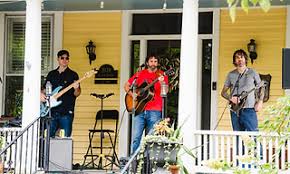 On a very different scale, my own town’s “porch concerts” are a delight. Maybe 11 or 12 groups might be playing when residents of my community of 4000 are ready to stroll down some neighboring streets to hear both the accidentally microtonal efforts of a garage band as well as real talent worth hearing. And then there are funny anomalies from all over. In Australia, some convenience stores placed speakers in their parking lots to drive away young loiterers. It’s the young listener’s loss that they will not hang around to hear the baroque music. But, of course, that’s the point.
My town also shares one of its main streets with a “scenic highway” passing through and out into the woods and fields along the upper Delaware River. The road and a parallel canal path are nice escapes. It also helps that the pedestrian-heavy town is careful to create walkways everywhere. But the problem of overwhelming noise also comes into focus there. In the summer, any number of motorcyclists use the route to escape the less pleasant roads of nearby cities. That’s their right. But a minority have found some demon retailers who has figured out that listening to audio should not be limited to an enclosed a car. Bikers with stereos blasting are annoying—perhaps a vestige of some Easy Rider fantasy. A motorcycle is usually and often intentionally loud. Google estimates a Triumph Daytona rises to 107.2 dB when accelerating, about 20 dB louder than it is safe to be around. Add on speakers and fellow riders, and you might as well be standing on an airport runway rather than a city sidewalk. It all amounts to a passing noise parade forced on anyone with a working set of ears and two good feet.
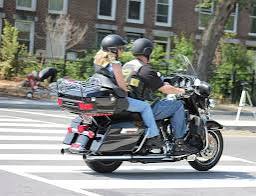 A walker’s personal space is about four feet. A biker with a radio blasting has usually claimed most of a city block for himself. Am I showing my age to be amazed at the lack of shame? I suppose men should be ready to argue about the size of their amplifiers. But I sometimes wonder if these folks may be defeated by life, inadvertently using their equipment as a pathetic stab for attention from others. Interestingly, a Reddit discussion of riding with music varies. Some bikers like “the music blasting.” Others note that they want “a peaceful ride” through the countryside. None I could find expressed any concern about intruding on anyone else’s space.
Media theorist Joshua Meyrowitz notes that our interest in some types of media create what he calls “the association factor,” meaning that others may find significance in media we have picked out to be seen or heard by others. We may not associate with a television commercial, but a person carrying a specific book or listening to music in a public place has assumed the burden of signaling who they are, at least slightly. If I carry around a hard copy of Truman Capote’s book In Cold Blood, it is a fair assumption that others will assume I’m interested in the author’s crime story. So it is with music that we carry with us that escapes. However indirectly, the association factor represents a marker about our character.
As an avid music listener I would like to be buried with my Walkman. But I will concede that the muffled sounds of music coming from a new grave might empty out a cemetery.