We seem to be bleeding out the positive energy that was sometimes the national style.
For many Americans this can seem like a season of despair. the constant din of alarming news on various platforms is wearing us out. Our politics now is fraught with controversy over the undoing of years of progress. Normal routes of trade and international cooperation have been undermined. And, as ever, gun violence continues at about 47,000 deaths a year: much higher than most other peer nations. All of this has been made worse by a president who has mostly abandoned the usual roll of ‘binding up the nation’s wounds’ with appeals to transcendent values. Instead, his ersatz rhetoric of hate punishes individuals and institutions unaccustomed to having to defend their usually laudable objectives. Add in the fact that that legacy television news is folding under the crush of MAGA and FCC threats. ABC, CBS and NBC have yielded enough to have imprints of the President’s shoelaces on their foreheads. How can a person escape this doom loop?
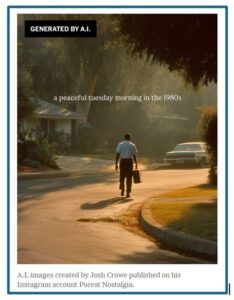
Most communities are safe, but the assurance of it is gone. No wonder people are looking to A.I. for prepackaged nostalgia for times that weren’t necessarily better, but seemed more civil.
Researchers like Harvard’s Stephen Pinker note that a look at a lot of hard data reveals our world is now safer and less violent than in previous years (The Better Angels of Our Nature, 2010). The difference is the expansion of the personal boundaries of the known made possible by news sites and social media that have penetrated and been absorbed by the culture. Clearly, Americans think they are less secure. Their perceptions of violence and disruption penetrate our mediated spaces: from school shootings to the collapse of the social or physical infrastructures of whole communities.
Through all of this it is worth remembering what “news” has become. It is now a 24/7 preoccupation for many of us. And we shift seamlessly from video news, social media, and various online sites devoted to updates and opinion. There is a transformation of attention to reporting from a one-shot glance at a newspaper or evening newscast into incessant doom scrolling throughout the day. All-news channels like CNN mostly attract an older audience and continuous viewership. This has been confirmed by research that includes the corollary that these viewers feel less safe even in their own communities.
What exacerbates the problem is the decline in the kinds of activities that generally made people feel better about themselves and others, such as attending live events, attending church services, or participating in clubs and service organizations.
If we remember that traditional news has usually included the worst things that happened on a given day, the pool of available encounters within a population of nearly 400 million is always substantial. Hence, we get Robert Putnam’s representative image of a person bowling alone to feed our sense of personal isolation. Our discomfort is also fed by the steady drone of crime as entertainment, such as the elaborately produced and popular Netflix documentaries about lethal family members.
Solutions
So if news is now ubiquitous and a heavy tax on the soul, what are the solutions? How do we become less sour and more productively engaged? Of course, expressing opposition to the authoritarian impulses of this administration is a must. But it may also make sense to follow neuroscientist and musician Daniel Levitin’s advice to seek the restorative power of music. Among other things, music can reinstate our faith in the ability of different people to come together in support of one single vision. The parts of any composition are complementary rather than competitive. It is also gateway to those parts of the brain that tap into positive feelings rather than harsher binaries of languages that ask us to pick sides. One can chose any musical form open to the non-discursive world of moods and feelings that are usually resolved in harmonic resolution. As Nietzsche noted, “Life without music would be a mistake.”
Baroque music usually lifts my spirit. It always reminds me what smart people working together can achieve. The lucky souls who have the talent to effectively enable this inventive world could be playing Bach. But they could also choose a modern classic like that selected by the Danish Girls Choir.
Some people find respite in putting digital media aside in favor of hiking, fishing, reading, or a simple game of cribbage. Modern media observers note that A.I. images of nostalgic scenes from the 90s or earlier on Instagram can do the trick. But anyone temped to find redemption through a richer experience of life can do better than find it on a cramped three-by-five device. Our politicians may be failing us. But there are still so many around us or nearby who are still on their game. Why commit to mediated experience through the filter of someone else’s political or ideological agenda?
Metals have a melting point. Zinc turns to liquid at about 800 degrees. That’s low for a metal, but an appropriate analogy for some of us who begin to get gooey at the sound of even the simplest music. Music can easily soften our hardened selves.
There are rough estimates by those who study such things that perhaps five to ten percent of the population suffers from what is sometimes called “musical anhedonia.” The “condition, if that’s the word, is the clinical term clinicians like Oliver Sacks have used to describe a person who is mostly immune to the pleasures of music.
Ironically, the condition is probably harder on avid music lovers than the people with this trait. Those of us who are “sound centric” are surely mystified by the indifference of persons who could care less about a particular concert or recording. We all know the experience, and we may wonder why someone is not capable of appreciating what is at the doorstep of their ears.
If the indifference of a person is total and across the spectrum of all musical forms or genres, it could well invoke a degree of pity, akin to the feeling we might experience if someone says that the Grand Canyon they visited was “nothing special.” What a loss to never really know a great avenue of human experience.
Can He Be Serious?
In How the Mind Works the influential psychologist, Stephen Pinker, partly reflects this vacuum of feeling. He compared music to “cheesecake:” certainly nice, but “biologically functionless. . .” That’s stunningly dismissive, and at least a little offensive. The comparison of a piece of unhealthy food with a consequential form of human expression (the most consequential?) suggests the very kind of indifference that is so puzzling about musical anhedonia. Pinker misses the impacts of the far richer domain of music, which in its ubiquitous 12-note forms may well be the world’s only universal language.
The Victorians understood what it meant to “swoon” over something. The word has gone out of favor, but was usually meant to suggest a profound emotional response within a person to someone or something: a trigger to feelings of ecstasy. Old it is. But it’s a good word, and it works for all of us who can name exactly the many pieces of music that send us to welcome arcadias. Those characteristics represent our musical melting points: triggered perhaps by a chord sequence in an old pop hit, a particular mix of voices or instruments (doubling a cello with a voice always works for me), or the “resolution” of a dark piece of classical music into a sunnier major key.
I surely saw swoons a few years ago that you can see as well in a video clip from PBS’s In Performance at the White House (seen here via YouTube). The guests were in the East Room listening to singers that meant a lot to the Obamas. When the multi-talented Usher and the band took the stage and led into the first notes of the Marvin Gaye classic, Mercy Mercy Me, the faces of the staffers and First Family in attendance lit up like a Christmas display. The audience swayed; they smiled and sang along. Some found it impossible to not move with the rhythm of Gaye’s catchy and knowing lyrics. It is a representative moment of what so many musicians and appreciators live to hear again and again. We anticipate the chance to add greater depth to our lives through auditory magic, be it from Gaye, or Taylor Swift, or Haydn, or Basie.
In The Sonic Imperative: Sound in the Age of Screens I tried to describe conventional theories about music with ordinary words, and mostly failed. Music is its own idiom: all expression and feeling, but little stipulation. It often surpasses the limited meanings possible with ordinary language. We need it to fill in the gaps between what we can verbalize and the far more inexplicable impulse to reach toward what we feel.

 Researchers like Harvard’s Stephen Pinker note that a look at a lot of hard data reveals our world is now safer and less violent than in previous years (The Better Angels of Our Nature, 2010). The difference is the expansion of the personal boundaries of the known made possible by news sites and social media that have penetrated and been absorbed by the culture. Clearly, Americans think they are less secure. Their perceptions of violence and disruption penetrate our mediated spaces: from school shootings to the collapse of the social or physical infrastructures of whole communities.
 If we remember that traditional news has usually included the worst things that happened on a given day, the pool of available encounters within a population of nearly 400 million is always substantial. Hence, we get Robert Putnam’s representative image of a person bowling alone to feed our sense of personal isolation. Our discomfort is also fed by the steady drone of crime as entertainment, such as the elaborately produced and popular Netflix documentaries about lethal family members.