
A continuous churn of disinformation now turns conventional notions of civic engagement upside down, making it wise to protect our understanding of the world as it is with more immediate connections that sustain us.
Give this thought experiment a try.
When we step back from our constant media chatter, we are better able to consider what really matters in our lives. The Trump show is an endless B-movie serial with a fool promoting rage-fueled ideas to bait the enemies he craves. There are evidently some among us who love this manufactured chaos. But most Americans dislike what he has done to deconstruct our national norms and institutions.
Perhaps one useful way to respond is to think of spaces that allow us to sustain our identity and personal sense of well-being. These virtual or actual islands we can recognize would include people who share the psycho-social spaces where we see ourselves. Geography may provide clear boundaries. In other cases the most significant description of this domain is the “noosphere,”—where people think in terms of the time-tested canons of rationality and durable understanding of what constitutes moral action. While many others can be interesting and pleasant, they may not provide evidence of the same essential views about how the world works empirically or morally. There is surely room for some plurality here, but in a country as vast as ours, there really is no alternative but to construct islands of sanity that we want for ourselves and to project to others.
I’m not talking about clinical definitions of sanity, but about the general view argued a hundred different ways by recognized philosophers and thinkers who were anchored in the real world, and who taught us how to evaluate truth claims as well as ways to evaluate qualities of personal character: figures as diverse as Aristotle, John Locke, Thomas Hobbes, and even Benjamin Franklin. Denying a tested and proven statement like “current polio vaccines work well” is a failure of these established standards, as is the threat to jail an otherwise blameless woman seeking an early abortion. Ditto for any encounter with an individual whose core choices seem alien to what a life of compassion should require. In many cases an “I believe” statement is an illogical option for a tested truth claim that requires us to yield to what is “known.”
We know many individuals who are effective in dealing with their friends, families, and career objectives. We also probably have an extended collection of “media friends” that provide their own forms of normalcy to our daily lives. True, the “para-social” nature created by one-way media cannot achieve the kind of rich interactions we have with others face to face. But most of us have pieced together an existence that has significant anchors in our town, neighborhood or particular media. All play a role in clarifying important shared values that build rather than destroy our sense of well-being. Even so, there are still too many others among us engaged in forms of magical thinking that make them unreliable communicators.
A norms-busting Donald Trump has forced us to look to other sources for clarity. His failures are always followed by some new conspiracy theory that only the witless can find plausible. The continuous churn of this disinformation turns conventional notions of civic engagement upside down, making it clear that we would be wise to protect our sensibilities about the world as it is with more grounded connections that can sustain us. Civic spaces need leaders with integrity. But with those in power at the federal level grievously lost in the weeds of fantasy, we may want to celebrate the long history of the nation in the coming days, but exclude what our current leaders have done to the republic.
Who gets to be on your island of sanity? Of course the population will be indefinite but still personally knowlable. The traditional value of a strong city or neighborhood should never be overlooked. I’d single out the black residents of Natchez, Mississippi, as seen in Suzannah Herberts’ 2025 documentary, who more clearly understand their regional history. As well, I would count the thinkers and searchers who flood the little New York town of Chautauqua every summer, or the 17th Century Quaker colonies that once dotted the landscapes of New York and New Jersey. And we can add the recognition of many others—through direct or indirect contact–who provide the character and rational judgment necessary to earn our trust.
Americans Blinded by Their Myopia
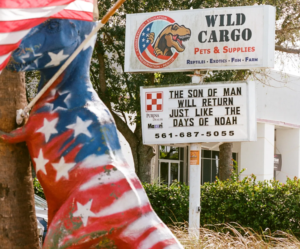 What does this necessary winnowing look like? Individual determinations will obviously vary. An example I find striking is Eliza Griswold’s description of some young American evangelicals described in a recent issue of The New Yorker. The piece quickly sets off alarms suggesting that these magical thinkers may be lost to the demands and possibilities of living in world governed by a cultivated ignorance. One 16-year-old “unschooler” working in her parents’ pet store near the corner of Gun Club Road and Military Trail in South Florida grew more alien to me as I read on. Especially in this state, how easy it is to shut down one’s own mental growth with ersatz educational standards, and then double down on the words of a Christian fundamentalist “prophet” like the recently assassinated Charlie Kirk. Not surprisingly, customers in the store get unsolicited faith-based advice on how to care for their exotic animals. Sadly, this person’s consciousness of a universe of vast possibilities will probably remain truncated.
None of this is a plea for classist exclusivity, but simply for evidence of another’s efforts to deal with the broader requirements of authentic knowledge and generous empathy.
It will always be an overstatement to see Florida as a place that harbors visions of normalcy that look more dystopian. And, to be fair, examples like this can apply to some in my community. All deserve a basic level of respect, but may not produce a feeling of kindredness that should be evident when we recognize ourselves in the words and behaviors of others.
 Our islands are probably stronger if they are physical places, such as a neighborhood or city. But natural heterogeneity in large populations may mean that they will have to be constructed through media sources that have produced what Joshua Meyrowitz describes as “media friends.” These individuals may reliably turn up on YouTube, Substack, Facebook, or scores of other affinity sites.
In the end, we give meaning and purpose to our lives by sheltering from the larger and chaotic culture, finding kinship outside of what the now- dominant political order can provide.
