Media theorist Marshall McLuhan reminded us that one medium is not easily translated into another.
Almost to the day that I finished a 600-page biography of composer John Williams, a friend sent me a copy of an article by the critic Jacques Barzun affirming the idea that music is not easily reducible to meaningful discussion. The issue is whether the stipulative qualities of ordinary language can add much to what musicians have “said” in the non-stipulative patterns of organized sound that are so attractive. Any discussion here is a thought experiment; It probes the nature of our love affair for sounds that–strictly speaking–do not “mean” any one thing.
Tim Greiving’s new book, A Composer’s Life: John Williams, is an exhaustive review of the hundreds of scores the composer produced, starting with episodic television in the 60s and carrying through to the serialized epics of Star Wars (1977), Harry Potter (2002), Jurassic Park (1993), and many other Steven Spielberg epics. Who can forget the feeling of being lifted by the climax of E.T. the Extra Terrestrial (1982), when soaring score matched a soaring Henry on a bike taking the alien back to the mother ship? In its way it was grand opera, with audiences sharing the thrill of an injustice being set right. Williams sought the same impact in scores for films like Schindler’s List (1983) and Jaws (1975).
Greiving is effective in connecting the dots of Williams life, and is especially interesting in suggesting the commercial and logistical arrangements necessary to bring an orchestral score to the screen. I’m less certain the book’s detailed discussions of various motifs or specific chord progressions adds much to the pleasure that happens when we experience them. That observation gets us back to the question at hand. Greiving’s otherwise excellent study does begin to drag in extended discussions less memorable films in mostly forgotten films.
Of course we learn something from the mostly Italian expressions passed on by the composer in a score. It means something that Williams wrote a significant amount of music with the manuscript notation of “Religioso,” especially in his big memorial set pieces like Saving Private Ryan’s Hymn to the Fallen (1998). But, in the end, notations of expression or naming the unique tonal moves of a piece may hardly matter to anyone except the musicians and avid appreciators. The key question is whether there is more to say in ordinary language. Does insight or wonder stop with the music itself, leaving our discussions as unsubstantial afterthoughts?
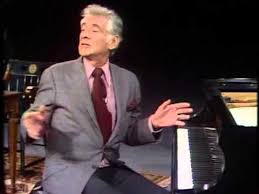 An easy answer is that words about musical form can enhance what we are hearing. Libraries of words about music can be vast and maybe compelling and revealing. That is surely what Leonared Bernstein thought in his famous 1973 Norton Lectures at Harvard. If there ever was a valiant effort to marry musical sounds with their meanings, these six lectures are it. It is no surprise that Bernstein leans heavily on what may be the slight cheat of using generative linquistics to bring its music to life. It suggests that music is just another “language:” a common but perhaps limiting metaphor that needs a harder look.
# # #
Barzun notes that some musical authorities believe that “anything you say about music, other than technical, will be silly or irrelevant.” Media theorist Marshall McLuhan similarly reminded us, one medium is not easily translated into another. The problem is when we begin to think of various forms of exchange as simple “carriers” of meaning. The metaphor suggests that content and the vehicle that carries it are distinct and easily separated. This is often how we think about language. But while It may help to learn about classical music’s Sonata form or the A-A-B-A structure of a lot of pop music, full appreciation hardly depends on knowing these patterns. And we are not going to get far by falling back onto the overworked and false dualism that music is a form of feeling separate from rationality. But speaking phenomenologically, these effects involve the whole individual. Music marries the two.
In this regard, Barzan hints of an insight that he dismisses too soon. In passing, he reminds us that some people have what is called “synesthesia,” or the perception of a particular color tied to a note or sound. Indeed, spin out this idea to its more general application and we have real translation that converts or compliments music as experience. Most of us have sense-experiences that we tie to particular songs or scores we know well. Barzan is surely right to note that “Whatever the cause, the tie between inarticulate sounds and bodily states [that we can verbalize] is a fact of experience.” This is clearly written on the faces of pop singer Laufey’s stageside audiences as as with listeners of the “affirmation of life” last movement of Gustav Mahler’s 5th Symphony. Surely it is natural to use favored images or experiences as touchstones for our enthusiasms.
And a final caveat. Since experience is processed mostly using the reservoir of a person’s available language, it may well be that we lack the kind of descriptive terminology that would do more justice to an attempt at rich translation. Might a sophisticated discussion of any work needs a better terminology than is usually available to a person who thinks and speaks in mostly one idiom? This is in addition to the reminder that turning music’s open-ended form into any stipulative language is bound to have limitations.