We speak. We write. We create works of art. All the while, we try to have confidence that the effects we intended will register with audiences. If it were only so.
In theory, communication looks so straightforward. When we address others we pass on what we assume are clear ideas with unambiguous meanings. We want to have confidence that the effects we intended will actually register.
Its not so easy. Shared meaning as a requisite of clear understanding is harder to achieve than we imagine. It turns out that we aren’t very good at transferring even simple information or individual preferences to others. Consider a simple case. A Huffington Post reporter noted that a Spanish language version of the President’s recent State of the Union Address missed a lot. In one case, where Obama used the phrase “I couldn’t be prouder of them,” the Spanish translation was, more or less, “I couldn’t feel masses proud of it.” It was a simple mistake, but anyone converting one language to another knows that perfect equivalency is illusive. All communication is translation. Even when the language remains the same, there is always an interpretive function which requires that the words pass through the filter of our experiences.
This doesn’t mean that we are always in a solipsistic fog. Some statements are relatively obvious and can produce a quick consensus. “Turn right” is not a vague command, but it can be ambiguous if the sender and receiver are facing each other. Similarly, statements like “He failed algebra in high school” or “She dislikes liver and onions” are mostly concrete and stipulative: two features shared with most kinds of mathematical statements. In math, common agreement about basic terms leaves little room for confusion. Yet, even moving to the slightly more complex task of naming simple objects can be problematic, especially if it’s the case that my idea of a “camera” is one that uses film and yours is the digital device in your phone.
These simple challenges with individual words are heightened when we scale up to the meanings of cultural products like a speeches, songs or movies. At this level the hope for uniformity of meaning pretty much goes out the window. For example, ask someone what songs on their music player, and you will get a list of favorites that are likely to be more personal than communal. What means so much to one enthusiast is often unlistenable to another. Young adults are especially tuned to hit the scorn button when they hear the favorites of older family members. I can still see my parents brace themselves for the inevitable taunt if I passed nearby when they were listening to completely uncool music. Similarly, in the presence of my favorites our children return the favor with polite silence. (Who could not love jazz played on steel drums?)
Finding widespread agreement on the significance of films is even harder. Many of us find it difficult to predict what a friend or family member will like. What seems so insightful to us can make no sense to others. Seeing someone’s growing puzzlement as you rhapsodize about a terrific performance can make the idea of “shared meaning” seem like an oxymoron.
The villain here is not just the tricky business of producing concurrent meaning. There is also an additional problem in the specific word that we often use when someone surprises us by their unexpected reaction to an apparently clear message. We often say that they didn’t get it: that they “misunderstood.” But notice what “misunderstood” implies about perspective. It suggests that the initial communicator gets to be the arbiter in deciding the authentic translation of an idea or thought. That sometimes makes sense. After all, it usually is their thought. But as an idea with a pretense to truth-testing, the judgment embedded in the word converts what is often a simple difference into an error. “Misunderstood” gives one side a free pass by putting the burden of a “mistake” on the other.
All of this should serve as simple reminder that meaning is naturally variable. Thankfully, dictionaries usually don’t get to have the last word. We are entitled to apply our experience to what we know and like. That we can’t predict with certainty how a person will receive our rhetoric is evidence that we have sensibilities which are different, but not necessarily deficient.
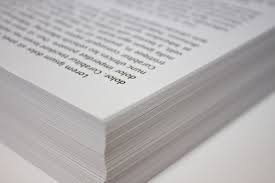
It’s a medium with many virtues we tend to overlook: low cost, portability, and compact storage of text, images and data.
Although the precise origins of paper are hard to identify, some authorities place it in China about 105 AD. Plant fibers gathered and poured into a water bath were spread and carefully removed by a screen underneath, leaving a thin layer of material that could be dried so it would accept paint or ink. Papermaking eventually migrated to Egypt and Iraq, and then to Europe. “Paper” made in what is now Egypt was usually produced from papyrus or parchment (an animal skin), the only tools for capturing language recognized in the Koran.
While Egyptian papyrus (from which the word “paper” evolved) was initially the preferred material, it required more resources and woodworking skill than was practicable elsewhere. Eventually, near the end of 780s dried fibers of fabric became the dominant ingredient, partly because it was less susceptible to forgeries than all the other alternatives, and because it could more easily be sized with oils made from animal by-products. Sizing produced a smooth surface able to hold ink.
This and much more is told in Lothar Müller’s new book, White Magic: The Age of Paper (Polity Press, 2014). He notes that even before the invention of the printing press in 1450 there was a steady stream of written material made by copyists, as well as “printers” using ink transfers from individual wood blocks. Hand copied books were numerous, along with items such as block-printed playing cards with monarchs painted on their surfaces. In the 14th Century it appears that nearly everybody played cards.
Arguably the most potent effect of the ability to make paper was not necessarily the book, but the ledger and the formal contract. Spain as the center of Phillip II’s empire is given credit (or maybe it should be blame) for creating one of the first paper-based bureaucracies. Decrees, written petitions, contracts and files were committed to the page. Still made from rag fibers until higher demand would require the substitution of wood pulp, paper made possible major advances that are frequently still used: the keeping of governmental and business ledgers, the practice of double bookkeeping, and the increasing use of correspondence by mail. In the latter case, a chain of effects followed wider access to postal systems, triggering the development of better roads and predictable timetables.
All of these advances are based on a medium with virtues we tend to overlook: low cost, portability, and compact storage of text, images and data. These conditions were the essential prelude to the printed book, which was made possible especially in the West because of the ease of creating standardized type based on the small Latin alphabet.
Not surprisingly, print formalized the idea of authorship, turning writers into long-form storytellers, and readers into linear thinkers. The availability of paper from mills sprouting up everywhere contributed to the flowering the enlightenment and, later, distribution of scientific research based on the premise of world-wide peer-review.
Müller’s study of paper and the book notes that the story of these media is not over. Paper gives history a durable record not yet equaled by digital files. He also reminds us that books are things. They can be owned, passed on, or resold. Many of us still draw satisfaction from their visible and tactile presence. By contrast, the electronic version is more accurately described as a licensed product. As such, it’s not quite the object for independent use that is a defining feature of its enduring paper counterpart.