Opinions without amplification: the problem is the equivalent of a trial where a judge only wants to hear opening statements.
We have opinions and we like to express them. We also have what we like to think of as reasoned positions, and we sometimes like to explain those at well. But anyone immersed in the stew of cable news these days is likely to see more of the first and less of the second: opinion-giving devoid of good reasons. For example, we are knee deep in arguments on health care reform. If a person expresses faith in a single-payer system built out from the expansion of Medicare–a common proposal–we need to hear their reasons. If given the chance they might add that it would have lower administrative costs, works reasonably well in Canada and elsewhere, and would simplify the administrative mess we now have. The problem is that our broadcast media give capable experts too little time to explain how such a system would work.
The topics happen to be political. But like aging divas in some old Broadway revival, none of the program hosts will not move from under the key light at the center of the stage.
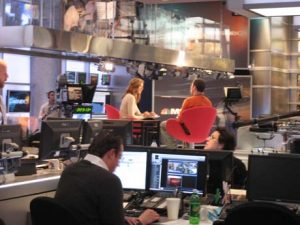
One of our cable news networks, MSNBC, favors hosts who are almost always reluctant to allow guests even a New York minute to elaborate on a point of view. Chris Matthews (Hardball) is the worst at sharing time, shutting down sometimes thoughtful guests by asking long questions he then proceeds to answer. Others on the network are inflicted with the same need to dominate, sometimes even Rachel Maddow. To be sure, the gifted Maddow is less guest-centric and almost always up to the task of defending her reasons. But the overall impression is of a network that has turned their evening news lineup into a series of “shows” based on “branded” celebrities. (For the record, we should have news “programs,” not “shows.” A “program” suggests at least the possibility of unscripted discussion.) The topics happen to be political. But like aging divas in some old Broadway revival, none of the program hosts will not move from under the key light at the center of the stage.
CNN is slightly less star struck. Their on-air journalists, including Erin Burnett, Anderson Cooper and Wolf Blitzer are able listeners and sometimes sharp questioners. CNN’s problem is that they have decided to add large panels of “experts” to comment on what is always “breaking News.” The pattern means there are as many as eight observers: party hacks and surrogates for the President, and sometimes a few people with real insight into governmental affairs (for example, David Gergen and David Axelrod.) But no guest is given more than a few seconds to make a point. Opinions, but too little amplification: the problem is equivalent to a court trial where a judge only wants to hear opening statements, but not supporting testifiers.
Older research put the average television news soundbite coming from an expert at about eight seconds, hardly enough time for anyone to clear their throats, let alone explain the intricacies of a policy proposal. Even in the expanded cable and streaming universe, the number does not seem to have grown. The guests are often decoration to add legitimacy to the proceedings, or to fill in important but minor holes of infrequent silence.
This matters because a true reasoned argument is a claim (assertion) and it’s good reasons. A claim alone is not enough. It’s intellectually crippling to only state assertions: the equivalent of trying to have a public debate via Twitter. All of this is made more poignant by the fact that true discursive media–the New York Times and Atlantics of the world–struggle to hold on to their readers. It seems that many Americans are too busy or distracted to remain engaged long enough to get full explanations. Instead, they get less about more, creating what political scientist Robert Entman once described as a “democracy without citizens.”
The eye has now fully extended its dominance over the ear, occasionally with interesting results.
The idea that some people are “visual learners” is an old one. But this observation has special relevance in our age where more media content comes to us in packages meant to be seen as much as read. What this means in its simplest form is that to see is to know. We understand something as meaningful if it comes to us as an image or in a visual frame. For example, there is new research that indicates that anti-smoking warnings on cigarette packages that include graphic pictures slightly increases the willingness of smokers to quit.
There are obvious and sometimes crippling disadvantages to the idea visual knowledge. Pictures are usually poor at capturing ideas: one reason that local television news often lives up to the dismissive phrase of a “vast wasteland.” “If it bleeds it leads” is the old phrase that suggests the narrow focus. But for the moment let’s be more positive. As various visual theorists have reminded us, “presentational media” have the advantage of no “access code.” We don’t have to be literate to understand feelings and impressions given off by photographs or images.
Appropriation of a visual meme can equal stealing a sacred text.
Television as a pervasive daily presence has certainly played its part in making us ocular-centric. This shift dates from the 1950s, when it became a household necessity. The new screen in the living room meant that family life would be changed forever. A second milestone in moving toward the visual was the consequential decision by Apple’s Steve Jobs to borrow (steal?) a Xerox research lab’s idea to use graphical interfaces for computers: what we know as the colorful icons and “windows” that present web content with store-window vividness. Add in video recording, DVD’s and easy-to-use cameras, and the transition to visual formatting of content was complete. Especially for younger Americans, the eye has fully extended its dominance over the ear, to the extent that people will sometimes accept bad sound even while they watch super high definition video images. It’s no surprise that the recent Pepsi ad campaign trading on the images of protest looked bad to so many people. Appropriation of a visual meme can equal stealing and co-opting a sacred text.
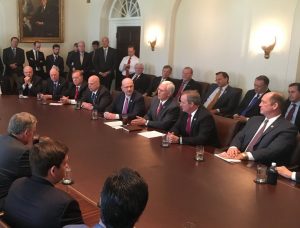
People with good visual acuity can sometimes see what the rest of us might miss. That was surely the case with many readers of a 2017New York Times column where Jill Filipovic asked us to take a closer look at a recent White House photo of a meeting of the “Freedom Caucus” members of the House of Representatives. Vice President Pence posted the photo (above), proudly noting that deliberations were underway to replace the Affordable Care Act. No woman appeared in the photograph. What Pence saw as a fitting representation of orderly deliberation Filipovic understood as a representation of unabashed sexism:
For liberals, the photo seemed like an inadvertent insight into the current Republican psyche: Powerful men plotting to leave vulnerable women up a creek, so ensconced in their misogynistic world that they don't even notice the bad optics (not to mention the irony of the "pro-life" party making it harder for women to afford to have babies).
Filipovic went on to argue that that this male power play and its image was evidence of a powerful misogynistic streak. And we can only applaud her ability to see what some of us otherwise might not have noticed. Reproductive issues are only some of many other concerns that uniquely affect a woman’s health. White and well-heeled men have been occupying dominant decision-making roles for so long that we may not “see” the gender majority excluded from the room. Thanks to her sense of visual acuity, the group’s decision-makingmonopoly and hypocrisy looks even worse.