“Making a few comments” in the spur of the moment is right up there in the pantheon of nightmares with snake handling.
Among communication skills, the ability to create an interesting and coherent message ‘on the fly’ varies greatly from person to person. In jazz, a “riff” is phrase or entire solo, usually made up on the spot. In public speaking the same kind of moment may be called an “impromptu speech,” which is its own category in oratorical competitions. In a theater or club we know the same kinds of instant exchanges as improvisations. Some actors are great at it. Others need a script to find their way. But there can be no doubt that skill at improvisation is a significant gift for a musician or actor. One of the high points of Damien Chazelle’s La La Land (2016) is a tryout where an actress is asked to tell any story. The riff that results is the poignant song “Audition,” a tale about her Aunt’s years in Paris, and a turning point in her life.
I once knew an academic colleague whose role required a lot of introductory comments for speakers and panels. He was confident he could produce insights on demand. But what usually came out was a stew of badly mismatched ingredients. “Winging it” was not his strength, and made worse by his tendency to lose track of the time. I’ve also known another academic who spoke as if he were reading prose polished on a diamond lathe. No syllable was out of place. He was mesmerizing, and also the source of more than a little envy.
Jazz gets its energy from the creative riffs of its performers; public speaking gets it’s notorious dread from the same requirement. “Making a few comments” in the spur of the moment is right up there in the pantheon of nightmares with snake handling.
Don’t memorize your comments. We now expect that a public presentation is a form of “heightened conversation.”
Interestingly, ancient orators were not that different. Preparing for the moment of delivery was something to stew over. But their solution was to memorize their remarks. Any figure in Greece or Rome with aspirations in civil affairs needed to be able to commit long speeches to memory. Words and their effects mattered that much.
But memory is now considered “the lost canon” of rhetoric. We no longer teach it. And some of us suspect that our toasters probably have more RAM memory than we possess. In addition, most of us are not very interesting when reciting ideas that have been over-rehearsed. Think of a poem from 7th grade whose meaning has been drained away because it was learned by rote. Those who are especially good at this kind of thing we call “actors.”
The trick is to split the difference. Think about what you want to say at an event where you will be called up. Take and use few notes (never a manuscript). Don’t memorize your comments. We now expect that a public presentation is a form of “heightened conversation.” A few non-fluencies that creep into our remarks will not matter, if the trade-off is the impression that we are thinking about what we are saying as we say it.
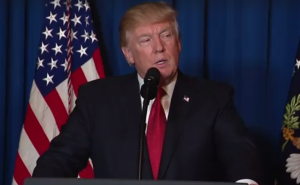
Listening to the President issue his bellicose threat against North Korea made people around the world wonder: why now?
Early in their college careers students of rhetoric are introduced to the enduring idea that a leader’s public remarks are shaped by some kind of precipitating event. As the University of Wisconsin’s Lloyd Bitzer noted decades ago, public figures respond when they believe their words will answer a problem, bending it’s trajectory in ways the speaker imagines will be positive. In the short version of the idea, rhetoric is a response to an “exigency.” It doesn’t exist in a vacuum; it’s almost always a piece of a larger conversation provoked by a significant event. George W. Bush was slow to react to Hurricane Katrina, taking a lot of heat for the delay. He was better in assuring Americans after 9/11.
This simple notion that has not gone unchallenged, but it is also more than an empty academic term. It rewards us by asking that any comment be set in the context of immediate past events, not just as an isolated island of thought. When a president or public official speaks, we expect that there are clear reasons–significant antecedents–for steering our attention toward certain issues. The theory goes on to note that in significant ways the antecedents will govern the response. The glaring lateness of Donald Trump’s denunciation of white hate groups last Sunday is a violation of the principle. But his tone deafness on key events always been one of his problems. His comments are too little too late or too much too soon.
Of course Pyongyang is always making threats, but nothing coming from them seemed to warrant an out-of-the-blue threat to engage them and the world in a potentially catastrophic nuclear exchange.
Listening to the President issue his bellicose threat against North Korea on August 7 made people around the world wonder: why now? At the time he was in the midst of a meeting on the nation’s opioid crisis, and yet the warlike language on North Korea is how he unburdened himself when reporters were ushered into the room:
North Korea best not make any more threats to the United States. They will be met with fire and fury like the world has never seen. [Kim Jong-un] has been very threatening beyond a normal state and as I said they will be met with fire and fury and frankly power the likes of which this world has never seen before.
Apparently only after his comments did we learn that the North Koreans blustered that they were looking at options for attacking Guam, some 1800 miles away. Of course Pyongyang is always making threats, but nothing coming from them seemed to warrant the President’s out-of-the-blue challenge to engage them and the world in a potentially catastrophic nuclear exchange.
This was troubling because the sabre-rattling affair would make more sense if the exigency for his words was after North Korea’s threat. But no. Trump commented first on a Tuesday of last week. The North Korean’s comment came on Wednesday. In the short term, the larger exigency resided with the Koreans.
It is so like Donald Trump to make inaccurate and combative comments for reasons that only he understands. Too often his reference points are still the former president and Ms. Clinton. In his rhetorical wanderings he often seems like a befuddled fisherman casting a line miles from the closest stream. In this case he did have legitimate bragging rights after the unanimous United Nation’s vote to increase sanctions against the North. Any other President would have used the occasion to build off this diplomatic success. But on the sanctions he was mostly silent.
In this strange pattern there is a lesson in how much we are hardwired to place the flow of a person’s ideas in a larger frame of reference. Meaningful rhetoric is almost always a moment in a river of known events.
Exigency theory explains how we arrive at attributions of other people’s motives. We naturally search for the antecedents that seem to trigger strong reactions in individuals. There is a form to these things. We expect to be able to identify contributing factors for a significant presidential statement. This feeds into the dialogical form that is second nature to us. We mentally ‘build out’ from a person’s words to make conclusions about what likely gave rise to them. When we ask questions like “why did Mary say that?” we are looking for the triggering exigency. When we can’t find one, we worry that we are missing something important, or that the speaker has a chaotic mind that has drifted into magical thinking.