Rarely has a writer so economically represented the forces that act on the mind.
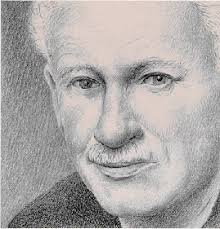
Kenneth Burke was a rhetorician, poet and public scholar. The New Jersey resident had a keen sense of the centrality of language to human thought, making him what W. H. Auden described as “unquestionably the most brilliant and suggestive critic now writing in America.” (1941). To this day the pull of his ideas is still immense.
Cognitive psychologists remind us that consciousness arises from language. Burke went much further. For him, language isn’t the residue of some other experience, it frequently is the experience. If we ask what it means to live as sentient creatures, Burke’s compelling answer is that we are driven by labels used by and applied to us. We live is a sea of verbal constructions. In his words, as laid out in the third clause of his “definition of man,” language is the “instrument of our own making” that separates us from our natural condition. And so it goes in Burke’s evocative five part “definition.” We live the most meaningful parts of our lives in the symbolic world.
This is how he expressed his perspective in Language as Symbolic Action (University of California Press, 1966), 16.
1.Man is the symbol-using (symbol-making, symbol- misusing) animal,
2. Inventor of the negative (or moralized by the negative),
3. Separated from his natural condition by instruments of his own making,
4. Goaded by the spirit of hierarchy (or moved by the sense of order),
5. And rotten with perfection.
 There is a lifetime of exploration contained in these five defining features, and even a journal devoted to this prodigious thinker.
Other animals communicate. But they communicate in signs. We connect using a broad mixture of signs and inherited symbols. If you don’t speak Norwegian, the language will be a mystery. Of course, a Norwegian stop sign can still be understood, as can most Norwegian faces. But the linguistic universe that permeates the culture offers few visual clues about what they mean. And since symbol making is a constant human project in any culture, the words we choose are existential. Stories, tracts, reports and conversations define the common boundaries of our world. Think of the descriptors that others have used about you and how deeply some of them have burned into your memory.

Behaviorists in his day sought to de-emphasize what Burke saw as obvious: that symbolic action is the representative human gesture.
The great threshold of language is why schools are structured to advance students mostly on their literacy skills. Language is the gateway to experience. Language shapes perception.
In his first clause Burke was pushing back against the reduction of human “behavior” to what can be physically observed. That was the fools-errand of the behaviorists in his day who sought to de-emphasize the obvious: that symbolic action is the representative human gesture.
The second clause adds a wonderful insight. We are not only symbol-makers and users, but the very act of expression through language makes possible a cognitive life that includes what is not or what should not be. We are the inventors of the negative. Language allows the construction of the past and predictions about the future. It makes it possible to imagine worlds present and missing. Most dramatically, consciousness of the negative means that we are alone in the natural world as creatures who can imagine their past and future. Bless their hearts, our pets live in the present. But our use of language as a tool of consciousness means that we carry the heavier baggage of knowing we have a finite life.
It is a keystone of ordinary language that it does more than name. It often judges as well. And so any practical understanding of our communication essence must include the rhetoric is infused with terms of judgement: words that praise and blame, words that suggest who is up and who is down. Ordinary language is hierarchical in ways that the languages of mathematics or programming almost never are. It would be odd, indeed, if a person “liked” the number 2 more than the number 4. Mathematical terms do not have what rhetoricians call “tendency.” Mathematical terms say nothing about their user’s feelings and attitudes. But my reference to someone I know as a “jerk” or “windbag” represents a hierarchy of preferences that I carry with me. As a symbol-user I cannot avoid marking my attitudes in word choices. Our personal rhetoric leaves impressions as clear as footprints in fresh snow.
As to the odd coda, “rotten with perfection.” The resources of language are equally available to enlighten or deceive, help us ‘know’ or distract us from ‘knowing.’ Our miraculous capacity for language gives us all of the tools we need to be disingenuous. And some of us are far too good at it.