The presence of a powerful organizing principle can fuel a lifetime of exploration.

These days our heads mostly in the material world. We spend a lot of time managing our things. But there are rewards for anyone willing to explore a system of ideas that can shine light on generative human impulses. Many of us can recall a transformative moment when the lights of understanding suddenly grew brighter: when so much of the strangeness of the world yielded to understandings that made sense. In most cases the trigger is usually some sort of panoramic explanation of social or physical phenomena. Anyone can cite some famous benchmarks that lead to profound insights: perhaps relativity theory, or a discovery as revolutionary as Louis Pasteur’s germ theory of disease, or the grounding assumption of sociology that individuals are best understood within communities.
Even so, while we still pay lip service to “the life of the mind,” it is hard to use that phrase in mixed company without producing some half-smiles hiding disbelief. “How quaint” might be the response of our friends, if they had less tact. Peter Bogdanovich’s What’s Up Doc (1972) perfectly captures the common stereotype of a socially inept and forgetful academic totally absorbed in the labyrinth of his or her own theory. The academic is presented as at least a century too late for the world he inhabits. In our time large epistemic questions have been replaced even in academia with more mundane “hard skills” that suggest the more modest aspirations of a trade school: Will this skill set make me employable? How will this course look on a resume?
We usually allow religious believers their one big idea—that Jesus was the son of God, or Joseph Smith was a latter-day prophet—but academics buoyed by a single system of thought are now apt to be seen as lost in a box canyon with no exit. As an undergraduate I remember a very good professor enthused by the ideas of General Semantics, among them: that misunderstandings can be disentangled once and for all. The idea that was popular in the 60s proposed that we can actually fix the natural ambiguities of meaning: a view that no longer carries much weight with people studying natural languages. But I still think about how he lit up when he talked about this vision.

Good ideas can help us put a lot of puzzle pieces in the right places.
As a 25-year-old I was captured by the writings of sociologist Erving Goffman and the literary critic, Kenneth Burke: two men working in two very different traditions who shared the view that human action is best understood with reference to the language of the theater. We are “actors,” “playing roles,” managing performances,” “learning scripts,” and so on. There’s more to this “dramatistic” perspective, but you get the idea. For me, it put a lot of puzzle pieces in the right places, and it is a catechism of analysis I still excitedly pass on to my students. I’m probably the typical case of an academic acolyte, more animated by the possibilities of a single system than the comparatively pale subjects of everyday conversation.
I would hope every student could go through this kind of ‘secular conversion.’ It fires the passion to see beyond a limited horizon.
The idea of creating a future around a core organizing principle sprang to mind while reading Tara Westover’s best-selling memoir, Educated (2018). She describes harrowing years trying to outgrow the low horizons of her survivalist family in Idaho. Westover lived a nearly feral existence where events and ideas like the Holocaust or the civil rights movement were total unknowns. Because her father was imprisoned by a fringe interpretation of his Mormon faith, the much larger world of books, schools and civil society were kept at a distance. Survivalists tend to thrive on these self-made islands of reductionism. His only big idea was that divine guidance interpreted through him would sustain his large and unruly family.
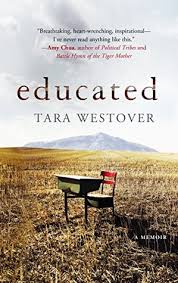 Westover goes on to describe her unlikely journey into the life of the mind, eventually winning a graduate degree in History from the University of Cambridge. What revelations she must have discovered in that journey! Unfortunately, we never really given a sustained glimpse of what they are. Her story fades when it slights topics that fueled her ambition. It’s not the same kind of memoir of ideas given to us years ago in Robert Pirsig’s popular Zen and the Art of Motorcycle Maintenance. (1974).
By contrast, her father’s big idea remains static and sealed off from development. He begged her to quit the university even after she showed real academic promise
Faith can take take that route to a dead-end. As a form of thought it can protect its owner from new experiences and better understandings. And that’s a problem for all of us. Faiths can thrive on small ideas, dangerous ideas, false ideas and beliefs that disenfranchise. They can poison what might otherwise grow.
So there’s the rub. Ideas can justify a kind of smug stasis. But more dynamic starting points can be paths to understanding and innovation.