The present moment has created more self-isolation than most would like. We know what it means to be alone with one’s own thoughts. Chatter with others may be in short supply. But our consciousness can easily take the chatter inside. We may share a common culture and lineage, and we can build bridges to each other, but can our reservoirs of self-reflection ever be made transparent?
Climate scientists warn that it will be just decades until areas of South Florida will become a watery archipelago. The level of the sea rises about one inch a year in Miami Beach, inundating streets that some residents continue to believe are flooded by water main breaks. Even in denial, those residents must sense that a chain of islands makes continuous connection with the rest of the community an insurmountable problem.
Interestingly, communication scholar John Durham Peters makes the same observation about human communication (Speaking Into the Air, 1999). We are, he says, our own islands of consciousness, forever separated from others. We may share the same culture, but we can never fully know another person’s world.
All of this is Peters’ way of reminding us that we have oversold our abilities to make things right through communication. He notes that problems of connecting with others are “fundamentally intractable.” Our attempts at doing so creates a “registry of modern longings” that can never be satisfied. Disappointment is a natural part of the effort. As Peters notes:
Our sensations and feelings are, physiologically speaking, uniquely our own. My nerve endings terminate in my own brain, not yours. No central exchange exists where I can patch my sensory inputs into yours, nor is there any “wireless” contact through which to transmit my experience of the world to you. . . . In this view, humans are hardwired by the privacy of experience to have communication problems.
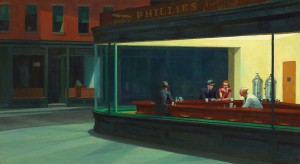
Of course the theme of humans physically together and psychologically apart is universal, reflected in everything from Edward Hopper’s lone figures in the painting, Nighthawks (1942), to virtually any film or play that treats individuals and relationships in all of their complexities. The tensions inherent in coupling and adapting are shot through most country ditties about loneliness as frequently as recurring film narratives of abandonment.
This perspective only seems pessimistic if we believe in a kind of communication that is so stipulative or stripped of complexity as to be uninteresting. I can say with great accuracy that the Ketchup in our household is in the refrigerator, and know I can be understood. But who cares? The things that usually matter–feelings, values, aspirations and needs–all hide more easily out of sight. Could it be otherwise when we engage with other living souls with different life histories, memories, fantasies and fears?
Another part of our common over-optimism about communication is that advances in technologies are themselves reasons to mitigate communication confusion. Our devices make it possible to talk or text through every waking hour. But, if anything, opportunities for sending and receiving messages only increase the chances to see the differences between us that remain.
The trick here is to accept the challenges that human complexity creates, without descending into the view that the outside world is mostly a mental mirage. To fall into that trap is to deny the chances that are still possible when words, images and music make sometimes durable bridges to others.




 Words and music that found their way to the ear always held me in their grip, like the weekend nights spent listening to KOA radio’s live bands from Denver’s old Elitch Gardens. It had to be KOA, the 50,000-watt giant with a tower and building that stood majestic and completely alone out on the flat prairie. At night and under a cloudless sky, it was an Art Deco apparition of glowing amber windows next to its broadcast tower. Lore has it that the fountain in front was also cooling water that circulated through the bowels of the building to keep the huge transmitters from overheating. Fact was then stranger than fiction to know that the high voltage equipment inside came into its own at dusk, sending its clear-channel electrons deep into six other states.