Are we a nation that is still addressable as a society that coheres?
Since the early democracies in Sicily a person or group with specific persuasive goals has been said to be locked in to the requirement to formulate messages that build on community attitudes. This idea is a central canon in communication studies. For most scholars in the field, the study of public persuasion would be unmanageable without this convenient notion. We understand an audience to be the generative source of successful persuasion attempts. It’s from their views that a persuader fashions ways to connect with them.
Yet this basic assumption is increasingly problematic. We still lean heavily on the belief that we can lump individuals together in cohesive groups with demographic and lifestyle similarities (age, sex, income, region of residence, and so on). Traditional media outlets such as television networks often “sell” their audiences to advertisers based on some of these features. And virtually every music, film and television producer is convinced they know their “market.” Even so, the concept of the audience rarely works as well in fact as it does in theory. In their study of The Mass Audience, James Webster and Patricia Phalen remind us that “audiences are not naturally occurring ‘facts,’ but social creations. In that sense, they are what we make them” (p. xiii).
There are two problems with this core idea the audience. One is that with the proliferation of “new” media choices contained in the Internet as a gateway supporting many “platforms.” In this environment audiences turn out to be neither uniform nor very predictable. Even the motives of those who self-select themselves into the same group can be surprisingly diverse. For example, it would be risky to infer much about the audience for content on Snapchat or any of the thousands of sites that stream video and audio content for free. Even analysts at The Nielsen Company—the nation’s most visible audience research firm—would concede that it’s extremely difficult to come up with reliable metrics especially for “one-off” events.
The second problem is even more daunting. The structural changes in our newly dominant media make individual usage far more scattered and fragmented. Aristotle wrote one of the first studies of human communication (The Rhetoric, circa 335 BC) with an eye on the challenges of addressing a few hundred citizens within a small city. Today, by contrast, audiences are sometimes defined in the millions, with messages delivered to them on a host of platforms that increasingly muddle the question of what makes a message “public” or “private.” We may still assume that most men do not read Cosmopolitan or Vogue. But beyond recording “hits” to a site, even popular message aggregators like the Daily Beast or similar news sites cannot be easily defined by their audiences. The impact of their customizable messaging is difficult to access.
Consider just two snapshots of current media use:
Digital devices of various sorts get about ten times more attention than newspapers and magazines. Most of these devices are accessing the web, where the average time spent on a single page is under a minute.
Among American teens who will shape future discourse, texting has become a time-consuming preoccupation, with an average of 60 separate messages a day, and 6-hours at social media sites over the same 24 hours.
Usage patterns like these hint at the paradoxes about the nature of modern discourse. Does our dependence on digital devices borne from imagistic platforms (graphical interfaces loaded into virtually all digital devices) disallow the kind of thinking about uniform attitudes that is thought to be needed for message development? Put another way, if modern life now proceeds as continuous exposure to a series of visual riffs in broad-based and space-restricted media such as U-tube or Google Plus+, is there any chance to create a series of appeals that speak to the needs of their heterogeneous users?
Is the fraying of our faith in a true national community one of the prices we will pay for the fragmentation of our media?
Beyond our love of shopping malls, mass market films and television, do we share anything like the common civic culture that was easier to see in the pre-digital age?
When Americans witnessed the first moon landing in 1969 there were just three national television networks that made up what some media historians have called “the national hearth.” Together they had a 93 share, representing about half of the nation’s total population.1 Are there still universal values and ideals that define our national life? In classical terms, is the collective polis still addressable as a common unit?
Some social theorists have noted that we are less a “melting pot” that blends away our differences than a culture that more or less accommodates them. If that is the case, the older idea of an audience sharing the same property of a common culture may be simply a fiction of media and communication disciplines. Should that turn out to be even partially true, we need to ask what a viable alternative model of communication that is not based on assessing audience-oriented appeals looks like. There is growing evidence that we already see the withering effects of undirected communication: for example, rhetorical bomb-throwing for its momentary thrills. “Trolling” in the “comments” section of news site is just one symptom.
All of these concerns may appear rather abstract. But they have real consequences. We traditionally assume that effective messages usually get their energy from appeals that trigger a sense of identification with a source and their message. We also assume that communication failure can often be attributed to messages that have “boomeranged,” meaning a piece of discourse has actually alienated those who received it. But, of course, you have to care about the effects of your words. So a fading tradition that assumes our words are chosen to match the needs of a given audience raises practical questions about whether enough Americans have the will to function in a society that coheres.
________________
193 percent of Americans watching television were tuned to this event. TV By the Numbers, July 17, 2009, http://tvbythenumbers.zap2it.com/2009/07/17/moonwalk-draws-125-million-viewers-cbs-and-cronkite-win-big/
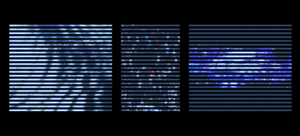
Video Installation, Tim White-Sobieski Wikipedia.org
Our fascination with video in all forms his has resulted in the loss of many of the nation’s newspapers, the decline of the network documentary, the near-disappearance of the magazine of ideas, and a younger generation for whom extended time with the printed page is an ordeal.
Over sixty years ago an American philosopher described with unusual clarity the very different communication functions of visual media. Susanne Langer was interested in art and social rituals, exploring how we process pictorial information. Philosophy in a New Key (Mentor Books, 1942) still resonates as a way to understand the importance of our mid-Twentieth Century cultural turn towards images, represented primarily by television, but also all of the other digital platforms that build on the “visual interfaces” that increased the spread of digital media. Langer was writing in the 1940s and could not have anticipated how video and computer technology evolved. But her insights were taken up by the Media Ecology Movement over the years, helping to clarify a set of effects that every American needs to understand.
Susanne Langer
Here’s the key insight that has evolved from her initial work. While video and television were once celebrated as new ways to pass on information, the better assessment is that these forms actually undermine the quest for ideas. Think of ideas as the non-material but potent bases for understanding the world around us. Ideas order our thinking and give form to our values. So there is irony that the flowering of theoretical breakthroughs in psychology, sociology and other fields in the first part of the Twentieth Century the seeds of non-print media would be sown to make them seem less urgent.
Consider the growth of critical and analytical insights that came mid-century from thinkers such as Walter Lippmann (modern democracies), George Herbert Mead (the construction of the self), Kenneth Burke (how language has its way with us) and David Riesman (the nature of the American character), to name just a few. All offered works about how we consciously construct ourselves and understand the external world: elaborately laid out accounts of what Langer called “discursive understandings” which can best be understood be understood on the page.
What changed? The culture of ideas would be undermined by rapidly expanding access to the presentational form of television, which feeds the already strong human impulse to feel rather than think abstractly. In plain words, visual media tied to commercial goals are usually death to print-based explorations of ideas. In plain language, visual media tied to commercial goals are usually death to the exploration of ideas.
If this sounds like aimless armchair theorizing, it isn’t. Langer’s original insight has helped us understand that television is representational rather than conceptual. It needs to show something, and nothing is more meaningful than the human face: the primary register of emotion.
As later writers noted, we don’t watch video content for the richness of its explanatory power. In fact, a printed transcript of a supposed informational program usually looks pretty sparse in print. The quintessential moment of television is actually the close-up. Any television director learning their craft will know that the face is the informational content of television. Human features are expressive. We are hardwired to read them and absorb all the cues they give us. While a theater actor needs to project his character with his full body. A television actor knows the key to success is mostly in how he uses expressiveness centered on the eyes. In spite of what we might think, we don’t watch even a “brainy” television program like Jeopardy because “we can learn a lot.” Mostly what draws us in is the human drama of trying to find the right answer. We like to ride the roller coaster of relief or regret along with the contestant who will perform them.
So what’s the cost in living in a video-saturated world? It’s ultimately that television is generally a distraction from what we have designed a liberal education and our great academic institutions to do: to encourage exploration of ideas that illuminate the human condition. Lord knows someone like television interviewer Charlie Rose tries. So do the interviewers of book authors who regularly appear on C-SPAN. But most of us are otherwise engaged, watching sketch comedies and police procedurals featuring people in desperate straits. The gut reaction in tight close-up will always trump a “talking head.” Vital concepts like economic fairness and social justice may be important, but they have the disadvantage of no precise material form.
Ask a television director to produce a program of ideas, and they will despair. There’s only so much B-roll footage you can show to enliven a visual presentation on American criminal justice practices, the widening gap between rich and poor, or how the sale of derivatives contributed to the financial collapse in 2008. Within commercial media the preference is almost always to underwrite programs of presentational content filled with images of humans in the process of coping. These are the kinds of “expressive moments” a CBS News executive once noted should be the bases of most of his network’s stories.
Because longer discussions of policy and ideas can’t compete, our fascination with video in all forms his contributed to the loss of many of the nation’s newspapers, the decline of the network documentary, the near-disappearance of magazines of ideas, and a younger generation for whom extended time with the printed page is an ordeal.
In American culture there is an entire turn away from accepting and exploring challenging issues of human and social complexity. Not only are presidential campaigns beginning to resemble reality shows, with their heightened moments of rage and put-downs, but we now expect that any expert called upon to comment on a breaking story should be able to explain themselves in seconds rather than minutes.
We are indeed paying a high price in our wholesale flight from the realm of discursive media. If conceptual thinking is an ability that makes us smarter, we have reasons to be concerned that our fascination with screens is doing the reverse.