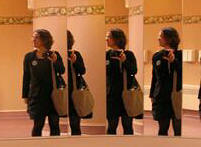
We are many selves. If you have the urge to fish around in the detritus of an individual’s rhetoric to catch them in ostensible inconsistencies, you are probably on a fool’s errand.
Comments about the questionable “authenticity” of the candidates are flying around the national press like Frisbees in a local park. Everyone from political junkies at Politico.com to the ubiquitous panels of experts cycled in and out of the cable news channels insist on judging the large flock of presidential aspirants by gauging the distance between their current positions and shakey media reconstructions of what they once believed. Somehow it gives us solace to find that a candidate has changed their tune. It reminds us that that they are political animals, supposedly a lesser form of the species.
In actual fact we would spend our time more productively critiquing their current positions. Changes in attitude, especially regarding public policy questions, are hardly surprising. It’s shortsighted to think an individual wouldn’t adapt to the norms of the community they want to influence. In addition, past votes or positions on legislation often include a range of complicating factors, as when a bad amendment is attached to a good bill.
Of course candidates lie and pander. But consistency is the most overworked trope of political analysis. The implication of intellectual dishonesty is overplayed, a surrogate for the more difficult but useful act of critiquing specific policy positions.
It’s also something of a folly to declare the actions of another “inauthentic,” for a whole host of reasons.
First, we are players of multiple roles, many of which cannot be known to those outside the politician’s close friends. Past statements on immigration policy from the Republican field follow them around like lost dogs. Most recapitulations of these statements miss reestablishing the settings in which the original statements were made, as well as the incremental alternatives that were politically viable at the time. For her part, candidate Hillary Clinton is frequently judged as not to be trusted because of prior statements that seem out of sync with the leftward shift of her views in the current campaign. Bernie Sanders is partly responsible for this change. But there have also been huge twists and turns of her career. Could it have been otherwise for a former Arkansas attorney, First Lady, Senator from the varied and vast state of New York, and former American Secretary of State? Opponents can feast on varied positions required by the many roles she has played and the constituents and stakeholders she has served.
The implication of intellectual dishonesty is overplayed, a surrogate for the more difficult but useful act of critiquing specific positions.
In addition to not acknowledging changing political views, a second problem is that we actually have very little understanding of even a well- known individual’s psychological biography. The forces that have shaped their judgments may be staked out in a dense landscape that biographers want to explore. But in searching for the first causes of specific beliefs and u-turns, we have launched ourselves into ambitious inference-making on a grand scale.
Stepping beyond the political for a moment, witness the early harsh judgments of mega-entertainer Bing Crosby after the publication of his estranged son’s book, Going My Own Way (1983). This was Bing as a cold and indifferent father. Years later these perceptions were partly undone by Gary Giddins’ well-researched celebration of Crosby’s solid talent and quiet generosity. (Bing Crosby: A Pocketful of Dreams, 2001). It lead to a full-blown renaissance of all things Bing and elevated him to the first tier of American jazz originals. The point is, the Bings of both books are still with us, and more or less valid within their distinctly different contexts.
We all acquire new facets of self that change what it means to be us. Broad features of character and personality tend to endure, but they are not static. Imagine the jerk who sat behind you in 7th grade homeroom. You can have some assurance that he has probably evolved and rejoined the human race.
Quick judgments of hypocrisy are mostly facile and dishonest in their misplaced certainty. By all means hold this current crop of presidential aspirants to their statements. But if you have the urge to fish around in the detritus of an individual’s rhetorical history to catch them in ostensible inconsistencies, you are probably on a fool’s errand.
Play your uncle Fred’s old vinyl copy of a Cream album, and years of dust caught in the grooves can make it seem like Eric Clapton was a tap dancer as well as an awesome guitarist.
Engineers measure the quality of audio and video equipment partly in terms of its signal to noise ratio. Older analogue forms of media—records, amplifiers, AM radio, and almost anything else along this sonic chain—often contributed significant amounts of their own noise: unwanted intrusions against the ideal of perfect silence. Hiss from audio tape and tube amplifiers were a common problem before the new century, as was an audible hum from a circuit picking up stray noise from other electrical sources. Even playing your uncle Fred’s old vinyl copy of a Cream album can let you re-live those days. Years of accumulated dust and scratches across the groves can make it seem like Eric Clapton was a tap dancer as well as an awesome guitarist. Listening to vinyl recordings of Debussy could be even worse. Clicks, hiss, pops and needle jumps were never part of the French minimalist’s musical vocabulary. Hearing them under his music is the equivalent to pouring coffee on a white rug.
These days music comes to us on a mostly clean canvas. Digital platforms and better equipment have mostly eliminated noise intrusions that older Americans remember from the early days of “stereophonic sound” and homemade Heathkit amplifiers. Even a humble MP3 player hardly produces an audible hiss.
Alas, a problem that good technology and engineering has mostly solved has remained as a common environmental nuisance. Too often the settings we inhabit impose a constant din.
I work on a bucolic campus with roads relegated to its edges, and it can still be hard sometimes to make myself heard over gas leaf blowers, jackhammers digging up water leaks, and all forms of construction and maintenance vehicles. Overhead, planes heading into local and distant airports narrow the gap between signal and noise.
Silence is especially an unsatisfied need in cities such as New York, where residents routinely retreat to headphones or the use of “white noise” to mask the cacophony of sound coming from the street and nearby neighbors. (See George Prochnik’s In Pursuit of Silence (2010) for a discussion of the range of intrusions).
St. Maarten Airport Wikipedia.org
And then there are the effects of too many evenings at concerts, where volume levels can equal the roar of planes arriving in the Caribbean’s notorious at St Maarten airport. Tinnitus is not just a condition of the old, but of many younger Americans who have racked up more decibels than miles. Sometimes the result of inner-ear nerve damage, Tinnitus affects about 1 in 5 residents of the United States.
If you have a one-note concert in your ears for long periods of time, you can match the frequency of the sound here, and more precisely, if wearing good headphones:
There is no shortage of studies connecting environmental noise to stress, lack of concentration, insomnia and irritability. With age we also seem less able to tolerate dense sound. For older adults, what was once the fun of being in a noisy restaurant with friends can begin to seem less festive, like trying to meditate on the beach directly under that Caribbean airstrip.
To be sure, we should celebrate the pristine audio landscapes we can now create. This is the age of complete music emersion. Technically speaking, musicians have never had a less cluttered acoustic to play against. But in spite of our successes with audio software, the idea of the signal to noise ratio is a reminder that we now have to contend with a world that is aurally more intrusive. As a solution, earphones not only transport us to to a paradise of music in its own study acoustic, they also help shut out the disordered noise of the places we occupy. That can be good. But the earwear that is part of the uniform of a commuter or jogger can also reduce our access to others nearby. We used to routinely greet strangers passing through our personal space with our eyes and maybe a simple hello. But the common sight of earphones on individuals in public spaces now sends a less welcoming vibe of unavailability.