This is a precious piece of jazz history, all the more so for being recorded in pre-corporate Las Vegas, which was fertile ground that helped good musicians become great.
Sometimes the perfect response is not what is said, but what is sung. Music is the great analogue to speech. And it seems that we often experience pleasure in a perfect match-up of words and music set alight by especially gifted musicians.
I always think of Nick Hornby’s feral but passionate clerks in High Fidelity. They shake off their mid-morning torpor when challenged by the owner to name the” top five” of any genre: autobiographies of musicians, blues recordings, songs about death, angry songs about women, songs to take on a desert island. In the novel and the even better film Barry and Dick may appear to be adrift and underemployed. But they are also connoisseurs, reminding us that we are all critics, and that ecstasy can even come in the transient moments of a musical phrase.
I’ve come to think of a particular song in this way. The music comes from a live recording made in 1966 and recognized by Rolling Stone, among others, as one of the best live recordings ever made. Track 18 is an especially precious slice of jazz history, all the more so for being recorded in pre-corporate Las Vegas, which was fertile ground that helped good musicians become great. The album is Sinatra at the Sands, made at time when the former “kid” from Hoboken was feeling the heat of the British pop invasion, and a declining interest in the Great American Songbook.
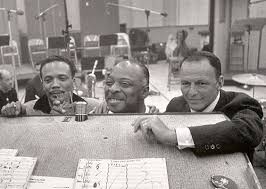
Everything comes together to make the music a perfect miniature of the brassy and confident music of its time. In the crowded Copa Room there’s the legendary Count Basie Band. Fronting it is a young but effective Quincy Jones, who has arranged the charts to show off the the legendary group assembled long ago by another “kid:” this one from Red Bank.
Jones, Basie and Sinatra Pinterest
And then there’s the song, a once-placid ballad written thirty years earlier by Rogers and Hart, but reborn to become the perfect vehicle for a singer in complete control. Frank Sinatra’s musical instincts were never better: a mixture of Rat Pack swagger and his total mastery of the tricky mechanics of jazz phrasing. At times ahead of drummer Sonny Payne’s rock solid beat and at times behind, it all adds up to a moment capturing musicians at the top of their game.
All politicians engage in degrees of hyperbole. Even so, we expect that political candidates will not become completely untethered from the facts as we know them: that they will not seek the favor of the least-informed by making statements that ignore the truth.
Those of us who follow such things thought years ago that we could put to rest the once-popular communications idea of the demagogue. The term was widely used when I was an undergraduate way back in the days before indoor plumbing. The idea is that a person could rise to power in civil society by pushing lies and falsehoods on a susceptible public.
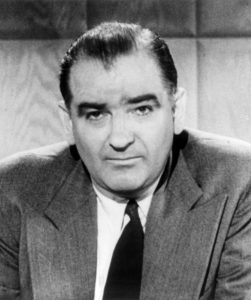
I remember putting a dusty 1954 volume of Reinhard Luthin’s red-covered American Demagogues back on a library shelf in the early 1970s with the firm belief that our democracy had moved on. I assumed that Luthin’s work was not where the future of American political communication would go. There would be no more jingoistic fabulists in American politics to match the discredited figures of Wisconsin Senator Joseph McCarthy, Louisiana’s Huey Long, Boston Mayor James Curley, and others. Surely our era of detailed backstories and proliferating media would prevent chronic liars and nativists from rising to become political heavyweights. As a nation we had become wiser if not happier.
But here we are well into the 21st Century, encountering the same kinds of willful prejudice-baiting, scapegoating and misstatements that made the rhetoric of figures like McCarthy so damaging. The Senator was not beyond holding up an empty sheet of paper and declaring that it contained the names of “known communists” who were presumably prepared to sell America out to the Soviets. Never mind that these alleged traitors were often artists, writers and even musicians. Who knew that the composer and conductor Leonard Bernstein was a threat to the “the American way of life?”
To be sure, all politicians engage in degrees of hyperbole. Overstatement is part of the campaign process. And some claims are not readily testable on empirical grounds. Even so, we expect that political candidates will not become completely untethered from the facts as we know them: that they will not seek the favor of a mob by making indictments they know to be false.
Trump’s strategic use of false assertions uttered to please a crowd has begun to fill a catalogue of certifiably incorrect claims.
If Luthin were alive today to revise his study, Donald Trump would have to be added to his examples. Trump’s strategic use of false assertions uttered to please a crowd has begun to fill a catalogue of certifiably incorrect claims. Many of his statements are breathtakingly dishonest. Most of us have heard them in familiar iterations:
-That President Obama is not an American citizen,
-That Obama is a “founder” of ISIS,
-That the President “invaded” Afghanistan,
-That Hillary Clinton was plausibly behind the death of family friend Vince Foster,
-That Ted Cruz’s father played an active role in the assassination of President Kennedy
-That voter fraud is a significant problem in American elections.
The list goes on to many more bogus claims. As of last week, the Pulitzer Prize winning organization Politifact found that 70 percent of the claims made by Trump in this campaign were mostly to completely false. In the same categories the percentage for Hillary Clinton was 28 percent.
The irony here is, of course, that in an age of proliferating information and easy access to it, there could still be so many of us who are not put off by Trump’s false claims. The conventional explanation is that we all exercise a “confirmation bias,” sometimes also known at the “theory of motivated reasoning.” The theory is simply the conventional idea that we look for evidence to confirm what we already believe, ignoring the rest. But at some point even a diehard believer probably can’t prevent the cognitive dissonance created by finally confronting the disconnect between support for a favored figure and the ransacking of settled truths. It’s one thing to find this pattern in a friend or relative with mental illness or clear cognitive deficits. It’s another to accept it from a person who wants to represent the United States to the rest of the world.