I see the question of how we treat the moral and ethical shortcomings of earlier art as partly understandable in terms of the intentions of the original artists.
When looking at the past, it is easy to react with shock at what we see as huge moral lapses on display in older cultural products. No one today can look at a filmed scene with a character in blackface without a cringe and a sense of regret. Portrayals of race in public art and media are always an interesting case.
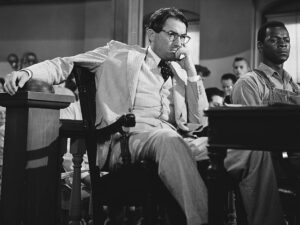
Even while the very different film To Kill a Mockingbird was considered a breakthrough account of justice denied to African Americans (book 1960, film, 1962), a modern view is that it’s still a “white narrative,” with a focus on Atticus Finch as the redeeming moral agent. The cultural rot that denied African Americans the right to live as equals was mostly overlooked in the story. We surely needed Mockingbird. Atticus is a wonderful character; his behavior enacts a form of empathy that is timeless. But we must turn to other sources to understand how depression-era Alabama was often a prison for its black residents.
And then there are the antique forms of racism intentionally or accidently on display in other films like Guess Who’s Coming to Dinner (1967) or the older Gone With the Wind. It’s interesting that HBO will only show Victor Fleming’s 1940 multi-Academy award winner with the understated disclaimer that “it denies the horrors of slavery.” But that warning is hardly sufficient to prepare us for what is now a completely sentimental and tone-deaf narrative about the southern insurrection. In fact, live long enough, and it’s hard to find a film or novel that does not offer plots and characters that were once admired, but now labeled as racist or sexist.
On a parallel track, some younger academics and musicologists are throwing in the towel on the great canon of western classical music, unable to comfortably explore the works of Brahms or Haydn–among many others–who indirectly benefited from eighteenth and nineteenth century patrons who counted humans as their property. Does our interest in exploitative and unjust social structures require that we abandon the artistic products made possible by these benefactors?
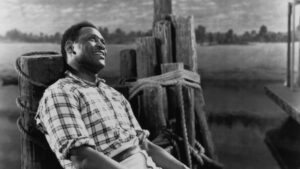
I see the question of how we treat the moral and ethical shortcomings of older art as partly understandable in terms of estimations of the intentions of the original artists. This is soft ground to be sure, since knowing the motivations of others is fraught with misperceptions. But if the answers are difficult to find, the questions are always worth asking. Did an artist seek to harm or exploit their subjects? Were characters created in ways to devalue their social identities? Were whole groups written off as less worthy of our understanding? As noted, it can be hard to know. But it is easier to feel better about the music of an old epic like Showboat (1936), knowing that Oscar Hammerstein’s lyrics enact his deep respect for diverse cultural pathways. One of the best moments in the work is given to Joe, an African American deck hand who sings about the misery of his limited life. “Old Man River” can be heard as a lament of racial injustice: a theme that is also carried out in a plot line that challenges the absurdities of old miscegenation laws.
By contrast, the character of Mammie in the screen epic, Gone With the Wind, is more one dimensional. She is an African American house slave with opinions that are freely given, but her character is not fleshed out in ways that are fully dimensional. The key film process that asks us align ourselves with one or two characters is loaded in favor of the privileged Scarlett, played by Vivien Leigh. For the record, The Ambassador Hotel where the ceremony was held required her to sit at a separate table away from others in the cast, suggesting something less than benign intentions from her Hollywood peers. More and more, the film has become watchable only as a dead specimen about the ostensible inconveniences faced by white folks at the end of the civil war.
Our tendency in the current climate of identity politics is to dismiss the earlier work of others if we detect personal slights that extend to a whole class of individuals. This rejection is not necessarily a bad impulse, but it is also an intellectual sleight of hand that matches the racist logic we abhor in others. Any time that one is meant to stand for all we are on even softer ground. These kinds of synecdoches distort the actual world and obviously ignore individual differences.
But on a broader scale we still can note is that those living in previous eras are indeed captives to the norms and horizons of the culture they were in. It seems obvious that we must permit creators of art to exist within the parameters of the only world they knew. We too easily exempt ourselves from this limitation, preferring the alternate fiction that we are free agents not captive to the low horizons of our own tribe. In due course our heirs will correct this misimpression; some of what we take for granted will surely be rebuked by future generations.
In the meantime, thorny issues remain. Do we let Thomas Jefferson off the hook for not releasing all of his slaves, even on his deathbed? His behavior was not necessarily a violation of the norms of the landed class at the time, but I can’t ignore this ethical lapse. It is clear from his partial creation of the Declaration of Independence that his horizons extended high enough to see the atrocity of owning others. He gave voice to values of equality and freedom; he only needed to enact them in his own behavior. Fully honorable intentions should have allowed him to leave this world not with a final business decision, but on a note of grace.